Loading article...

On Sept. 15, 2026 the Senate voted 49–50 on cloture for H.R. 3633, leaving the Digital Asset Market Clarity Act short of the 60 votes needed to open debate.
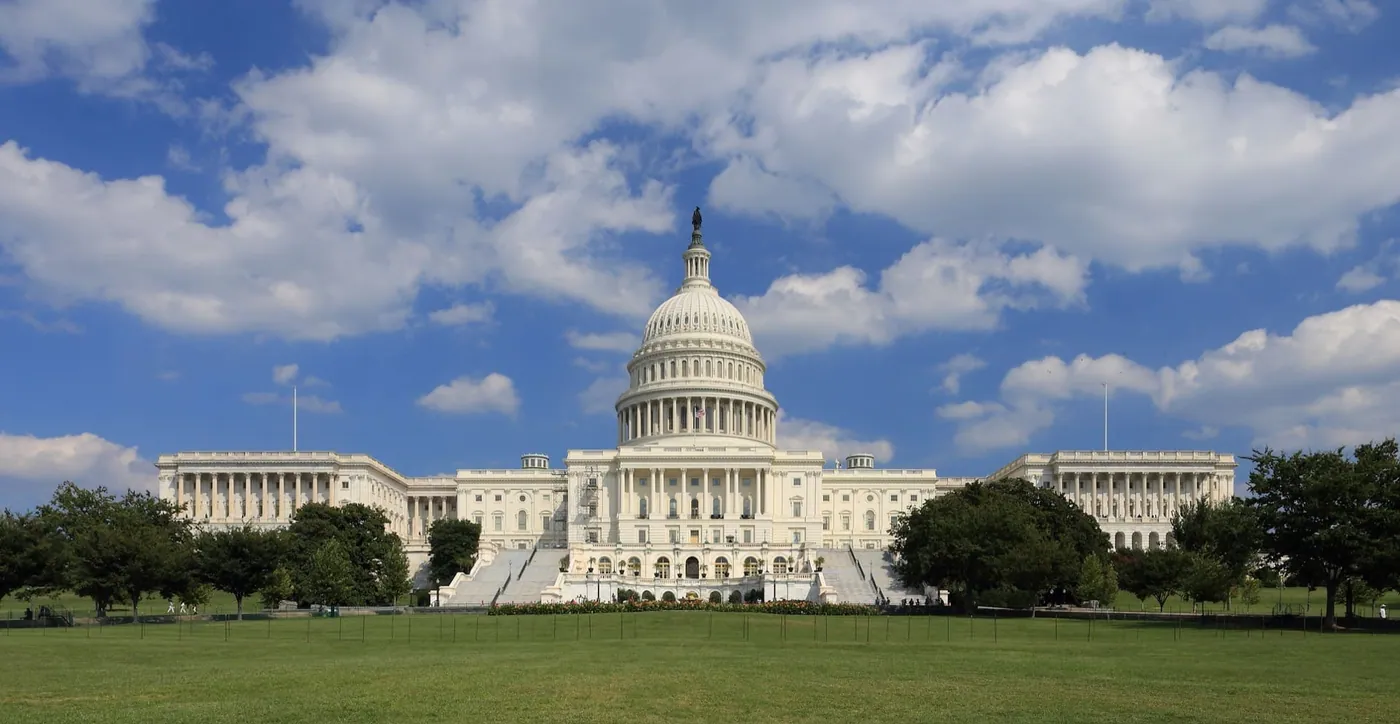
Panoramic daytime view of the west front of the U.S. Capitol in Washington, D.C. Photo: Martin Falbisoner via Wikimedia Commons (CC BY-SA 3.0). Source
The Senate on Sept. 15, 2026 voted 49–50 on a motion to limit debate and take up H.R. 3633, the bill that would carry the Digital Asset Market Clarity Act. Sixty votes were needed to move forward; the tally fell short, so the chamber did not open floor debate on the substitute package that Republicans had prepared.
CBS News reported that, according to its tally, every Senate Democrat voted no, along with four Republicans: Susan Collins of Maine, Josh Hawley of Missouri, Jerry Moran of Kansas, and Thom Tillis of North Carolina. The Hill described the vote as a failed motion to proceed on the Clarity Act.
The roll call was procedural. It did not enact or reject final bill text. Without the 60 votes, the Senate did not move to amendments and a passage vote on the substitute.
Before the vote, Senate Majority Leader John Thune, R-S.D., said on the floor that passing the bill would be the “next logical step” after Congress approved the GENIUS Act stablecoin legislation in 2025, according to CBS News. Sen. Cynthia Lummis, R-Wyo., released updated substitute text on Sept. 10. The Hill reported that Senate Republicans called a package they released the Sunday before the vote their “last, best and final offer,” including revised ethics language. On the floor, Sen. Elizabeth Warren, D-Mass., said the ethics provisions would still allow President Trump to profit from crypto holdings, according to CBS News; the outlet reported she argued the language would not block what she described as his “next $1.4 billion in crypto profits.”
After the vote, Fox News quoted Lummis telling reporters, “I think we're done. It's over,” citing more than a year of work and what she called “over 120” Democratic requests incorporated into the text. When asked whether the bill would return to the floor, Fox News quoted her answer as “Nope.” The same report said backers saw little Senate calendar time before the November midterm elections.
Sen. Bernie Sanders, I-Vt., has publicly opposed the bill and raised ethics questions around Trump-family crypto income. He posted on X about two hours before the cloture vote, which was scheduled for 2:15 p.m. ET:

Bernie Sanders
@BernieSanders
Crypto billionaires have spent nearly $300M on the midterm elections. Meanwhile, Trump and his family have pocketed more than $1.4B from crypto deals. Now the crypto industry wants Congress to do its bidding by passing the corrupt CLARITY Act. The Senate must say NO.
View on XSen. Elissa Slotkin, D-Mich., was among Democrats Republicans had tried to win for a yes vote on proceeding to the bill. The Hill and other outlets had described her as a possible swing vote before she voted no. She posted on X after the roll call:

Sen. Elissa Slotkin
@SenatorSlotkin
Today, I voted no on the Clarity Act, legislation meant to regulate cryptocurrency in America. The ethics provisions in this bill are simply too thin. President Trump, his children, and his Cabinet are making billions of dollars in the crypto space, in part from bilking everyday Americans out of their hard-earned money. I cannot in good conscience vote for any legislation that codifies that behavior from public officials. Not for President Trump or Secretary Lutnick today, nor for any Democrat who may take advantage of it in the future. On the national security front, there is more to be done to make sure we have the tools in place to stop money laundering and shut down funding avenues for terrorists and nations like North Korea and Iran. This was essential after 9/11 and remains essential to keep Americans safe. And as of now, our agencies, including the CFTC, lack the necessary oversight and staffing to implement this legislation, and that should be addressed. There are strong, bipartisan provisions in this bill that could serve as the foundation for a new attempt at providing the crypto industry with the guardrails it needs. I believe that the U. S. should lead the world in cryptocurrency innovation, but we need to get it right. I remain open-minded to that work ahead.
View on XAnthony Pompliano, who runs Professional Capital Management and hosts The Pomp Podcast, posted later on Sept. 15:

Anthony Pompliano 🌪
@APompliano
Bitcoin doesn’t need the Clarity Act because bitcoin already has clarity.
View on XMichael Saylor is executive chairman of Strategy, the software company formerly known as MicroStrategy. He posted later the same day:

Michael Saylor
@saylor
The only clarity you need is Bitcoin.
View on XStani Kulechov founded Aave, a DeFi lending protocol. He posted after the vote:

Stani
@StaniKulechov
CLARITY failed. Now DeFi needs to win through adoption. Build products millions of people want. Become too important to ignore. Regulation will have to catch up. The Uber path.
View on XBrad Garlinghouse is CEO of Ripple. He posted a numbered four-part message in a single post on X after the vote:

Brad Garlinghouse
@bgarlinghouse
1/ This one stings. Our team gave everything we had to get the Clarity Act across the finish line. So did most of the industry. This was an opportunity bigger than Ripple or one company - we did this for the industry, for consumers and to cement the US’s position as the crypto capital of the world and as a leader in the future of finance. Ultimately, consumers and U. S. competitiveness got left behind. 2/ A post mortem needs to be done on why this failed (more from me on that in the days ahead). The politics of the democrats (the anti-crypto army) was elevated over good policy. 3/ There is still reason for optimism for crypto in the United States. Now, the SEC, under Chair Atkins, and the CFTC, under Chair Selig, will continue to work hard to issue rules to fill the legislative gap and we will continue to be actively engaged in that rule making process. 4/ Ripple's business has never been stronger, real demand across traditional finance and the digital asset ecosystem. A missed vote in Washington doesn't change our momentum, our global footprint, or our customers.
View on XLummis released updated Senate text for the Digital Asset Market Clarity Act on Sept. 10, ahead of a vote her office had said it expected on Sept. 15. The document is styled as an amendment in the nature of a substitute to H.R. 3633: if adopted, it would strike the House bill's text after the enacting clause and replace it. It is a proposal, not enacted law or a final agency rule. Lummis's release announced the scheduled vote and the update; the official Senate substitute text carries no named amendment number or calendar number on its first page.
The DeFi sections are one part of a 630-page substitute. The draft also addresses ancillary assets, digital-commodity intermediaries, stablecoins, banking activities, customer property in bankruptcy, ethics requirements, law-enforcement programs, and other subjects. Its table of contents divides the measure among a Banking Committee division, a Digital Commodity Intermediaries Act division, ethics provisions, and an effective-date division. The substitute calls the overall measure the Digital Asset Market Clarity Act and separately names its securities title the Lummis-Gillibrand Responsible Financial Innovation Act of 2026.
That scope differs from the version the House sent to the Senate in 2025. The Government Publishing Office lists H.R. 3633 as an engrossed House bill dated July 17, 2025, with the short title Digital Asset Market Clarity Act of 2025. The House text used a different structure and included an Anti-CBDC Surveillance State Act title. The Senate document would substitute for that House language, so the House engrossed text alone does not describe what the Senate would have amended.
The proposal does not treat every application labeled DeFi as a regulated entity. It defines a “decentralized finance trading protocol” as a distributed-ledger system through which multiple participants may execute a financial transaction under a predetermined, nondiscretionary automated rule or algorithm, without relying on someone other than the user to hold custody or control of the digital assets in the transaction. Section 10301 of the substitute uses that definition for securities-side rules; Section 20209 repeats the test for commodities-side rules.
A protocol within that definition may qualify as a “non-decentralized finance trading protocol” if it meets at least one of three conditions. One is that a person, or a group under common control or acting in concert, may directly or indirectly control or materially alter the protocol's functionality, operation, or consensus or agreement rules. Another is that the protocol does not operate, execute, and enforce its operations and transactions solely through pre-established, transparent rules encoded in the distributed-ledger system's source code. The third is that such a person or group may use the protocol to restrict, censor, or prohibit use of it, including system-based user activity. The operative definition requires a protocol to fit the base DeFi definition and then meet one or more of those conditions.
The text refers to direct and indirect authority through a contract, arrangement, understanding, relationship, or otherwise. It does not name particular protocols or set a single technical test for control. It would direct the SEC, CFTC, and Treasury to construe the term consistently across the relevant provisions. A label, a governance token, or open-source code alone would not by itself determine whether a protocol or a person fits the definition. Sections 10301 and 20209 call for agency rulemakings rather than a fixed list of covered services or controllers.
The draft would treat decentralized governance systems in a specific way. A transparent, rules-based system through which people form consensus on development, publication, maintenance, or administration may qualify as a decentralized governance system when it is not under the unilateral control of a person or coordinated group. The substitute says the system and its participants would be treated as separate persons unless they are under common control or have an agreement, arrangement, or understanding to exercise control. It also says the governance system, solely because it operates as such, would not be a person or group acting in concert. The definitions and rule of construction do not appear to grant every participant immunity from a control finding; they define how the system and participants would be treated in proposed rulemakings.
If enacted, the proposal would require the SEC, in consultation with Treasury, to issue rules after notice and comment. Those rules would clarify how a person or coordinated group that controls a defined non-decentralized DeFi protocol and is subject to the Securities Exchange Act would need to meet applicable requirements, including registration, conduct, disclosure, recordkeeping, supervision, and other securities-law duties. The SEC's assessment would be activity-based and limited to securities-related functions performed by the controller, such as brokerage, dealing, trading, execution, clearing, or custody. The securities provision says the analysis would not turn on technological form, distributed architecture, or a claimed decentralized characterization.
Section 20209 would create a parallel CFTC process. The CFTC, consulting with the SEC and Treasury, would write rules explaining how covered controllers would need to comply with applicable Commodity Exchange Act requirements. Its activity-based test would apply to digital-commodity functions, including brokerage, dealing, trading, execution, clearing, and custody. The CFTC provision similarly calls for registration, conduct, disclosure, recordkeeping, supervision, and other requirements only as applicable under that Act.
The provisions do not state that each person associated with a protocol must register. Registration or registrant-like compliance would follow only if the relevant agency determined it in the required rulemaking, based on the functions the controlling person or group performs. The draft also says that no presumption would arise that a person or activity covered by either section is, or is not, subject to the Exchange Act, Commodity Exchange Act, or Bank Secrecy Act without that rulemaking determination. The no-presumption clauses would limit the proposal's immediate legal effect; they do not say existing law never applies.
For a controller that the SEC or CFTC determined must register or comply as a registrant, Treasury would define compliance with Bank Secrecy Act and related anti-money-laundering and counter-terrorist-financing duties through notice-and-comment rules. The text conditions that treatment on existing law causing the person to be treated as a financial institution because of the registration or compliance. Both tracks of the substitute say they would neither expand nor contract the SEC's, CFTC's, or Treasury's statutory authority under the Bank Secrecy Act as it stood the day before enactment.
The draft would preserve existing investigative and enforcement authorities for the SEC, CFTC, and Treasury regarding people determined through the new rulemakings to be covered. It does not specify how those agencies would exercise their existing authority in a particular investigation, and it does not state that a protocol's software would become a financial institution. The preservation and construction provisions distinguish a controller from a distributed-ledger system or software code.
On the securities side, the text says neither the statute nor rules under its DeFi-controller section may require a distributed-ledger system or software code to register in its own capacity. It also says those provisions may not be read to prohibit a system's launch, deployment, or operation. The corresponding CFTC section uses the same formulation for commodity regulation. Sections 10301 and 20209 do not appear to exempt all conduct around software from regulation.
The proposal would separately protect people from Commodity Exchange Act coverage solely because they compile, relay, search, sequence, or validate network transactions; provide computational work, node or oracle services, bandwidth, or similar incidental services; or develop, publish, or constitute a distributed-ledger system and certain wallet-related software. The software-developer provision says that protection would apply only when the listed activity is the sole basis for coverage. It also says the broader developer language would not extend to certain post-deployment activities, which the statute addresses separately.
For decentralized finance trading protocols, the CFTC-side exclusion would apply only to digital-commodity cash or spot-market regulatory provisions. It would cover, when those activities alone are the basis for coverage, a user interface that lets a user read and access data; governance-system administration or distribution; administration or distribution of a DeFi messaging system; participation in a smart-contract liquidity pool; and certain wallet and custody software. Section 4v proposed by Section 20209 does not appear to exempt futures, swaps, or every other category of activity from all federal law.
The same provision would retain the CFTC's anti-fraud, anti-manipulation, and false-reporting enforcement authorities. Its state-law preemption for the specified software and spot-market activities would exclude state anti-money-laundering, anti-fraud, and anti-manipulation authority. It says the provision would not grant new CFTC jurisdiction or expand the agency's pre-enactment authority. Those savings clauses are limited by their own conditions and exceptions.
The substitute also addresses web-hosted “distributed ledger messaging systems,” defined as applications that let a user create or submit instructions or messages to a ledger application or DeFi trading protocol to execute a transaction. The definition excludes a ledger application, protocol, or system; a DeFi trading protocol; clients, nodes, validators, and other computational infrastructure; and software or hardware wallets. Treasury would have 360 days after enactment to issue guidance for U.S.-owned or operated messaging systems on sanctions and illicit-finance obligations, risk management, and compliance considerations. Section 10302 says that guidance could include address screening and measures to block or restrict prohibited or high-risk transactions, while also stating that it would not expand or contract existing sanctions, anti-money-laundering, or financial-institution definitions.
Participation in an incident-response or security council would not by itself establish control under the proposal. That exception is conditional. The council's action would need to be a pre-defined, temporary, rules-based cybersecurity measure responding exclusively to a specific and documented incident or imminent threat; it would need to use publicly disclosed on-chain authorization; it would need to be limited in scope and duration; and no one person could hold unilateral control. The procedures and operational limits would need to be in public written documentation reasonably available to the relevant federal regulator before those emergency powers are used. The emergency-measure language says such measures could not be used for unrelated protocol upgrades, governance decisions, or economic changes.
The legislation would generally take effect 360 days after enactment. A provision requiring rulemaking would take effect later: 360 days after enactment or 60 days after the final implementing rule is published in the Federal Register. The effective-date section ties DeFi-controller duties to enactment and subsequent rulemakings. The Sept. 15 cloture vote failed, so those dates would apply only if Congress later passes substantively similar language.