Loading article...

An empirical thesis and career guide on becoming an Ethereum Virtual Machine smart contract engineer, analyzing the compiler toolchain, formal verification methods, gas mechanics, security vectors, and current compensation bands.
Writing software for a distributed, adversarial virtual machine differs fundamentally from traditional application engineering. In standard web infrastructure, application runtime failures result in HTTP 500 errors, rollback transactions, or container restarts managed by orchestrators. In smart contract development on the Ethereum Virtual Machine, code execution is irreversible, state alterations are final, and every computational opcode consumes real economic capital in the form of gas. A single logic omission or misplaced memory pointer can permanently drain protocol liquidity.
According to research from Immunefi and the OWASP Smart Contract Top 10, over 1.8 billion dollars in digital assets were extracted across decentralized finance in 2024 and 2025 alone, with logic errors, access control failures, and oracle manipulation accounting for more than eighty percent of total capital losses. As a consequence, protocol teams, decentralized autonomous organizations, and institutional infrastructure providers have restructured their hiring standards. Becoming a Solidity developer in modern decentralized finance requires far more than basic syntax familiarity. It demands mastery of the low-level EVM execution architecture, rigorous invariant testing using modern fuzzing engines, formal verification methodologies, and gas optimization strategies.
Solidity is an object-oriented, statically typed curly-bracket language designed to compile directly to Ethereum Virtual Machine bytecode, as specified by the core language team in the Solidity Documentation. Gavin Wood originally proposed the language specification in 2014, and Christian Reitwiessner led early development alongside contributors funded by the Ethereum Foundation. Rather than targeting a hardware processor architecture like x86 or ARM, the Solidity compiler targets a quasi-Turing-complete, 256-bit registerless stack machine operating on deterministic state transitions.
Understanding how the EVM manages data locations is a foundation for writing secure, gas-efficient contracts. The virtual machine exposes the execution stack, volatile memory, persistent state storage, transaction calldata, and transient storage.
TSTORE and TLOAD instructions. It can persist through internal and external calls in one transaction, then clears at the end of that transaction.The stack operates with a maximum depth limit of 1024 elements, where each slot accommodates a 256-bit word. Opcodes can only directly access the top sixteen elements using the DUP and SWAP instructions. When a Solidity function defines excessive local variables or complex parameters, the compiler throws the stack-too-deep error. Senior engineers navigate this constraint by encapsulating related variables within custom data structs, utilizing memory pointers, or invoking internal helper functions that establish clean stack frames.
Volatile memory exists exclusively for the duration of a specific message call. It is byte-addressed and initialized to zero. Memory allocation incurs linear gas costs for the initial 724 bytes, but scales quadratically beyond that threshold according to EVM yellow paper formulas. Allocating oversized dynamic byte arrays or deeply nested arrays in memory without strict bounds checks will rapidly consume an entire block gas limit.
Persistent storage represents the state space recorded permanently across all Ethereum validator nodes, verifiable through public explorers like Etherscan. Storage is structured as a key-value mapping of 2^256 addressable slots, each measuring 32 bytes in width. Because storage modifications require global state consensus and bloat client disk footprints, storage access represents the most computationally expensive operation in EVM execution. Writing to an uninitialized slot using the cold SSTORE opcode costs 20,000 gas units, whereas reading a cold storage slot with SLOAD consumes 2,100 gas.
The introduction of EIP-1153 transient storage in the Dencun hard fork added the TSTORE and TLOAD opcodes. Transient storage provides temporary storage slots that persist across external calls within a single transaction, but discard automatically once execution finishes. At a fixed cost of 100 gas per read or write, transient storage has revolutionized reentrancy guard designs, payload forwarding, and transient approvals in modern protocol architectures.
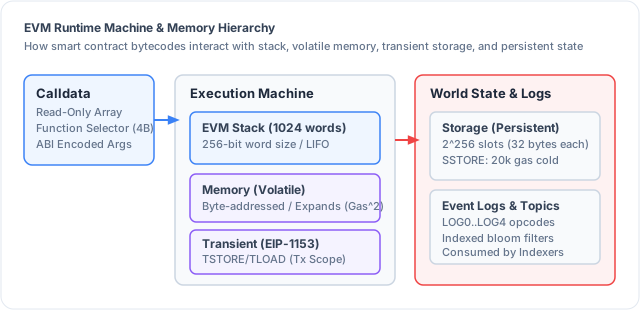 Figure 2: Architectural dataflow of smart contract execution from inbound transaction calldata through volatile memory, transient storage, and persistent state trie storage.
The era of building enterprise decentralized protocols using browser-based sandboxes or slow JavaScript test runners has passed. While the Remix IDE remains a helpful educational sandbox for rapid prototyping, production engineering workflows across institutional teams rely on high-performance native toolchains.
The prevailing industry standard for smart contract development is Foundry, an open-source framework developed in Rust by Paradigm. Foundry consists of three core command-line tools: Forge, Cast, and Anvil. Forge executes compilation, dependency management, and automated testing. Cast enables developers to perform RPC calls, encode calldata, and sign transactions directly from terminal environments. Anvil spins up local, high-throughput Ethereum execution nodes that can instantaneously fork live state from networks like Ethereum mainnet, Arbitrum, Optimism, or Base.
Foundry revolutionized smart contract testing by allowing developers to write test suites directly in Solidity rather than wrapping calls in TypeScript abstractions like Hardhat. This architectural decision eliminates serialization overhead, guarantees exact gas profiling parity with mainnet execution, and unlocks native fuzzing capabilities.
// SPDX-License-Identifier: MIT
pragma solidity 0.8.28;

import {Test} from "forge-std/Test.sol";
import {LiquidityVault} from "../src/LiquidityVault.sol";

contract LiquidityVaultTest is Test {
    LiquidityVault public vault;
    address public alice = makeAddr("alice");

    function setUp() public {
        vault = new LiquidityVault();
        vm.deal(alice, 100 ether);
    }

    // @notice Fuzz test with automated inputs
    function testFuzz_DepositAndWithdrawalAccounting(uint96 depositAmount) public {
        vm.assume(depositAmount > 0.01 ether);

        vm.prank(alice);
        vault.deposit{value: depositAmount}();

        assertEq(vault.balanceOf(alice), depositAmount);
        assertEq(address(vault).balance, depositAmount);

        vm.prank(alice);
        vault.withdraw(depositAmount);

        assertEq(vault.balanceOf(alice), 0);
        assertEq(address(vault).balance, 0);
    }
}
Beyond testing frameworks, modern development pipelines incorporate static analysis and linting suites. Tools such as Slither and Solhint parse contract abstract syntax trees to identify common vulnerabilities, including uninitialized state variables, reentrancy paths, shadow variables, and incorrect visibility modifiers prior to test deployment.
When building client interfaces or automated backend workers, Solidity developers interface with contracts using Viem, a lightweight, type-safe TypeScript library, alongside Wagmi for React state hooks. Legacy codebases frequently continue to support Ethers.js or Web3.py for Python-based trading bots and indexing pipelines. Infrastructure node access is provisioned through RPC services such as Alchemy, Infura, or QuickNode, while complex transaction simulations are verified in staging using platforms like Tenderly.
Decentralized finance relies on composability, which is made possible by standardized interfaces standardized through the Ethereum Improvement Proposal process. A proficient Solidity engineer must understand the internal execution mechanics and common edge cases of these foundational token standards:
The ERC-20 Specification defines the uniform API for fungible tokens. While basic implementations look simple, production environments encounter real hazards. Certain major tokens, including USDT, do not return a boolean value upon transfers, violating the strict standard and causing standard interface calls to revert. Production contracts use safe transfer wrappers like the SafeERC20 library from OpenZeppelin to handle non-standard return values, fee-on-transfer mechanics, and rebasing token balances.
The ERC-721 Specification establishes the standard for non-fungible tokens, tracking distinct asset identifiers across owners. The standard includes the safeTransferFrom method, which checks whether the recipient address is a contract and invokes onERC721Received. If the receiving contract fails to implement this hook or maliciously re-enters the transferring contract, unexpected state corruptions can occur.
The ERC-1155 Multi Token Standard, pioneered by the Enjin team, allows a single smart contract deployment to manage an infinite variety of fungible, semi-fungible, and non-fungible token IDs. This reduces deployment gas footprints and enables batch balance transfers in gaming and prediction markets.
The ERC-4626 Tokenized Vault Standard has emerged as the definitive design pattern for yield-bearing vaults across lending protocols and liquid staking derivatives. ERC-4626 standardizes the mathematical relationship between deposited underlying tokens and newly minted vault share tokens. Implementing ERC-4626 requires careful defensive programming against share inflation attacks, where an attacker front-runs an initial depositor with a donation to artificially distort share price calculations.
Protocol teams usually combine several layers rather than building every primitive from scratch:
Major decentralized protocols like Uniswap Labs, Aave Governance, Compound Finance, and MakerDAO / Sky serve as living reference implementations. Studying how Uniswap v3 uses concentrated liquidity ticks encoded as custom bit maps, or how Aave v3 executes flash loans via callback execution, teaches engineers how to organize real-world protocol logic.
Smart contract security is not an administrative compliance checklist. It is an adversarial discipline. Once a contract deploys to mainnet, autonomous arbitrage bots, MEV searchers orchestrated via Flashbots, and malicious exploiters scan every transaction and public contract address for mathematical or logical oversights.
Reentrancy remains a pervasive attack vector despite years of public awareness. A reentrancy vulnerability occurs when an external call transfers execution control to an untrusted contract before the calling contract updates its internal accounting state. The standard mitigation is strict adherence to the checks-effects-interactions pattern, supplemented by mutex reentrancy guards or transient storage locks.
// Vulnerable implementation: state modified after external call
function withdrawBad() external {
    uint256 balance = balances[msg.sender];
    require(balance > 0, "No balance");
    (bool success, ) = msg.sender.call{value: balance}("");
    require(success, "Transfer failed");
    balances[msg.sender] = 0; // State change occurs too late
}

// Secure implementation: Checks-Effects-Interactions pattern
function withdrawSecure() external {
    uint256 balance = balances[msg.sender];
    require(balance > 0, "No balance");
    balances[msg.sender] = 0; // Effect applied prior to external interaction
    (bool success, ) = msg.sender.call{value: balance}("");
    require(success, "Transfer failed");
}
Beyond reentrancy, security engineers must defend against arithmetic edge cases. While Solidity 0.8.0 introduced automatic compiler-level checks for integer overflows and underflows, developers must still guard against precision loss caused by integer division truncation. Rounding directions must always favor protocol solvency over individual user gains.
Oracle manipulation represents another primary source of catastrophic DeFi liquidations. Relying on spot prices queried directly from decentralized AMM liquidity pools exposes contracts to flash loan price distortions within a single transaction block. Robust protocols integrate decentralized oracle networks like Chainlink Documentation or compute geometric time-weighted average prices (TWAP) with extensive observation windows.
Leading audit firms like Trail of Bits, OpenZeppelin, Consensys Diligence, CertiK, and Spearbit emphasize that unit testing alone is insufficient. Modern protocols require invariant testing and property-based verification. In invariant testing, the engineer defines absolute mathematical truths that must never break regardless of sequence, input values, or call depths. For instance, in an automated market maker, the token balance of the contract must always be greater than or equal to the total issued pool claims.
Fuzzing frameworks like Foundry and Echidna generate thousands of pseudorandom transaction sequences to break these invariants. For mission-critical protocols managing hundreds of millions in TVL, teams apply formal verification engines like Halmos from a16z and Certora Prover. These tools convert Solidity bytecode and mathematical specifications into satisfiability modulo theories (SMT) formulas, mathematically proving whether any set of inputs exists that could violate system security invariants.
Aspiring engineers hone these defensive auditing instincts by solving public security challenges such as Ethernaut by OpenZeppelin and Damn Vulnerable DeFi, followed by participating in competitive audit contests hosted on Code4rena and Sherlock.
Gas optimization is not merely about penny-pinching transaction costs. In competitive on-chain systems, gas efficiency dictates user adoption, DEX trade routing priority, and protocol viability on Layer 1 Ethereum.
Gas consumption in the EVM is governed by deterministic opcode pricing rules. Understanding how the Solidity compiler maps source statements to bytecode allows engineers to eliminate waste:
Storage packing represents the easiest and most impactful storage optimization. EVM storage slots measure 32 bytes. If a developer orders contract state variables carefully, the compiler packs multiple sub-word variables into a single storage slot, drastically reducing expensive SSTORE operations.
// Inefficient: Uses 3 separate 32-byte storage slots (96 bytes allocated)
contract InefficientStorage {
    uint128 public a; // Slot 0 (uses 16 bytes, leaves 16 bytes empty)
    uint256 public b; // Slot 1 (uses full 32 bytes)
    uint128 public c; // Slot 2 (uses 16 bytes, leaves 16 bytes empty)
}

// Optimized: Packs variables into 2 storage slots (64 bytes allocated)
contract OptimizedStorage {
    uint128 public a; // Slot 0 (16 bytes)
    uint128 public c; // Slot 0 (16 bytes, packed alongside a)
    uint256 public b; // Slot 1 (32 bytes)
}
Other high-yield gas optimization techniques include:
Declaring state values that never change after deployment as constant or immutable. The compiler writes these values directly into runtime bytecode rather than reading from storage, saving 2,100 gas per read.
Caching array lengths in memory during loop execution, rather than querying dynamic array properties from storage on each iteration.
Replacing legacy string revert errors with custom errors defined via error Unauthorized();. Custom errors encode as a 4-byte selector rather than storing and serializing lengthy ASCII strings, saving both deployment size and execution gas.
Using calldata instead of memory for read-only function parameters in external functions. This avoids allocating new memory copies and reads arguments directly from transaction inputs.
For critical hot paths, senior engineers drop into inline assembly using Yul, the intermediate language developed by the Solidity team. Yul allows developers to bypass compiler safety wrappers, implement custom bit-shifting algorithms, and manipulate memory pointers directly. Open-source optimization libraries such as Solady demonstrate how high-performance assembly can reduce token transfer overhead by up to forty percent compared to standard libraries.
The EVM landscape has evolved far beyond a monolithic Layer 1 network. Today, the majority of user transactions, consumer applications, and high-frequency trading occur on Layer 2 rollups and application-specific chains.
Layer 2 rollups inherit base-layer Ethereum security while executing transactions off-chain and posting compressed transaction batches or state diffs back to Layer 1. These include optimistic rollups built on the OP Stack such as Optimism Superchain and Base, Arbitrum Orbit chains, and zero-knowledge rollups like Polygon Labs zkEVM.
Writing contracts for Layer 2 rollups requires understanding network-specific gas formulas. On rollups, gas costs are split into execution gas and L1 data availability gas (calldata or blob gas introduced via EIP-4844). Because L1 data publication often constitutes eighty percent or more of transaction expenses, minimizing calldata footprint and zero-byte compression takes precedence over micro-optimizing execution opcodes.
Simultaneously, user onboarding is transforming through Account Abstraction. Historically, every transaction required execution from an Externally Owned Account (EOA) controlled by a single private key. The ratification of ERC-4337 Account Abstraction and the introduction of EIP-7702 allow smart contracts to function directly as user accounts.
In this architecture, users sign off-chain objects called UserOperations rather than raw transactions. Specialized network actors known as Bundlers aggregate these operations into Ethereum transactions and submit them to an audited singleton EntryPoint contract. Paymaster contracts can sponsor gas fees on behalf of users or allow them to pay with ERC-20 stablecoins like USDC. Solidity engineers building modern decentralized applications are increasingly tasked with writing custom account modules, session key validators, and automated paymaster policies.
UserOperation containing call data, a nonce, and gas limits.Data indexing infrastructure has also matured. Applications no longer poll raw JSON-RPC endpoints to display user balances or historical activities. Solidity developers write event emissions with precise parameter indexing so that subgraphs deployed on The Graph or custom indexing pipelines can query on-chain history using GraphQL. Analytics dashboards built on Dune Analytics allow teams to evaluate transaction volume, token velocity, and user retention metrics in real time.
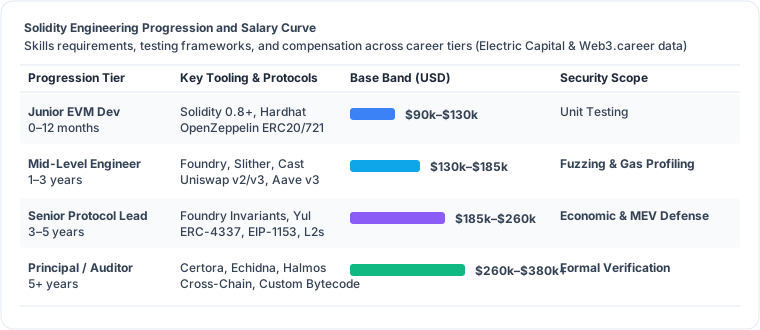
The job market for smart contract engineers has matured from early experimental speculative hiring into a disciplined engineering discipline. According to the Electric Capital Developer Report, active monthly open-source crypto developers remain above 20,000 globally, with Ethereum and EVM-compatible ecosystems maintaining over seventy percent of total developer mindshare.
Compensation benchmarks across Web3 hiring surveys, including research from Pantera Capital, Web3.career, and institutional recruiters, reflect high base pay combined with token incentive packages:
Junior smart contract engineers with strong programming fundamentals and verified Foundry test projects typically enter salary bands between $90,000 and $130,000 USD. Mid-level developers with production mainnet experience, audited codebase contributions, and deep DeFi primitives knowledge command base salaries from $130,000 to $185,000. Senior protocol engineers and team leads managing core protocol architecture earn base compensations between $185,000 and $260,000, frequently supplemented with token grants vesting over three to four years.
Independent security researchers and smart contract auditors occupy an even higher tier. Top competitive auditors participating in bug bounties on Immunefi or contests on Code4rena regularly earn between $250,000 and $500,000 annually, with elite researchers earning seven-figure bounties for identifying critical vulnerabilities in high-TVL protocols.
Hiring teams assess candidates based on verifiable, on-chain evidence rather than traditional resumes. The most effective portfolio for an aspiring Solidity engineer includes:
A comprehensive GitHub repository displaying end-to-end Foundry test suites with invariant tests, fuzzing runs, and automated Slither CI actions.
A fully audited, fork-tested implementation of an advanced DeFi mechanism, such as an ERC-4626 vault with fee splits, an automated liquidity manager, or a custom Uniswap v4 hook.
Documented participation in public audit contests or responsible disclosure bug bounties on platforms like Code4rena or Immunefi.
Direct contributions to recognized open-source libraries, protocol repositories, or educational developer resources such as Cyfrin Updraft.
Mastering Solidity requires disciplined dedication to computer science fundamentals, virtual machine mechanics, and adversarial thinking. By committing to deep EVM knowledge, adopting modern native toolchains like Foundry, and prioritizing verifiable security practices, developers can build durable careers at the frontier of decentralized finance and global cryptographic infrastructure.
Explore more guides and career playbooks