Loading article...

An empirical thesis and strategic negotiation guide for evaluating Web3 compensation packages, structuring fiat and stablecoin base salaries, valuing token grants, and auditing vesting clauses.
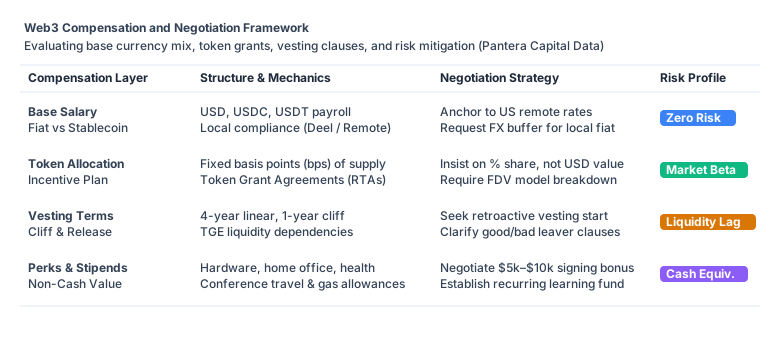
Negotiating compensation in the Web3 industry presents complexities that do not exist in conventional software engineering. In traditional technology enterprises, total compensation structures follow predictable patterns: a base fiat salary, standard health and retirement benefits, and equity structured as Incentive Stock Options (ISOs) or Restricted Stock Units (RSUs) tied to publicly traded shares or private 409A valuations managed on platforms like Carta and Pulley.
In decentralized technology organizations, compensation is multi-dimensional and structurally volatile. Offers frequently combine fiat currency, fiat-pegged stablecoins like USDC issued by Circle USDC or USDT from Tether USDT, native protocol token grants, equity in offshore development foundations, and variable governance bounties. Without an empirical framework to evaluate token liquidity, fully diluted valuation overhangs, and tax liabilities, candidates risk accepting compensation packages whose perceived value evaporates during market downturns.
According to comprehensive compensation research from Pantera Capital and hiring datasets from Web3.career, blockchain engineering and executive roles command significant premiums over equivalent Web2 roles. However, realizing that compensation requires sophisticated negotiation strategies. This guide analyzes how candidates should evaluate compensation structures, anchor base salaries, value token grants, audit vesting contracts, and protect against systemic downside risks.
A competitive Web3 offer consists of distinct financial layers, each carrying specific regulatory, liquidity, and volatility profiles:
Base compensation provides downside protection and covers living expenses. In Web3, candidates frequently have the option to receive base compensation in fiat currency (USD, EUR, GBP) via traditional payroll providers or in USD-denominated stablecoins (USDC or USDT) paid directly to a self-custodial wallet like Safe (Gnosis Safe).
Global payroll compliance platforms like Deel, Remote, and Oyster allow remote teams to issue legal local contracts with automated tax withholding while facilitating crypto-to-fiat payroll splits. Candidates living in countries with high local currency inflation or restrictive capital controls often negotiate for one hundred percent stablecoin compensation.
Web3 organizations operate under diverse legal and corporate structures, which dictates the form of long-term upside incentive:
Traditional Equity: Common in venture-backed infrastructure companies, centralized exchanges like Coinbase and Kraken, or software developer tooling firms. Equity grants candidates ownership in the corporate entity that owns the intellectual property and revenue.
Token Grant Agreements (RTAs / RSAs): Common in decentralized autonomous organizations and protocol development labs. Candidates receive the contractual right to receive native protocol governance or utility tokens.
Hybrid Packages (Equity + Token Warrant): The prevailing institutional standard pioneered by venture capital firms like a16z crypto and Paradigm. Employees receive equity in the operating lab company alongside a proportional token warrant granting rights to tokens issued by an independent protocol foundation in the future.
The single most common mistake candidates make when evaluating Web3 offers is accepting a recruiter's nominal dollar valuation of a token package at face value.
For example, a recruiter may state: "We are offering a $150,000 base salary plus $100,000 per year in tokens based on our current valuation." Candidates must immediately ask: Is the token currently liquid and traded on major exchanges? If unlaunched, what is the assumed Fully Diluted Valuation (FDV), and how was that figure determined?
If the protocol token is already live and actively traded on exchanges tracked by CoinGecko and CoinMarketCap, candidate valuation must account for price volatility and illiquidity.
Locked tokens that vest over four years cannot be sold today. Market liquidity may not support large sales without slippage, as demonstrated by market depth metrics on DefiLlama. Financial analysts apply a Discount for Lack of Marketability (DLOM), typically ranging from 25 to 45 percent, when valuing unvested liquid tokens.
If the token has not yet launched (pre-Token Generation Event, or pre-TGE), dollar figures are meaningless. If a project assigns an arbitrary two-billion-dollar valuation to an unlaunched protocol with zero user traction, claiming that an employee receives "$200,000 in tokens" is deceptive.
In pre-TGE negotiations, candidates must negotiate for a fixed percentage of total token supply, expressed in basis points (1 basis point = 0.01% of total token supply):
$$ ext{Token Grant Share} = rac{ ext{Number of Granted Tokens}}{ ext{Maximum / Total Token Supply}} imes 10,000 ext{ bps}$$
Standard benchmarks for early-stage protocol hires:
First 5 Core Engineers: 25 to 75 basis points (0.25% to 0.75% of total supply) each.
Engineers 6 Through 20: 10 to 25 basis points (0.10% to 0.25% of total supply) each.
Senior Hires Post-Series A: 5 to 15 basis points (0.05% to 0.15% of total supply).
Insisting on basis points protects the candidate against silent dilution. If the protocol subsequently increases total token supply, the candidate's contractual percentage remains protected if anti-dilution clauses are secured.
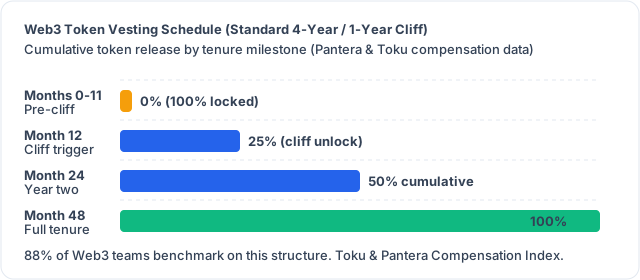 Figure 2: Architecture of token vesting curves showing the one-year cliff followed by linear monthly releases and secondary market distribution.
A token allocation is only as valuable as the contract enforcing it. Candidates must scrutinize the fine print of Token Grant Agreements (TGAs) and employment contracts, watching for critical operational clauses:
The established industry benchmark across Web3 is a four-year linear vesting schedule with a one-year cliff. Under this model:
Year 0 to 12 Months: Zero tokens vest.
At Exactly 12 Months: Twenty-five percent of the total token grant vests instantaneously.
Months 13 Through 48: The remaining seventy-five percent vests in equal monthly or per-second linear increments.
Candidates must confirm when the vesting clock begins. In pre-TGE projects, teams sometimes draft agreements where vesting does not start until the token actually launches. If the project delays launch by two years, the employee works two years without vesting a single token. Candidates should insist that vesting begins on their official employment start date, regardless of when TGE occurs.
Even after tokens vest on paper, projects frequently impose secondary lockups. For instance, if an employee has vested 25 percent of their tokens when TGE occurs, the foundation may require all team tokens to remain locked for an additional six to twelve months post-launch to satisfy exchange listing requirements or investor covenants tracked on TokenUnlocks.
Candidates must clarify: Will vested tokens be liquid immediately upon TGE, or will they be subject to an exchange-mandated lockup?
Employment contracts often define conditions under which unvested, and sometimes vested, equity or tokens can be reclaimed by the company.
Candidates must ensure that voluntary resignation after completing the one-year cliff categorizes them as a "Good Leaver," preserving their full legal ownership of all tokens vested up to their departure date. Beware of predatory clauses that grant the company repurchase rights on vested tokens at nominal cost.
In corporate acquisitions or protocol mergers, acceleration clauses protect employees:
Single-Trigger Acceleration: Tokens or equity automatically vest immediately upon a change of control (such as an acquisition by a larger entity like Consensys or Binance).
Double-Trigger Acceleration: The prevailing standard. Tokens vest immediately if the company undergoes an acquisition AND the employee is terminated without cause within twelve months of the transaction.
Negotiating a Web3 compensation package requires systematic execution across multiple offer rounds:
Do not reveal salary expectations early in the screening process. When pressed by recruiters, anchor your expectations to verifiable compensation data from Web3.career, Levels.fyi, and Pantera Capital surveys.
Explain that your target compensation reflects current US-remote benchmark rates for your technical tier, adjusted for the high capital risk associated with decentralized protocol development.
Before responding to a compensation proposal, request written answers to four fundamental questions:
What is the current fully diluted token supply and current circulating supply?
What percentage of total token supply does this grant represent in basis points?
What are the vesting commencement dates, cliff terms, and post-TGE lockup conditions?
What is the historic valuation from the most recent venture financing round, and who are the lead institutional investors (e.g., Framework Ventures, Delphi Digital, or Galaxy Digital)?
A legitimate, well-capitalized team will answer these questions transparently. Evasiveness is a primary red flag indicating disorganized cap tables or inflated valuation promises.
Never make a one-dimensional counter-offer that simply asks for more money. Instead, present flexible trade-offs that align with the company's capital strategy:
If the company is capital-constrained: Offer to accept a slightly lower base salary in exchange for higher token basis points or earlier vesting acceleration.
If the company is well-capitalized with high treasury reserves: Request a higher base salary in liquid USDC alongside signing bonuses, reducing exposure to volatile token assets.
Non-Cash Value Levers: Negotiate for non-dilutive benefits, such as remote home office stipends ($3,000 to $5,000), recurring conference and travel allowances to attend major hackathons like ETHGlobal, health insurance reimbursement, and professional education funds to complete security certifications on Cyfrin Updraft.
To negotiate effectively, candidates must enter discussions armed with verifiable market salary distributions. Data collected across thousands of verified offers by Web3.career, Levels.fyi, and the Pantera Capital compensation survey reveals distinct compensation bands across engineering specializations:
Smart contract engineers building on Ethereum and Layer 2 ecosystems command premiums when they possess verified proficiency in Foundry and invariant testing. Systems engineers programming in Rust for the Solana Foundation or client teams like Paradigm Reth occupy the upper percentiles of base salary compensation.
Security researchers and smart contract auditors command the highest overall upside. Because an undetected exploit can compromise an entire protocol, top auditors at firms like Trail of Bits, Spearbit, and CertiK, as well as competitive wardens on Code4rena and Sherlock, negotiate profit-sharing cuts from private audit retainers and bug bounties hosted on Immunefi.
Analyzing realistic negotiation scenarios illustrates how candidates can optimize multi-asset offer structures:
Candidate Profile: Senior backend systems engineer transitioning from distributed cloud systems into Layer 2 execution client engineering.
Initial Offer:
Strategic Analysis and Counter-Offer: The candidate notes that the token value is based on an arbitrary, unverified pre-TGE valuation. Furthermore, tying the vesting start date to the token launch creates immense risk; if market conditions delay the launch by eighteen months, a year and a half of labor goes unvested.
The candidate counters:
Final Outcome: The company accepts the basis point framing (settling at 20 bps) and changes the vesting start date to day one, protecting the candidate against launch delays while securing equity upside.
Candidate Profile: Experienced security researcher joining a major decentralized lending protocol managing over $500 million in TVL across Arbitrum Docs, Optimism, and Base.
Initial Offer:
Strategic Analysis and Counter-Offer: The candidate recognizes that governance tokens on major protocols like Aave Governance, Compound Finance, and MakerDAO / Sky are liquid, but subject to broad crypto market beta. If DeFi token multiples contract, compensation drops substantially.
The candidate counters:
Final Outcome: The protocol approves the performance bonus and tooling allowance, aligning the researcher's financial incentives with absolute protocol solvency.
In decentralized autonomous organizations governed by token voting, such as the Arbitrum DAO or the Optimism Governance collective, employment does not follow traditional corporate HR models. Contributors receive compensation through community grant proposals, working group budgets, or sub-DAO streams.
Key operational strategies for DAO contributors include:
Multi-Signature Escrow Streaming: Utilizing tools like Sablier, LlamaPay, or Superfluid to establish real-time per-second salary streaming from an audited Safe (Gnosis Safe) multi-signature treasury. This prevents arbitrary payroll halts caused by sudden governance disputes.
Governance Delegation Terms: If compensation includes voting tokens, contributors should negotiate clear guidelines on voting rights. Can the contributor vote their unvested tokens in governance elections, or do voting rights remain with the foundation until tokens unlock? Major DAOs typically allow unvested tokens to vote on protocol proposals, empowering contributors to shape product strategy.
Tracking Ecosystem Health: Contributors should monitor protocol revenue, treasury runway, and fee generation on Token Terminal, Dune Analytics, and Etherscan to ensure the DAO maintains at least twenty-four months of stablecoin operating runway. Macro industry insights published by Messari, The Block Research, and Bankless provide necessary context when assessing DAO longevity.
Web3 compensation can create catastrophic tax liabilities if structured incorrectly. In many jurisdictions, receiving liquid tokens is treated as ordinary income based on the fair market value of the tokens on the day they vest.
If an employee vests $100,000 worth of tokens and the token subsequently drops eighty percent in value before the employee sells to pay taxes, the employee may owe more in income tax than the remaining tokens are worth.
Key defensive tax strategies include:
83(b) Elections (for US Taxpayers): Filing an 83(b) election with the Internal Revenue Service within 30 days of receiving unvested equity or restricted tokens allows the recipient to pay income tax on the asset's nominal value at grant (often fractions of a cent) rather than on its value as it vests over time.
Stablecoin Base Safeguards: Ensuring that base salary covers all anticipated personal income tax liabilities, avoiding the need to liquidate volatile tokens in distressed market conditions.
Professional Advisory Consultation: Retaining specialized crypto tax accountants before signing cross-border consultancy or token allocation contracts.
By approaching compensation negotiations with empirical rigor, demanding capitalization transparency, and insisting on protective vesting terms, Web3 professionals can secure high-yield compensation packages that withstand market cycles and build long-term generational wealth.