
The Digital Eurodollar: How B2B Stablecoins Are Rewiring Trade
Beyond cryptocurrency trading, stablecoins have quietly replaced correspondent banking across wholesale supply chains. A 3,500-word examination of working capital mechanics, offshore dollar systems, ERP integration, and emerging trade corridors.

In 1957, the Soviet Union faced a practical dilemma. It held substantial US dollar balances from export earnings but feared keeping them inside American financial institutions where Washington could freeze them. The solution was simple: deposit the dollars in the Banque Commerciale pour l'Europe du Nord in Paris and Moscow Narodny Bank in London.
Those deposits gave birth to the Eurodollar market: US dollars created, held, and settled outside the domestic borders and regulatory perimeter of the United States.
Over the next five decades, the Eurodollar system grew into the financial backbone of global trade. From post-war European rebuilding to the Asian manufacturing boom, businesses trading across borders needed a single, widely accepted currency to price contracts and settle invoices. Because foreign banks could not directly access the domestic US Federal Reserve payment system, they created an elaborate relay network called correspondent banking.
In this system, banks opened special accounts with each other across borders: a "Nostro" account (meaning "our money on deposit with your bank") and a "Vostro" account ("your money on deposit with our bank"). Whenever an Italian textile buyer wanted to pay an Indian cotton mill in dollars, their local banks did not move physical cash across the ocean. Instead, money-center banks in New York, London, and Frankfurt acted as middlemen, manually adjusting ledger balances between these foreign accounts.
Global institutions like JPMorgan, Citibank, and Deutsche Bank became the toll collectors of this architecture. They charged fees at every step and required local banks to park millions of idle dollars in reserve accounts simply to guarantee that daily wire requests would clear.
That system worked when manufacturing hubs were centralized and trade moved at the leisurely pace of paper documents delivered by mail. In an era of real-time logistics, fast-moving e-commerce, and global supply chains operating on thin profit margins, this relay network has become a costly bottleneck.
What is happening today is not a fad or a speculative cryptocurrency trend. It is a direct evolution of monetary history: global businesses are moving away from slow, paper-dependent Eurodollar bank ledgers and adopting programmable, on-chain digital dollars that settle instantly.
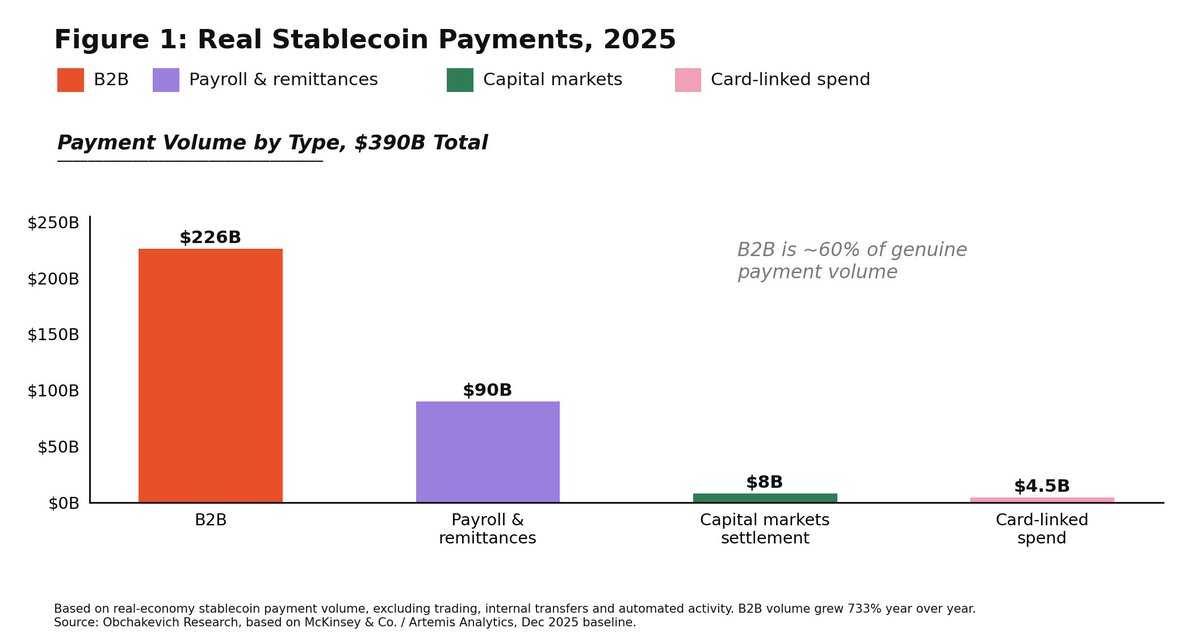 Commercial B2B trade invoicing now makes up approximately 60% of all non-speculative stablecoin volume, totaling ~$226B in 2025.
The Macro Reality: Cutting Through the $33 Trillion Figure
Every pitch deck in the crypto sector highlights the same headline: blockchains process over $33 trillion in annualized volume.
That number is useless for evaluating the real economy. Most of it represents automated market maker rebalancing, exchange arbitrage, decentralized finance leverage loops, and bot wash trading.
When researchers at McKinsey & Company and Artemis Analytics filtered out automated bot activity and internal exchange transfers, they found that actual payments for real-world goods and services in 2025 totaled approximately $390 billion. That represents roughly 0.02% of global cross-border transactions.
The structural story sits inside that $390 billion:
- Commercial B2B trade invoicing accounted for roughly $226 billion, representing nearly 60% of all real-world stablecoin payment volume. That figure grew 733% year-over-year.
- Cross-border payroll and retail remittances totaled $90 billion, representing roughly 23% of real volume.
- Institutional capital operations accounted for $8 billion, representing 2%.
- Consumer card-linked spending stood at just $4.5 billion, representing barely 1.2% of the total.
The overall monthly transactional run-rate grew from $5 billion in January 2024 to more than $30 billion per month by early 2026 according to payment data from BVNK.
While media attention focuses on consumer crypto debit cards and retail remittances, non-crypto small and mid-sized businesses have quietly become the dominant users of stablecoin rails.
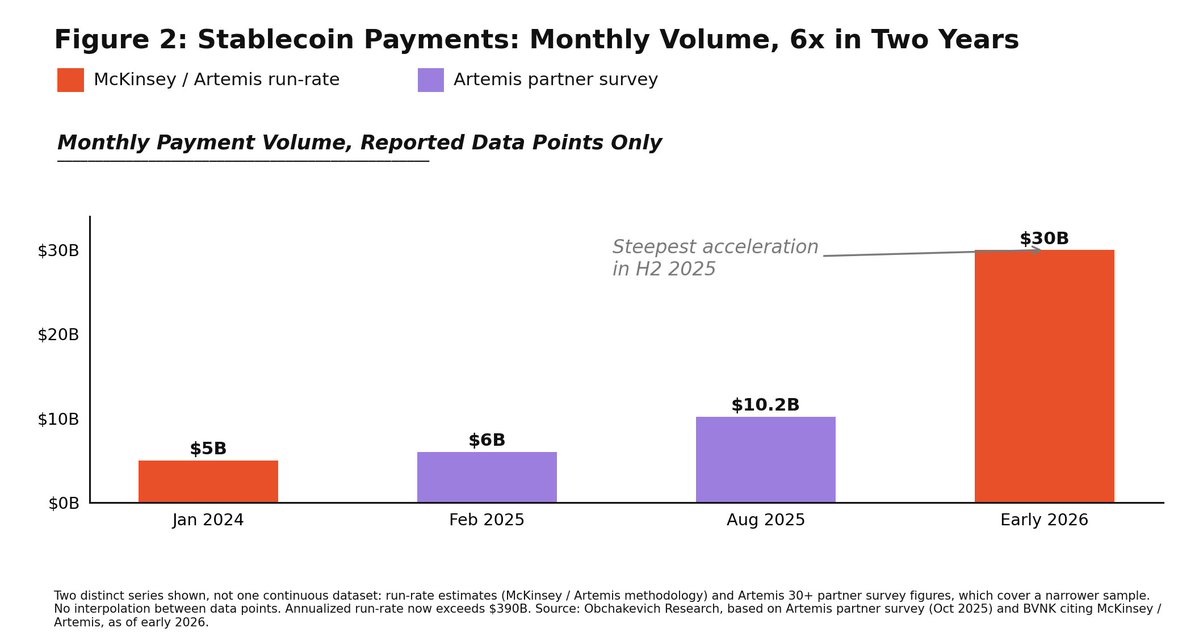 Monthly genuine commercial payment volume expanded sixfold between January 2024 and early 2026, surpassing $30B/month.
The Anatomy of Trapped Capital in Correspondent Banking
To understand why an electronics importer in California or an apparel manufacturer in Vietnam settles invoices using digital dollars, one must examine the balance-sheet friction of traditional international wires.
When a corporate buyer sends a cross-border SWIFT payment to an overseas supplier, funds do not travel directly. Instead, they move through a series of intermediate institutions:
- Buyer's Domestic Bank: Initiates the transfer and extracts an origination wire fee ($25 to $50).
- National Clearing Facility (Fedwire / CHIPS): Routes the payment to a designated money-center bank.
- US Correspondent Bank (Nostro / Vostro): Converts currencies at a retail foreign exchange markup, typically 1.5% to 3.5% above interbank rates.
- Foreign Intermediary Bank: Charges an in-transit processing fee ($15 to $75) and queues the transaction for manual compliance review.
- Supplier's Regional Bank: Imposes an inward remittance charge and converts funds into local currency after a float delay of 3 to 5 business days.
At every hop in this chain, friction compounds across four distinct areas:
1. Intermediary Fee Stacking
Each correspondent bank along the route extracts an administrative fee. On a $150,000 shipment of industrial machinery or electronic components, fixed deductions and hidden wire markups shave $500 to $2,500 off the principal before arrival.
2. Trapped Working Capital and Float
Settlement typically takes three to five business days. If an intermediary bank flags an invoice for manual screening across time zones, the delay extends to two weeks. During this window, shipping containers sit at port terminals, bills of lading cannot be released, and working capital remains frozen in transit.
3. Asymmetric Foreign Exchange Spreads
For non-G10 currency pairs, such as paying a Brazilian, Indian, or Nigerian supplier, commercial banks quote wide bid-ask spreads well above the interbank mid-market rate. Suppliers price this exchange-rate volatility directly into their wholesale catalog pricing, raising costs for downstream buyers.
4. Trapped Nostro Liquidity
According to research by the Bank for International Settlements, global commercial banks maintain hundreds of billions of dollars in pre-funded foreign Nostro accounts simply to facilitate daily payment execution for corporate clients. This locked capital earns minimal return and creates systemic liquidity drag across the banking sector.
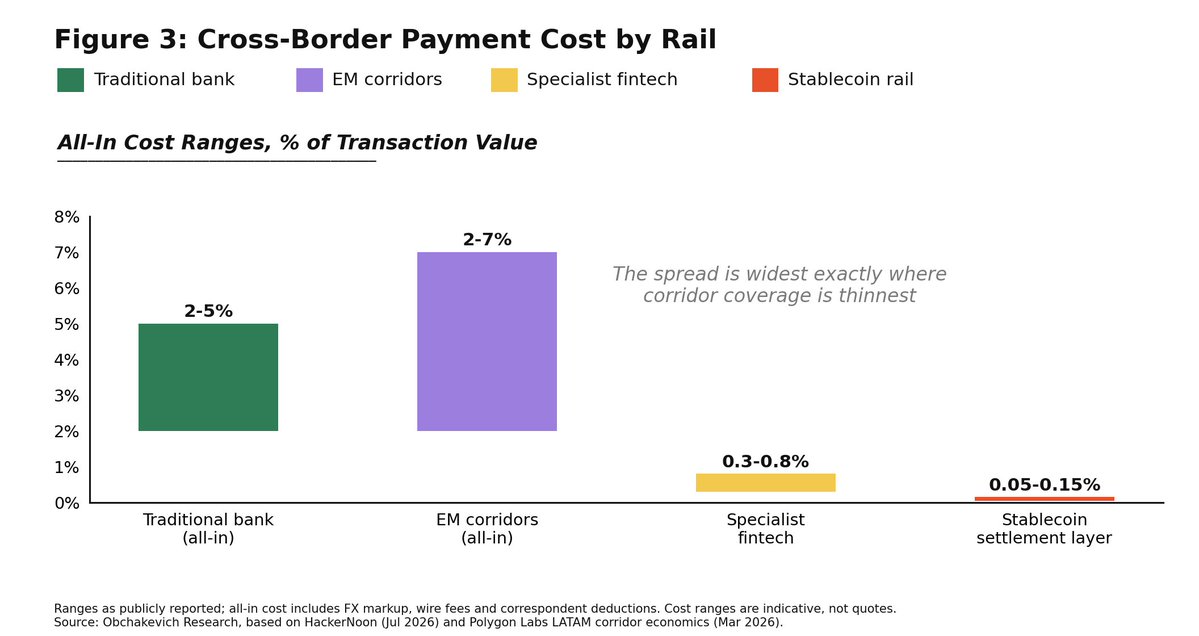 All-in cost comparison across transaction rails. While domestic G10 clearing is relatively cheap, emerging-market corridors extract up to 7%, creating massive economic incentives to switch to digital dollar rails.
Settlement vs. Messaging: The Technical Distinction
The core innovation of stablecoins is often misunderstood. A blockchain is not just a faster messaging network like SWIFT.
To understand the difference, consider a simple analogy:
When you send a text message to a friend saying "I transferred $50 to your account," the text message is not the money. The message simply communicates intent. Your friend still has to wait for their bank to receive the funds, clear the fraud checks, and update their account balance.
This is how SWIFT works. SWIFT does not move money. It only sends secure messages between banks saying "Please debit Account A in New York and credit Account B in Frankfurt." The actual money movement, called settlement, happens hours or days later when central banks reconcile their ledgers. If an intermediate bank in the chain encounters a glitch, halts operations for a weekend, or flags the transfer for a compliance check, the money gets trapped in limbo.
A public blockchain collapses messaging and settlement into the exact same single step (known technically as an atomic transaction). When digital dollars move on a blockchain:
- The payment instruction and the transfer of value happen simultaneously.
- Payment verification occurs through mathematical cryptography in 15 to 30 seconds.
- Final settlement is permanent and cannot bounce or get held up by an intermediary bank.
- The base network fee is negligible, typically costing pennies or a fraction of a percent (5 to 15 basis points, where 100 basis points equals 1%), regardless of whether the transfer is for $5,000 or $5,000,000.
| Dimension | Correspondent SWIFT | Specialist Fintechs (Wise, Revolut) | On-Chain Stablecoins |
|---|---|---|---|
| Settlement Latency | 2 to 5 business days | 1 to 2 business days | 15 to 30 seconds |
| Clearing Certainty | Probabilistic (subject to correspondent holds) | Probabilistic (partner bank clearing dependent) | Deterministic (atomic cryptographic settlement) |
| Operating Hours | Banking hours (Mon-Fri, 9am-5pm) | Banking hours with batch clearing | 24/7/365 continuous |
| Fee Structure | 2% to 7% (FX spread + wire deductions) | 0.3% to 0.8% (capped corridors) | 0.05% to 0.20% (ledger tier) |
| Escrow Mechanism | Paper Letters of Credit (LCs) | Proprietary platform escrow | Programmatic smart contract escrow |
| ERP Integration | Batch MT103 / ISO 20022 files | Proprietary REST APIs | Real-time webhooks & on-chain proofs |
Global Corridor Mechanics: Where the Capital Moves
Public on-chain data and corporate payment disclosures demonstrate that commercial stablecoin adoption is concentrated along specific high-volume global trade routes:
+---------------------------------------------------------------------------------------+
|                       GLOBAL COMMERCIAL STABLECOIN CORRIDORS                          |
+---------------------------------------------------------------------------------------+
|                                                                                       |
|   [ NORTH AMERICA ]                                   [ GREATER CHINA & ASIA-PAC ]    |
|   United States Inflow: ~$127B/mo   <=============>   China Inflow:     ~$71B/mo      |
|   Consumer & Wholesale Procurement                    Hong Kong Inflow: ~$51B/mo      |
|         │                                             Singapore Regional Hub          |
|         │                                                       │                     |
|         ▼ (Finished Goods / Raw Materials)                      ▼ (Electronics & Tech)|
|   [ LATIN AMERICA ]                                   [ SUB-SAHARAN AFRICA & ME ]     |
|   Total Inflow: ~$174B                                Average SWIFT Friction: >6.0%   |
|   - US-Mexico: $61.8B (-4.5%)                         Turkey: High-spread inflation   |
|   - Intra-LATAM & Central America: $112.2B            Mobile Money Integration (M-Pesa)
|                                                                                       |
+---------------------------------------------------------------------------------------+
1. The Trans-Pacific Sourcing Axis
The single largest commercial stablecoin corridor connects North American and European importers with manufacturing hubs across Greater China and Southeast Asia.
Data from Artemis Analytics shows monthly inbound stablecoin flows heavily weighted toward major industrial endpoints:
- United States: ~$127 billion / month
- Mainland China: ~$71 billion / month
- Hong Kong: ~$51 billion / month
Under legacy telegraphic transfer protocols, paying a supplier in Shenzhen or Taipei requires days of foreign exchange pre-approval. Using stablecoins, wholesale buyers settle invoices immediately upon cargo inspection, enabling factories to release bills of lading on the same day.
2. Latin America: The Shift to Balance-Sheet Dollarization
Latin America received approximately $174 billion in cross-border transfers in 2025 according to Bybit's regional analysis and World Bank data. Crucially, the traditional US-to-Mexico corridor contracted 4.5% to $61.8 billion, marking its first annual decline in over a decade.
Meanwhile, $112.2 billion, nearly two-thirds of the region's volume, flows into Central and South America, where currency volatility is highest.
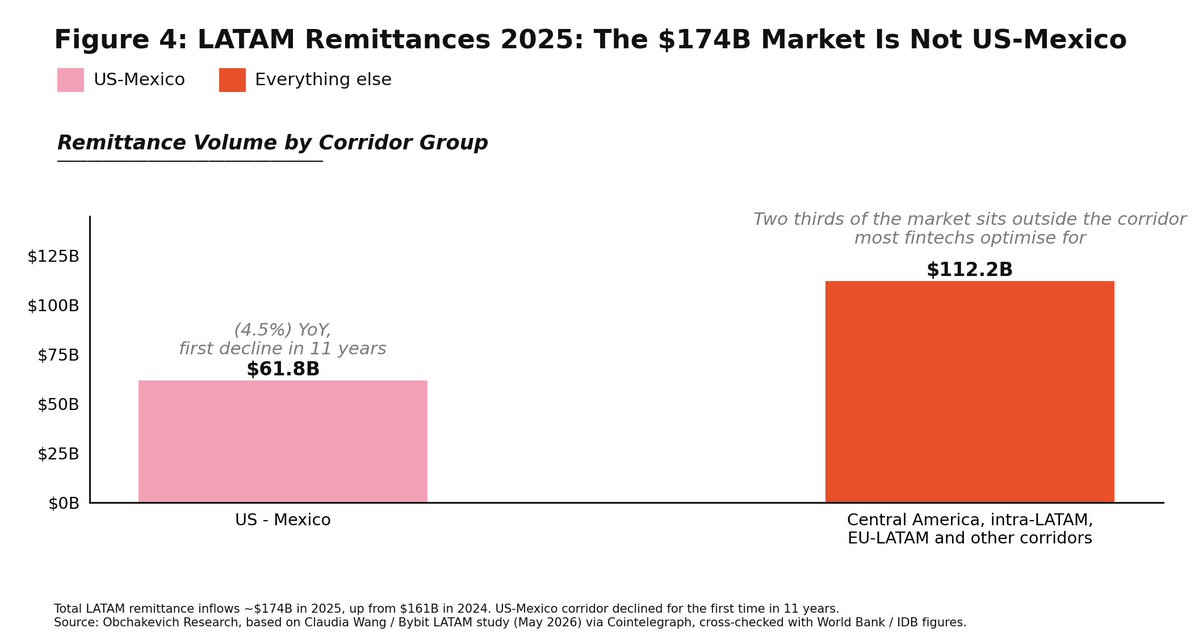 Over $112B of Latin American cross-border volume flows into South and Central America, outside the heavily saturated US-to-Mexico corridor.
In South America, businesses use stablecoins differently than in Western markets. The primary objective is not merely transaction speed, but holding US dollars on corporate balance sheets.
In countries like Argentina, where annual inflation regularly erodes working capital, dollar-pegged stablecoins make up over 70% of all crypto asset purchases. When an industrial exporter in Colombia, Brazil, or Argentina invoices an overseas client, they actively prefer not to convert into domestic fiat. By maintaining balances in USDT or USDC, they insulate their working capital against currency devaluation and use those dollars directly to procure imported raw materials.
Institutional infrastructure has scaled rapidly to serve this demand:
- Conduit reached $10 billion in annualized volume in 2024 by bridging digital dollars directly into domestic instant-clearing networks like Brazil’s Pix and Mexico’s SPEI.
- Bitso Business now provides stablecoin treasury services to over 1,900 enterprise clients, reporting 30% to 50% savings on typical cross-border settlement costs.
3. Sub-Saharan Africa: Mobile Money Integration
According to the World Bank Remittance Database, Sub-Saharan Africa remains the most expensive cross-border payment market in the world, with average transaction costs exceeding 6.0%.
The primary hurdle in Africa is connectivity. Most international banks have no direct technical integration with domestic clearinghouses across African nations.
Fintech platforms have resolved this by linking stablecoin settlement directly into mobile money networks like M-Pesa, MTN Mobile Money, and Airtel. Incoming digital dollars are automatically converted into local mobile currency within seconds, enabling multinational companies to pay regional contractors, agricultural suppliers, and logistics operators without touching slow traditional bank wires.
4. Europe and the MiCA Regulatory Fracture
While emerging markets rely overwhelmingly on Tether (USDT), which commands more than 80% of global commercial payment volume as tracked by Castle Island Ventures, the European Union's Markets in Crypto-Assets (MiCA) regulation has created an operational divide.
Under MiCA, stablecoins must hold authorized e-money licenses and comply with strict bank-reserve mandates. Because USDT does not hold an EU e-money license, licensed European exchanges and payment service providers have restricted its use, favoring regulated alternatives like Circle’s USDC and EURC.
This creates a split in global payment routing: the token used by 80%+ of businesses in Asia and Latin America (USDT) is restricted inside the EU. Cross-border fintechs must build multi-currency liquidity routers that ingest USDT from global suppliers, execute offshore conversions into USDC or euros, and disburse funds via SEPA Instant.
The Infrastructure Acquisition Wave
Over the past 24 months, traditional payment incumbents recognized that building blockchain infrastructure internally was too slow, leading to a wave of acquisitions:
| Acquirer / Network | Asset / Target | Transaction Valuation | Strategic Objective |
|---|---|---|---|
| Stripe | Bridge | ~$1.1 Billion (2024) | Turn-key stablecoin orchestration across 30+ fiat currencies; powered ~$400B in annualized stablecoin payment volume |
| Mastercard | BVNK | Up to $1.8 Billion (March 2026) | Integrates regulated European and UK fiat-to-crypto banking rails directly into Mastercard's commercial settlement network |
| Visa | Internal Solana / Ethereum Rails | Direct Deployment | Scaled stablecoin settlement run-rate to ~$7B annualized across merchant acquirers |
| Conduit | Emerging Market Network | Series A Expansion | Direct integration into Brazil Pix, Mexico SPEI, and 23 African mobile money rails |
This institutional wave demonstrates two points:
- The settlement rail has been validated. Global payment networks now treat stablecoins as standard infrastructure rather than an experimental edge case.
- Corridor access is uneven. Capital has poured into G10 payment corridors (US-Europe, US-Mexico, UK-EU), driving margins toward zero. Meanwhile, high-spread corridors like direct trade within Latin America, US-Turkey trade, and Sub-Saharan disbursements remain supported by only a handful of enterprise platforms.
The Invisible Banking Stack: Enterprise ERP Integration
Early crypto payment solutions failed because they required corporate finance teams to manage private keys, acquire volatile gas tokens, and interact with browser wallet extensions. Corporate controllers, treasurers, and tax auditors will not tolerate operational workflows that introduce private key custody risks to their general ledgers.
The modern trade finance architecture solves this through the "Stablecoin Sandwich", where blockchain mechanics are completely invisible to both sender and receiver:
+-----------------------------------------------------------------------------------------------+
|                       THE INVISIBLE ENTERPRISE SETTLEMENT STACK                               |
+-----------------------------------------------------------------------------------------------+
|                                                                                               |
|  [ North American Importer ]                                                                  |
|         │                                                                                     |
|         ▼ 1. Initiates standard bank transfer (ACH / FedNow) in USD from existing bank account|
|  [ Regulated Banking / In-Ramp Partner ]                                                      |
|         │                                                                                     |
|         ▼ 2. Converts fiat to stablecoin in backend liquidity pool (10-15 bps fee)            |
|  [ High-Throughput Public Ledger (Solana, Base, Arbitrum, Tron) ]                               |
|         │                                                                                     |
|         ▼ 3. Programmatic cryptographic settlement executes across borders in 15-30 seconds   |
|  [ Destination Liquidity Provider / Off-Ramp Gateway ]                                         |
|         │                                                                                     |
|         ▼ 4. Deposits local currency via domestic fast rail (Pix, SPEI, SEPA, UPI)             |
|  [ Overseas Supplier ]                                                                        |
|    Receives native fiat in their bank, or retains clean digital USD on balance sheet          |
|                                                                                               |
+-----------------------------------------------------------------------------------------------+
Recent academic research on implementing stablecoin transactions in SAP ERP demonstrates how settlement connects directly into enterprise suites like SAP, Oracle NetSuite, and Microsoft Dynamics:
- Automated Invoicing: Invoices generated in ERP systems automatically produce unique cryptographic payment addresses or payment links.
- Instant Reconciliation: When an on-chain transfer settles, webhooks notify the ERP system, matching transaction hashes against purchase orders and clearing accounts receivable in real time.
- Audit-Ready Reporting: General ledgers record transactions in traditional fiat units of account, accompanied by on-chain cryptographic receipts that provide verifiable proof of payment.
Programmable Trade Credit and Smart Escrows
The next evolution beyond basic invoice settlement is programmable trade credit, as outlined in recent economic frameworks on SME tokenized credit and multilateral cross-border payment platforms.
To understand why this matters, consider the fundamental dilemma of international trade: the buyer doesn't want to pay until they receive the goods, and the seller doesn't want to ship until they are guaranteed payment.
Historically, the global economy solved this through Letters of Credit (LCs). A buyer's bank promises to pay the seller's bank, but only after inspecting a thick stack of physical paper documents proving shipment.
While Letters of Credit make trade possible, they are extraordinarily slow and expensive:
- They cost between 1.5% and 3.0% of the entire shipment value in bank fees.
- They require weeks of manual paperwork verification by human bank clerks.
- Small and medium-sized exporters are routinely rejected by big banks because they lack large credit lines or political connections.
Programmable digital dollars offer an automated alternative: a smart contract escrow. A smart contract is simply an automated computer program that holds funds securely and releases them only when specific, verifiable conditions are met.
[ Buyer deposits digital USD into Smart Contract Escrow ]
                          │
                          ▼
[ Shipping Milestones Automatically Verified via Real-World Data ]
  - Milestone 1: Cargo loaded onto vessel (Verified via digital bill of lading) -> 20% released to supplier
  - Milestone 2: Vessel arrives at destination port (Verified via customs data) -> 40% released to supplier
  - Milestone 3: Goods inspected at distribution warehouse (Quality approved)   -> Final 40% released
                          │
                          ▼
[ Supplier receives payment automatically, without waiting weeks for bank approval ]
By connecting the payment code directly to real-world tracking systems (such as GPS container sensors, port customs databases, and electronic shipping manifests), funds are unlocked step-by-step as cargo physically moves across the globe.
This automation eliminates manual bank paperwork, slashes guarantee fees, and provides immediate working capital to small exporters who previously could not afford bank trade finance.
The Unresolved Frontier: Legal Finality Across Sovereign Borders
While the software to move digital dollars in seconds works reliably, the legal system has not yet caught up.
In computer code, a transaction is finished the moment a blockchain confirms it: numbers change in digital wallets, and the math is permanent. But in the physical world, commerce is governed by judges, bankruptcy courts, and sovereign national laws.
Consider a real-world scenario:
A retail company in the United States buys $200,000 worth of auto parts from a manufacturer in Brazil using digital dollars. The payment arrives in the Brazilian company's wallet in 20 seconds. Two days later, before the cargo even arrives at the port, the US buyer unexpectedly goes bankrupt.
In a traditional banking system, clear commercial laws (such as Article 4A of the Uniform Commercial Code in the US) define the exact millisecond when a debt is legally satisfied and who owns the money.
With stablecoins, these legal definitions do not yet exist across borders:
- Can a bankruptcy judge demand the money back? In traditional insolvencies, courts can "claw back" payments made right before bankruptcy. If a court decides that sending cryptocurrency tokens did not legally wipe out the underlying trade debt under commercial law, the supplier could be forced to return the funds.
- Which country's law applies? If the digital dollars hopped through decentralized liquidity pools and international payment gateways between New York and São Paulo, which jurisdiction has legal authority over the dispute?
International bodies like the UNCITRAL Model Law on Electronic Transferable Records have made progress by recognizing digital shipping papers as legally equivalent to physical documents. However, there is still no globally accepted legal treaty for digital dollar payments.
Until commercial trade laws and bankruptcy courts explicitly recognize on-chain stablecoin settlements as definitive legal payments, enterprise adoption will face a clear ceiling. The fundamental hurdle in global trade is no longer moving money across borders in seconds. It is ensuring that once settled in code, the payment cannot be overturned in court.