Loading article...

The path to smart contract work: EVM basics, Solidity, security, audits, and hiring.
Smart contracts move billions of dollars with no undo button. That is why the role pays well and why the bar is proof, not promises. Across 2,400 postings 78% of Web3 developer jobs require Solidity, with auditors reaching $250k to $500k and a 20 to 40% premium over Web2 equivalents. This guide gives the full path: basics, language, toolchain, security, testing, portfolio, and hiring.
Start with the execution model, not syntax. Ethereum's technical intro covers blocks, nodes, proof of stake, and the EVM as the canonical computer. EVM reference details the stack machine with 1024 slots of 256 bits, gas metering, and the memory, transient, and storage tiers. Solidity's own introduction explains what a contract is and how EVM storage works. Ethereum.org's smart contract guide adds the practical side: anyone can deploy with ETH for gas, and high-level code must compile to EVM bytecode. Solidity's homepage positions the language itself: statically typed with curly-brace syntax. If you are new to chains entirely, read what a blockchain is and what Ethereum is first.
Key ideas to hold: state lives forever and costs rent in gas. Code is public. Upgrades need planning because deployment alone is immutable. Everything downstream follows from those three facts.
Solidity first for almost everyone: it has the jobs, the courses, and the audit tooling. Ethical Crypto's comparison frames the trade-offs: Solidity's checked math since 0.8, Rust's ownership model, Vyper's deliberate limits. Blockchain App Factory's 2026 table makes it chain-first with hiring and audit-cost trade-offs. Vyper's docs list what it removes on purpose: no inheritance, no overloading, no inline assembly, bounded loops, with reentrancy protection built in. Arbitrum Stylus documents how Rust contracts interoperate with the Solidity ABI through WASM. For language context see top Web3 languages and blockchain development languages.
Learn Solidity's contract model: creation, visibility, getters, modifiers, events. Then stop adding languages and go deep on one.
That said, know what the alternatives optimize for, because interviews probe the comparison. Vyper trades expressiveness for auditability: no inheritance, no function overloading, no inline assembly, bounded loops, and reentrancy protection by default, per its Solidity-differences page. Teams securing billions in canonical vaults and registries accept the smaller feature set for the smaller attack surface. Arbitrum Stylus goes the other direction: write contracts in Rust, compile to WASM, and interoperate with Solidity ABI, with differences around storage accessors, attributes, and the absence of modifiers and assembly. The performance edge matters for compute-heavy paths like order books and games. Chain-first comparison tables keep the decision practical: target chain first, team skills second, theoretical purity last. Move deserves a mention for Aptos and Sui roles, but learn it only when chasing those ecosystems specifically.
Foundry or Hardhat, then both eventually. Markaicode's comparison finds Foundry compiling two to three times faster and testing four to five times faster, with Hardhat's JavaScript ecosystem against Foundry's Rust speed. deployment guide contrasts Forge, Anvil, Cast, and Chisel against the Hardhat runner, tasks, and plugins. Eduard Stere's framework review adds the decision rule both ways with Hardhat 3's Rust runtime. DEV's 2026 benchmark on 80 tests plus a use-both workflow shows where each wins. MetaMask's comparison walks installation, Anvil versus Hardhat Network, and deployment script differences. Blockchain Council cites a 26-contract compile at 14.56 seconds against 8.53 with Ignition versus forge scripting. Hardhat 3 itself brings the Rust runtime with Solidity and TypeScript tests plus OP Stack and Base simulation. Try Foundry the modern toolkit for the fast path.
Testing is where juniors separate from hires. Foundry's invariant guides define the invariant prefix, handler and ghost patterns, and runs, depth, and interval config. Cyfrin's fuzzing guide separates stateless from stateful fuzzing with counterexamples, run counts, and target contracts. DEV walkthrough shows testFuzz prefixes with bound versus assume patterns plus fixture amounts and seed config. RareSkills documents the 256-run, 15-depth defaults with open versus handler-based testing. Write fuzz tests before you claim anything is safe. Hiring teams treat missing tests as a reject signal.
Install both toolchains on day one even if you learn one first. Pin compiler versions per project and commit lockfiles. Juniors lose days to environment drift that a ten-minute setup checklist prevents. MetaMask's comparison shows the Anvil versus Hardhat Network split that decides local iteration speed. Blockchain Council benchmarks quantify it: 26 contracts in 14.56 seconds against 8.53.
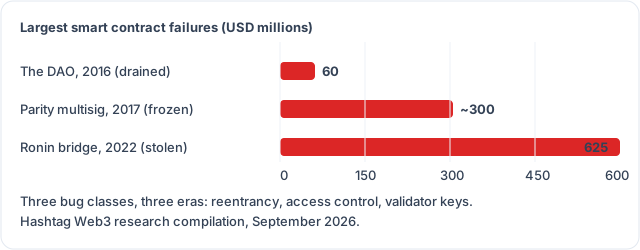
Every major bug class has a billion-dollar exhibit. Learn them in order: $60M in 2016 became $625M by 2022, and the failure moved from contract logic to keys to libraries along the way.
The DAO, June 2016. Recursive-call reentrancy drained 3.6 million ETH, about $60M then, and split Ethereum from Ethereum Classic. Smart Contract Hacking documents the mechanics and date. CoinDesk's contemporaneous report covers the $150M-plus raise with funds locked in a child DAO.
Parity multisig, 2017. Two disasters, one codebase. Parity's post-mortem details the November library self-destruct freezing 513,774.16 ETH across 587 wallets via initWallet. Ars Technica reports the roughly one million ETH frozen figure with Polkadot treasury impact. CNBC covers the accidental-trigger narrative. TechCrunch adds the July theft of 150,000 ETH and the early 600,000 ETH estimate.
Ronin Bridge, March 2022. Validator keys compromised, 173,600 ETH plus $25.5M USDC gone, six days undetected. Smart Contract Hacking gives the amounts. Smartcontractaudit stresses no contract logic was exploited: five-of-nine signatures were simply valid, with Lazarus attribution. Decrypt dates discovery to March 29 with a gas-free RPC backdoor. WalletWitness walks the forensics: $540M at theft versus $625M later, $150M Binance-led reimbursement, $80M-plus through Tornado Cash.
The defenses follow directly. Solidity's security docs mandate checks-effects-interactions and warn against tx.origin for auth. OpenZeppelin's ReentrancyGuard source shows the nonReentrant modifier with its transient-storage successor. API docs add PullPayment and Pausable to the standard kit. post-Istanbul analysis killed the 2300-gas stipend habit in favor of guards and pull payments. OWASP's reentrancy taxonomy covers single, cross-function, cross-contract, and read-only variants. Alchemy's best-practice guide opens with $2.3B in first-half 2025 losses and a proxy and access-control checklist. OnFinality's checklist adds Slither detectors and the msg.sender versus tx.origin rule. For tokens and NFTs you touch, read the standards before the tutorials.
OpenZeppelin's audit flow runs preparation plus automated inspection with about 60% of lows caught by tooling and two researchers per line with fuzzing. Trail of Bits maturity model defines nine control families with fuzzing required from moderate maturity up. Pricing reviews put Trail of Bits near $50k to start with one-to-three-month leads on a Slither, Echidna, and Medusa toolchain. Diligence comparison scopes two to four weeks and $50k to $500k-plus against four to eight weeks and $100k to $1M-plus. NomosLabs' 2026 pricing sets tier-one minimums at $50k to $500k-plus against a $750 single-contract baseline. DevOracles breaks it down further: $5k to $15k per token, $15k to $40k per protocol, $50k to $100k-plus per bridge, tier-one $80k to $200k-plus near $25k per engineer-week.
Build audit-ready habits early. The price bands below explain why prevention beats review: a basic token check costs less than a week of junior salary, while a tier-one bridge review costs more than a senior year. Every finding you catch in development is a five-figure saving.
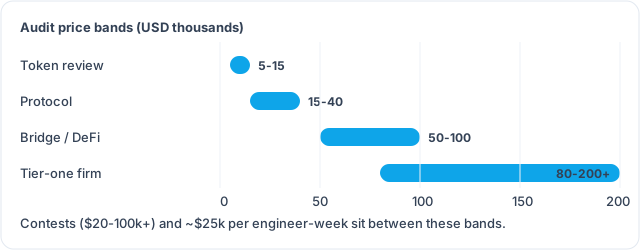 Figure: 2026 review pricing by scope. Data: NomosLabs pricing guide, DevOracles value analysis.
Trail of Bits ' handbook gives the code-maturity and token checklists with Echidna, Medusa, Slither, and Manticore guidance. Crytic's exercise repo pairs not-so-smart contracts with the same toolchain. ConsenSys' recommendations cover untrusted-contract marking, send versus transfer versus call trade-offs, assert versus require, and pragma locking. OpenZeppelin's development docs show the Hardhat plus ethers flow with imports over copy-paste.
Once hired, the highest-paid lane is security review. Auditors clear $250k to $500k with tier-one firms billing near $25k per engineer-week. The path runs through contests, then junior review slots, then firm roles. Expect all-nighters before mainnet freezes and some of the most satisfying debugging of your career.
SpeedRunEthereum's challenge roadmap runs NFT, crowdfunding, token vendor, dice, DEX, lending, stablecoin, and prediction-market builds. Cyfrin Updraft serves 200,000 students across 40 videos from Remix basics through oracles and fallbacks. CryptoZombies remains the classic first tutorial: an in-browser game starting from zero. Cyfrin's blockchain roadmap orders Hardhat plus Foundry with SpeedRun and CryptoZombies exercises. free-course guide documents 200,000 members with 1.5 million lessons on the basics to Foundry path. course roundup adds 96-plus hours on Updraft, 400,000 CryptoZombies users, and SpeedRun on Scaffold-ETH 2. Pick one track and finish it. Half of two courses is worth less than all of one. For choosing a crypto wallet to deploy from, keep it simple: one browser wallet, one hardware wallet later.
How to choose between the big three tracks? CryptoZombies wins on zero setup and game feel, which suits absolute beginners testing interest. SpeedRun wins on shipped artifacts, since every challenge ends deployed with a frontend, which suits portfolio builders directly. Updraft wins on depth and structure with 96-plus hours, which suits learners who want one comprehensive spine instead of many tutorials. free-course guide documents the scale behind each option with member and lesson counts. Whichever you pick, the completion test is the same: can you build the next project without rewatching lessons? If yes, move on. If no, rebuild the last challenge from memory before continuing. Tutorial hell ends the moment you close the video and ship something ungraded.
Months 1 to 2: foundations and first deploys. Finish one interactive course track end to end. CryptoZombies takes most beginners from zero to a working game in weeks. Deploy every tutorial contract to a testnet and keep a log with addresses. Read the EVM reference alongside, one section per week, until storage, memory, and calldata stop blurring together.
Months 3 to 4: toolchain and testing depth. Move everything into Foundry or Hardhat with real test suites. 80-test benchmark data shows which toolchain fits your machine and habits. Add fuzz tests to every project. handler plus ghost-variable pattern from the invariant guides generalizes to nearly any stateful contract. Enter one audit contest on test code to feel real reviewer pressure.
Months 5 to 6: portfolio and applications. Build the five staples with verified sources, gas notes, and demo threads. AMM stablecoin. Apply while doing bounties, following one-to-three-week loop with take-homes and founder chats.
Almost every junior writes these five bugs. Learn to spot each in other people's code and you will stop writing them in your own.
Reentrancy by update-after-call. Any Ether or token transfer before state updates is suspect. DAO's recursive drain is the canonical exhibit. Fix with checks-effects-interactions plus OpenZeppelin's guard.
tx.origin authentication. Phishing contracts forward calls, so authorizing on origin instead of sender hands control to attackers. Solidity's security docs flag this explicitly. Always check msg.sender.
Unbounded loops over user-controlled arrays. Gas limits turn these into denial-of-service vectors. Paginate, pull instead of push, and bound every iteration. OnFinality's checklist treats loop bounds as a pre-deploy gate.
Missing access control on sensitive functions. Mint, pause, upgrade, and withdraw functions without owner or role checks get drained within hours of deployment. Alchemy's best-practice guide lists access control beside proxies as the two most skipped basics.
Stale oracle reads. A spot price with no staleness check or TWAP invites manipulation. RareSkills' project list keeps oracle-fed builds in the curriculum precisely because pricing bugs recur. Read twice, use once.
Cyfrin's portfolio set names them: Chainlink lottery, crowdfunding, Uniswap-style AMM, stablecoin, and DAO. RareSkills adds NFT-for-ERC20 swaps, vesting, crowdfunding, English auctions, marketplaces, lotteries, and blackjack. Scaler's fifteen-tier list runs from vaults, ERC-20s, voting, and escrow through todos, lotteries, and marketplaces to multisigs, DAOs, oracles, upgradeables, and audits. LearnWeb3DAO's DAO tutorial builds proposals, voting, and execution with a fake NFT marketplace on Hardhat and Next.js.
Each project ships four artifacts: deployed contract with verified source, repo with tests, one-page writeup with gas notes, and a demo thread. That format is exactly what hiring screens score: correctness, then security, then testing, then quality, then gas. See building a Web3 portfolio and standing out with your resume.
The loop is short. GM.careers documents one to three weeks: screen, four-to-eight-hour take-home, system design and code review, founder chat. Web3Vacancy's 2026 guide adds the prep list: Solidity majority share, Foundry as standard, two-to-three-week timelines, Ethernaut and Damn Vulnerable practice. CryptoRecruit's 2026 guide centers proof of work over resumes with deployed contracts, Code4rena participation, and EVM, gas, proxy, and DeFi interview topics. Damn Vulnerable DeFi supplies the flash-loan, oracle, governance, NFT, DEX, and lending challenge set worth grinding first.
Pay bands, 2025 to 2026, plotted below from junior to lead with the auditor spike highlighted. The shape tells the career story in one glance: steady growth to senior, then a premium for the two scarce skills, auditing and protocol leadership.
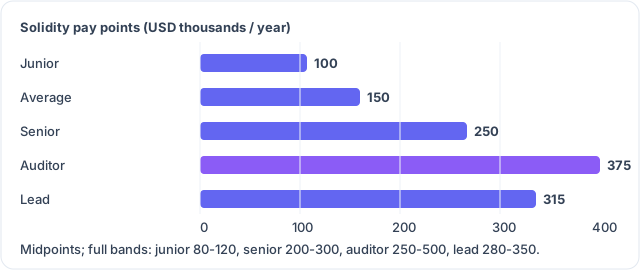 Figure: pay points with full bands in the footnote. Data: web3.career Solidity data, DeFinitive benchmarks, Signal compensation guide.
web3.career averages Solidity at $150k between $65k and $257k. DeFinitive averages $155k for blockchain and $175k for Solidity with juniors at $120k to $150k and seniors at $195k to $250k plus 15 to 40% in tokens. Web3Vacancy's guide medians $165k mid-level with $80k to $120k junior, $200k to $300k senior, and $280k to $350k-plus lead, up 18% year over year. Signal survey confirms the $250k to $500k auditor band. CryptoGrind tables base pay from $90k to $350k with staff at $300k plus $50k to $100k in tokens. Metana ranges $70k to $200k with freelance at $75 to $150 an hour and entry at $70k to $100k.
Code review is where working developers actually learn security, faster than any course. Start by reviewing test code and documentation pull requests, where mistakes cost nothing and maintainers welcome help. Graduate to contest findings on finished audits: read the published report first, then diff your own notes against the winners to calibrate severity judgment. Code4rena-style contests and the audit firm blogs form a continuous curriculum if you treat every report as homework. Trail of Bits publishes its checklists openly, which turns private methodology into public study material. Review weekly, write up monthly, and your public record starts looking like a junior auditor's well before any firm hires you.
Pair reviewing with reading. Pick five canonical codebases and read them line by line with the docs open: an ERC-20, Uniswap v3 core, Aave v3 pool, OpenZeppelin's Ownable plus ReentrancyGuard, and one upgradeable proxy set. OpenZeppelin's API docs annotate the security primitives as you read. The v3 whitepaper rewards careful readers with the concentrated-liquidity math most candidates hand-wave. Aave's developer docs show production-grade pool architecture with real invariants. Keep a bug journal: every suspicious pattern you find, whether real or false alarm, with the reasoning written out. After fifty entries you will read new code the way reviewers do, which is exactly the skill take-home reviews score above all else.
Solidity, unless you already write Rust or target Solana specifically. More jobs, more courses, more auditors read it. Add Rust second for range.
Six to twelve months of steady building for most career switchers: three months of courses and challenges, three months of portfolio projects with tests and audits of your own code, then applications while doing bounties.
Computer science degrees No team in the salary data asks for one. They ask for deployed contracts, test coverage, and security reasoning. A degree helps with theory; shipping helps more.
Practicing security safely Fuzz every project, run Slither, enter Code4rena-style contests on test code, and grind Damn Vulnerable DeFi. contest and challenge circuit is the documented path from learner to auditor-track.
Resume lead section Deployed contract addresses first, then tests and audit notes, then experience. Screening rubrics rank correctness above all, and missing tests read as a reject signal.
No. Postings data keeps Solidity near 78% of developer demand with Rust second, and every alternative toolchain still interoperates with Solidity ABI somewhere in the stack. Learn Solidity deeply, then add the chain-specific language only when targeting that ecosystem for real roles.
Learning Vyper too Only after Solidity pays your bills or a target role demands it. The hour you spend on a second language is an hour not spent on fuzzing, contests, or portfolio depth, and hiring data rewards depth over breadth at every level.
Because audit pricing explains what your security habits are worth. Basic token reviews start near $5k to $15k, protocols run $15k to $40k, bridges $50k to $100k-plus, and tier-one firms charge $80k to $200k-plus. Every finding you prevent in development saves a multiple of your salary in review cycles. Teams know this, which is why take-homes weight security reasoning alongside correctness.
Review weekly, write up monthly, and your public record starts looking like a junior auditor's well before any firm hires you. That record compounds faster than any credential, and it travels with you across every future application. Start the first review this week, while the reading habit is warm. Future employers will ask what you reviewed long before they ask what courses you finished.
Explore more guides and career playbooks