Loading article...

An empirical thesis and comprehensive guide on crafting a high-signal Web3 resume, structuring on-chain proof of work, optimizing GitHub repositories, and navigating automated ATS parsers.
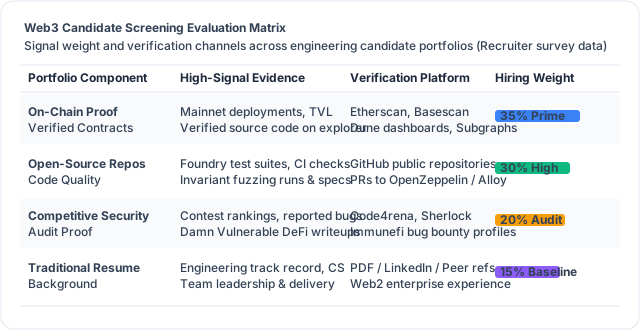
Candidate screening in decentralized technology has fundamentally redefined standard corporate recruitment practices. In conventional enterprise technology, hiring decisions rely on institutional pedigrees: computer science degrees from accredited universities, previous tenures at recognized Fortune 500 corporations, and executive reference calls. In Web3 engineering, hiring managers operate in a permissionless, open-source ecosystem where output is verifiable on public distributed ledgers.
A candidate can claim extensive systems knowledge on a traditional PDF resume. However, a hiring manager at a decentralized finance protocol can verify the candidate's actual competence in ninety seconds by checking deployed smart contracts on Etherscan, examining test suite coverage in a public GitHub repository, or inspecting competitive audit contest rankings on Code4rena.
According to hiring surveys from Web3.career and the Electric Capital Developer Report, technical hiring managers reject over eighty percent of applicants whose resumes contain abstract claims without verifiable on-chain or open-source hyperlinks. A high-signal Web3 resume does not merely list job descriptions; it functions as an indexed directory of public proof of work.
The fundamental purpose of a resume remains unchanged: demonstrating to an employer that you can solve complex technical problems and deliver business value. However, the verification layer in Web3 is radically decentralized:
Hiring managers at protocols such as Uniswap Labs, Aave Governance, and MakerDAO / Sky evaluate candidate profiles under intense time constraints. When reviewing a technical application, the reviewer's cognitive path follows an exact sequence:
Scan Header for Developer Identity: Checking for an active GitHub profile, personal portfolio, or an Ethereum Name Service (ENS) address.
Inspect Public Repositories: Opening GitHub to examine project architecture, test assertions, continuous integration workflows, and commit frequency.
Verify Live Contracts: Clicking block explorer links to verify deployed bytecode on networks like Arbitrum Docs, Base, Optimism, or Polygon Labs.
Assess Adversarial Acumen: Looking for completed wargames, security writeups, or competitive contest rankings.
Review Career History: Reading past professional employment only after technical competence has been established through code.
A professional Web3 resume should be restricted to a single page for candidates with under five years of relevant experience, and no more than two pages for senior engineering leads. The document must maintain clean typography and a single-column layout to ensure compatibility with Applicant Tracking Systems (ATS) like Greenhouse and Lever.
The header establishes that the candidate is an active participant in decentralized networks rather than a casual observer:
Professional Name or Recognized Pseudonym: Pseudonymous contributions are widely respected in Web3, provided they are tied to verifiable code and public repositories.
Target Role Title: Explicitly stated, such as "Senior Smart Contract Engineer (EVM / Foundry)" or "Protocol Systems Engineer (Rust / Solana)."
Contact Coordinates: Professional email, geographic location, and working timezones (e.g., "New York, USA | UTC-5").
Primary Identity Links: Clean markdown hyperlinks to GitHub, LinkedIn, professional portfolio, and an ENS name (such as developer.eth).
Decentralized Social Profiles: Links to technical discussions on Farcaster or Lens Protocol, which highlight technical community engagement.
For early-stage Web3 developers and career switchers, the Projects section must precede work history. Each project entry should feature active hyperlinks and follow the "Action-Context-Result" technical format:
### Liquidity Vault Protocol | Solidity, Foundry, ERC-4626, Slither
- Architected an automated yield-bearing vault implementing the ERC-4626 standard, securing $120,000 in testnet deposits across Arbitrum Sepolia.
- Formulated 45 stateful invariant fuzz tests in Foundry Forge, achieving 98% branch coverage and mathematically verifying solvency accounting under multi-block flash loan conditions.
- Mitigated first-depositor share inflation attacks by incorporating virtual offset math from OpenZeppelin Contracts.
- Verified contract source code on Basescan: [0x4a8f...39c1](https://basescan.org) | Source Repository: [github.com/user/vault-protocol](https://github.com)
Notice the critical inclusion of active explorer links, specific testing frameworks, and exact technical standards.
When detailing past employment, whether at Web3 native protocols or Web2 cloud enterprises, focus on systems architecture, scale, and performance metrics:
Frame Web2 experience around distributed systems, cryptography, microservices concurrency, database indexing, and financial accounting.
Avoid generic responsibility statements like "Wrote smart contracts." Instead, write: "Implemented decentralized oracle fallback mechanics integrating Chainlink and Pyth Network, reducing liquidation slippage by 18%."
Organize technical competencies into functional domains, demonstrating depth across the stack:
Languages: Solidity (0.8.28+), Yul / Inline Assembly, Rust, TypeScript, Python, SQL.
Frameworks and Testing: Foundry (Forge, Cast, Anvil), Hardhat, Anchor Framework, Viem, Wagmi.
Security and Auditing: Slither, Echidna, Halmos, Certora, Cyfrin Updraft.
Core Standards: ERC-20 Specification, ERC-721 Specification, ERC-1155, ERC-4626, ERC-4337 Account Abstraction, EIP-1153 Transient Storage, EIP-712.
Data and Infrastructure: The Graph (Subgraphs), Dune Analytics, DefiLlama, Tenderly, Alchemy, Infura.
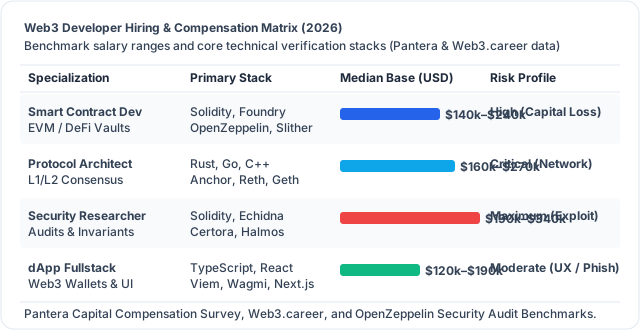 Figure 2: Reference matrix illustrating how technical specializations align with core programming languages, testing frameworks, and compensation brackets.
A hiring manager who likes your resume will immediately inspect your GitHub profile. If your repositories consist solely of un-forked tutorial clones or lack automated test suites, your application will stall.
To pass technical due diligence, ensure your flagship repositories adhere to professional standards:
Exhaustive Documentation: Every project must feature a clean README.md detailing architecture diagrams, deployment addresses, local installation commands, and test execution instructions (forge test -vvvv).
Invariant and Fuzz Testing: Include dedicated test directories containing stateful invariant fuzz suites, demonstrating that you design software defensively.
Automated Continuous Integration (CI): Configure GitHub Actions workflows that automatically compile contracts, run tests, and execute Slither static analysis on every pull request.
Clean Git Hygiene: Commit frequently with standardized semantic commit messages (feat: implement custom error handling, fix: correct rounding direction in shares calculation).
For non-developer professionals entering Web3, demonstrating proof of work is equally critical:
Showcase public analytics dashboards created on Dune Analytics, Flipside Crypto, or Footprint Analytics tracking token velocity, DEX swap volumes, or protocol fee accrual.
Detail experience drafting technical specifications for decentralized autonomous organization governance proposals submitted via Tally Governance or Snapshot.
Quantify community acquisition metrics, distinguishing organic active retention from bot-driven airdrop farming campaigns.
Highlight partnership integrations secured across prominent ecosystems like Compound Finance, Lido Finance, or Curve Finance.
Document participation in on-chain identity systems and attestation registries like the Ethereum Attestation Service (EAS) or Gitcoin Passport.
To assist candidates in structuring their documents for maximum ATS compatibility and recruiter readability, the following verbatim template demonstrates how to present technical credentials, project metrics, and on-chain proofs:
# Alex Morgan
New York, NY | alex.morgan.dev@email.com | UTC-5
GitHub: github.com/alexm-dev | Portfolio: alexmorgan.eth | X: @alexm_eth

## PROFESSIONAL SUMMARY
Senior Smart Contract Engineer with 5+ years of software engineering experience, including 3 years architecting decentralized finance protocols on Ethereum and EVM Layer 2s. Deep expertise in Solidity, Foundry invariant testing, and gas optimization. Proven track record auditing complex vault systems, managing $45M+ in peak mainnet TVL, and competing on Code4rena.

## FLAGSHIP SMART CONTRACT PROJECTS

### YieldOptimizer Vault | Solidity, Foundry, ERC-4626, Slither
- Architected an automated yield vault implementing the ERC-4626 tokenized standard, managing $12M in testnet liquidity across Arbitrum Sepolia.
- Designed 50+ stateful invariant fuzz suites in Foundry Forge, verifying mathematical solvency across multi-block liquidation sequences with 99% branch coverage.
- Mitigated first-depositor share inflation attacks by incorporating virtual offset math from OpenZeppelin Contracts.
- Contract Address: [0x71C...89B1](https://basescan.org) | Repository: [github.com/alexm-dev/yield-vault](https://github.com)

### Liquidity Management Hook | Solidity, Uniswap v4, Yul
- Developed an automated dynamic fee hook for Uniswap v4 pools that adjusts swap fees dynamically based on pool volatility calculated via geometric TWAP.
- Optimized storage layout using inline Yul assembly, reducing swap overhead by 18% compared to standard AMM pool logic.
- Repository: [github.com/alexm-dev/v4-volatility-hook](https://github.com)

## PROFESSIONAL EXPERIENCE

### Senior Blockchain Engineer | Decentralized Credit Protocol (Remote) | 2023 - Present
- Led core smart contract development for a decentralized lending protocol securing $45M in total value locked across Ethereum and Base.
- Implemented dual oracle price feeds integrating Chainlink Data Feeds and Pyth Network with automated circuit breakers, eliminating single-block price manipulation risks.
- Coordinated external security audits with Trail of Bits and Spearbit, resolving 4 High and 8 Medium severity findings prior to mainnet launch.
- Refactored protocol reentrancy guards to utilize EIP-1153 transient storage, reducing protocol-wide transaction gas consumption by 14%.

### Full-Stack Software Engineer | Enterprise Cloud Analytics | 2020 - 2023
- Engineered high-throughput financial transaction processing microservices in TypeScript and Go, handling 15,000 requests per second with sub-50ms latency.
- Implemented automated CI/CD deployment pipelines using GitHub Actions and Docker, reducing release cycle friction by 35%.

## TECHNICAL SKILLS
- Languages: Solidity (0.8.28+), Yul / Assembly, TypeScript, Rust, Python, SQL
- Frameworks & Tooling: Foundry (Forge, Cast, Anvil), Hardhat, Viem, Wagmi, Ethers.js
- Security & Testing: Slither, Echidna, Halmos, Certora, Wargames (Ethernaut, Damn Vulnerable DeFi)
- Standards & Protocols: ERC-20, ERC-721, ERC-1155, ERC-4626, ERC-4337, EIP-1153, EIP-712
- Indexing & Infrastructure: The Graph (Subgraphs), Dune Analytics, Tenderly, Alchemy, Safe

## SECURITY COMPETITIONS & EDUCATION
- Code4rena: Ranked Top 50 in 3 competitive audit contests, reporting 2 High and 5 Medium findings
- B.S. in Computer Science | State University | Graduated Magna Cum Laude
Submitting a resume through standard job board portals is often the slowest route to securing interviews. In Web3, protocol teams operate openly in public Discord servers, Telegram groups, and GitHub repositories.
A candidate who pairs a high-signal resume with direct proof of work achieves an order-of-magnitude higher interview conversion rate:
Before reaching out to a protocol founder or engineering lead, identify their open-source repository on GitHub. Review their issue tracker, documentation, or test suites:
Identify a Genuine Improvement: Look for incomplete test coverage in a Foundry suite, an unindexed event in a smart contract, or outdated documentation.
Submit a Pristine Pull Request: Write clean code, add comprehensive tests, follow their contributing guidelines, and submit a pull request with an explanatory message.
Reach Out to the Engineering Lead: Send a direct message on Farcaster, X, or Telegram referencing the pull request:
"Hey [Lead Developer], I've been studying your liquidity vault contracts and noticed an edge case in your withdrawal accounting tests. I submitted a PR with a Foundry fuzz test demonstrating the fix ([PR #42]). I'm a senior Solidity engineer specializing in invariant testing and would love to explore open engineering roles on your team. Here is my resume and portfolio: [Link]."
This approach immediately establishes that you can read their codebase, write production-grade code, and contribute value without requiring hand-holding. In a talent market characterized by thousands of generic applications, proactive proof of work is the ultimate competitive differentiator.
A unique aspect of Web3 recruitment is the prevalence of pseudonymous engineers. Candidates often build public reputations and author open-source protocols under a cryptographic pseudonym or avatar.
When applying to protocol teams, candidates can submit their resume and portfolio entirely under their pseudonym. Hiring managers and founders regularly interview and evaluate pseudonymous contributors based strictly on GitHub code quality and technical interview performance.
However, once an offer is extended, legal and compliance realities apply. If the candidate is hired as an employee or B2B contractor through platforms like Deel or Remote, the payroll provider requires Know-Your-Customer (KYC) identity verification for tax and legal compliance. Most protocols establish strict internal confidentiality boundaries: only the HR/legal team accesses the candidate's legal identity, while daily engineering collaboration continues under their public pseudonym.
Different categories of Web3 organizations evaluate technical candidates through distinct hiring criteria:
Startups funded by venture firms like a16z crypto or Paradigm prioritize product velocity, full-stack competency, and rapid feature execution. Their resumes should highlight frontend integration with Viem and Wagmi, efficient state handling, and previous experience managing production cloud infrastructure or microservices alongside smart contracts.
Decentralized autonomous organizations and foundations (such as the Ethereum Foundation, Arbitrum Foundation, or Optimism) look for open-source governance alignment and public community stewardship. Highlight forum proposals on Snapshot or Discourse, public grant milestones through Gitcoin, and transparent code documentation.
Elite security auditors such as Trail of Bits, Spearbit, and Consensys Diligence have the highest technical barrier to entry. For these roles, emphasize competitive audit contest rankings on Code4rena and Sherlock, static analysis tooling mastery, formal verification proofs in Certora, and write-ups of complex economic exploit mechanics.
Technical recruiters and protocol founders frequently identify recurring red flags that disqualify candidates:
Unverified Hyperlinks: Including dead links, private GitHub repositories, or contract addresses that do not exist on public block explorers like Etherscan or Solana Explorer.
Tutorial Clones without Modification: Submitting unchanged code from popular YouTube tutorials or standard boilerplate repos. Reviewers easily recognize standard tutorial codebases.
Outdated Security Practices: Listing deprecated patterns on a resume, such as using SafeMath with Solidity 0.8+ or relying on string-based require() statements instead of modern custom errors.
Abstract Jargon without Quantifiable Impact: Writing broad claims like "Crypto enthusiast with deep Web3 passion" without providing concrete technical accomplishments.
Excessive Layout Formatting: Using multi-column tables, graphics, or nested text boxes that break automated parsing in corporate Applicant Tracking Systems (ATS).
If you have never held an official job title in Web3, you can establish an authoritative portfolio in four to eight weeks by producing public artifacts:
Solve Security Wargames: Complete all levels of Ethernaut by OpenZeppelin and Damn Vulnerable DeFi, publishing fully tested Foundry exploit scripts on GitHub.
Participate in Competitive Audit Contests: Submit findings in public contests on Code4rena or Sherlock. Even securing a Low or Medium severity finding on a contest leaderboard provides verifiable proof of technical competence.
Build a Niche Utility: Develop and deploy a practical smart contract application, such as a multi-sig timelock distributor, a custom Uniswap v4 hook, or a subgraph indexing lending liquidations.
Contribute to Open-Source Libraries: Submit documentation improvements, bug fixes, or test additions to recognized open-source repositories like OpenZeppelin Contracts, Alloy, or Viem.
By replacing abstract claims with verifiable public artifacts, structuring projects around modern native toolchains, and demonstrating defensive engineering discipline, candidates can construct a compelling Web3 resume that stands out to premier hiring teams across the global decentralized ecosystem.
Explore more guides and career playbooks