Loading article...

A technical guide for founders and engineering leads: screening smart contract habits, salary bands, take-home audit tests, token compensation, and infiltration defenses.
Hiring an engineer in crypto carries existential risk that enterprise software recruiting never encounters. In traditional software development, an uncaught regression can be patched with an emergency continuous deployment commit within thirty minutes of discovery. In decentralized protocols, immutable smart contracts execute on public blockchains where any transaction is irreversible. If an engineer deploys code containing a reentrancy vulnerability, storage collision, or logic flaw, an anonymous attacker can execute a flash loan exploit and drain total value locked within a single transaction block.
Data compiled by Chainalysis crypto crime report and Immunefi Web3 bug bounty report shows that over $2 billion in decentralized assets is lost annually to smart contract exploits, with over 65% of compromises tracing back to access control bugs and faulty business logic. Sourcing, screening, and closing world-class Web3 engineers requires mastering five rigorous disciplines: defining specialization requirements across the blockchain stack, evaluating security-first coding habits, securing the interview loop against nation-state infiltration, benchmarking compensation across liquid salary and token vesting, and operating compliant cross-border payroll.
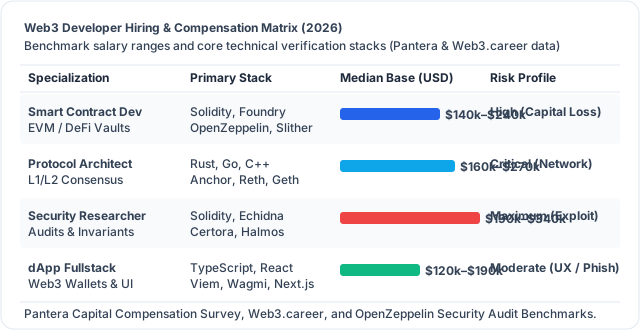
Recruiting failures often begin with poorly scoped job descriptions that request an engineer who can simultaneously develop smart contracts, build consensus mechanisms, and design React frontends. Web3 engineering divides into four distinct specializations with divergent verification toolchains:
Smart contract developers focus on application-layer business logic. On EVM-compatible blockchains (Ethereum, Arbitrum, Base, Optimism, Polygon), engineers write in Solidity 0.8.x using testing frameworks like Foundry testing framework documentation and Hardhat development environment. On alternative Layer 1 ecosystems like Solana or NEAR, engineers build in the Rust programming language documentation utilizing the Solana Anchor framework. Smart contract engineers must understand token standards, automated market maker mathematics, upgradeable proxy storage mechanics, and gas optimization.
Protocol and systems architects operate below the contract layer. These engineers build peer-to-peer networking layers, consensus engines, rollup sequencers, and execution clients. They program primarily in Go, Rust, or C++, optimizing low-level memory layout, state trie performance, and data availability interfaces.
Security researchers and formal verification engineers evaluate protocol code before mainnet deployment. They utilize static analyzers, property-based fuzzers, and mathematical provers to verify that protocol invariants hold under all possible execution states.
Web3 fullstack engineers build user-facing decentralized applications. They develop in TypeScript and Next.js, integrating Web3 connection libraries (viem, wagmi, ethers.js) and transaction simulation engines like Tenderly transaction simulation platform to provide gas estimation, wallet connection, and error handling for end users.
Founders must tailor candidate searches to their target blockchain ecosystem. Electric Capital developer report and Electric Capital crypto developer taxonomy note that while EVM developers represent the largest talent pool, Rust adoption has expanded rapidly, creating intense competition for experienced Solana and multichain systems engineers.
Evaluating a Web3 engineer requires assessing defensive habits rather than syntax recall. Senior hiring managers screen for systematic defenses against common exploit vectors cataloged in the OWASP Smart Contract Top 10.
Screening focuses on four core competencies:
First, understanding the checks-effects-interactions pattern and reentrancy defenses. When a contract interacts with external untrusted addresses, it must update internal state balances before making the external call. Candidates must explain why relying on reentrancy guards alone without proper state updating leaves contracts vulnerable to cross-function or cross-contract reentrancy.
Second, invariant testing and fuzzing depth. Basic unit tests verify predictable code paths with predetermined inputs. In decentralized finance, exploits occur when malicious users supply unexpected parameter combinations or execute multiple transactions within a single block. Candidates should demonstrate experience with property-based testing tools such as Foundry invariant tests, Echidna property-based fuzzer by Trail of Bits, or formal verification tools like Certora formal verification platform and Halmos formal verification for EVM.
Third, static analysis and compiler optimization awareness. Proficient Solidity engineers regularly run automated static analyzers like Slither static analyzer by Trail of Bits to catch uninitialized storage pointers, reentrancy vulnerabilities, and dangerous strict equality checks. They avoid dangerous practices such as using tx.origin for authorization or relying on block timestamps for randomness.
Fourth, upgradeable proxy storage layout comprehension. If a protocol plans to deploy upgradeable contracts, the candidate must demonstrate complete mastery of delegatecall storage layouts. Inserting a new state variable ahead of existing variables in an implementation contract causes catastrophic storage collisions, overwriting critical protocol balances. Candidates should know how to utilize storage gap arrays in audited libraries like OpenZeppelin contract libraries.
Audit and bounty leaderboard performance provides definitive proof of ability. Hiring managers benchmark candidate competence by examining verified vulnerability submissions on Code4rena competitive auditing platform, Sherlock smart contract coverage protocol, and Cantina security review network. An engineer ranked in the top tier of competitive auditing platforms has proven their ability to uncover complex logic vulnerabilities under production constraints.
Hiring remote engineering talent introduces severe nation-state security threats. Sophisticated cyber adversaries systematically target cryptocurrency startups to place fraudulent operatives inside core engineering teams. Once hired, these operatives exfiltrate private keys, divert treasury transactions, or commit malicious repository backdoors.
Federal investigations published in the US Department of Justice DPRK IT sanctions alert and FBI Internet Crime Complaint Center advisory on remote workers document widespread operations where fraudulent workers use stolen identities, AI-manipulated photographs, and North American proxy laptop farms to pass remote interviews. The forensic investigation in the KnowBe4 incident report on fake remote IT hire revealed that an operative attempted to load infostealer malware within minutes of receiving access credentials.
Threat analyses from CrowdStrike threat analysis on Lazarus IT workers and Mandiant investigation into DPRK remote workers confirm that fraudulent candidates frequently conduct video interviews with synthetic deepfake audio or video overlays.
Recruiting workflows themselves serve as an active attack vector. Reports from Check Point Research on trojanized job offers and Bitdefender Labs report on BeaverTail infostealers disclose that threat actors pose as candidates submitting coding test repositories packed with malicious Node.js build scripts. When a hiring manager clones the repository and runs npm install, scripts execute in the background to scrape browser passwords, Discord session tokens, and local wallet private keys.
Hiring teams enforce strict operational countermeasures adhering to OWASP Web3 Operational Security Guide and Security Alliance SEAL 911 incident network:
Compensation in Web3 balances liquid cash or stablecoins against long-term token upside. Data from Pantera Capital blockchain compensation survey, Web3.career developer salary database, CoinDesk crypto compensation trends, and Blockworks crypto salary index outlines current market benchmarks:
Base salaries for smart contract engineers range between $140,000 and $240,000 for mid-level contributors, and $190,000 to $310,000 for senior protocol architects. Security researchers and formal verification specialists command base compensation exceeding $300,000 to $350,000 due to severe market scarcity.
Base salaries are predominantly disbursed in USD-pegged stablecoins (USDC or USDT) or liquid fiat currency. Stablecoins provide predictability for living expenses without exposing contributors to market volatility.
Token equity grants represent the primary financial upside. Standard institutional token distribution guidelines from Variant Fund token distribution design and Dragonfly Capital Web3 compensation survey establish that protocols allocate 15% to 20% of total fully diluted token supply to the employee and contributor pool. Founding engineers typically receive 1.0% to 2.5% of total supply, while early senior engineers receive 0.25% to 0.75%.
Token awards require careful structural execution:
Because Web3 developer talent is distributed across more than 70 countries, operating compliant international payroll is an essential operational capability. Relying on centralized manual wires creates administrative delays and currency conversion penalties.
Modern protocols deploy hybrid payroll rails:
Standard algorithmic coding assessments evaluate general software engineering trivia rather than protocol engineering judgment. To evaluate how candidates handle real-world blockchain constraints, high-performing engineering teams design take-home assessments that simulate live production conditions.
Two evaluation formats yield the highest predictive validity:
Format one is an audit and vulnerability report. The candidate receives a self-contained 250-line Solidity contract implementing an automated market maker pool, lending vault, or staking rewards contract. The contract contains four intentional vulnerabilities: a reentrancy vector, an unindexed storage slot collision, an arithmetic rounding error that favors arbitrageurs, and an unchecked external call return value. The candidate is asked to submit a structured finding report classifying severity according to CVSS standards, detailing the attack vector, and providing Foundry test cases proving the exploit and subsequent remediation.
Format two is a gas optimization challenge. The candidate is given a functionally correct contract that executes an airdrop distribution, token vesting claim, or multi-asset swap. The candidate must refactor the contract to minimize gas consumption while maintaining 100% test suite pass rates. High-caliber candidates demonstrate mastery of low-level EVM execution: replacing storage reads with memory or calldata pointers, packing multiple uint128 variables into single 32-byte storage slots, utilizing unchecked arithmetic blocks where overflow is mathematically impossible, and optimizing loop iterations.
Teams must cap take-home assessments at three to four hours and pay candidates a stipend in USDC ($300 to $500). Paying candidates signals organizational respect and increases completion rates among senior engineers who hold competing offers.
Beyond basic smart contract syntax, production protocol development frequently interfaces with off-chain cryptographic primitives. A smart contract developer who misunderstands signature validation or oracle update latency introduces severe economic vulnerabilities.
Hiring leads screen for three advanced technical competencies:
First, signature verification and replay defense. Candidates must explain the mechanics of ECDSA signature verification (ecrecover), signature malleability risks, and why protocols mandate EIP-712 typed structured data signing. They should know how to implement nonce tracking and chain ID validation to prevent cross-chain or replay attacks.
Second, Merkle tree distribution architectures. When distributing airdrops, whitelist allowances, or reward claims to tens of thousands of addresses, storing user lists directly in smart contract storage costs thousands of dollars in gas. Candidates should explain how to generate off-chain Merkle trees, publish a single 32-byte Merkle root on-chain, and verify cryptographic inclusion proofs with logarithmic gas complexity.
Third, decentralized oracle mechanics and staleness checks. Contracts that query external price feeds must handle oracle downtime, sequencer outages on Layer 2 rollups, and extreme price volatility. Candidates must know how to inspect oracle round timestamps, verify minimum return values to defend against zero-price crashes, and implement multi-oracle fallback mechanisms.
Hiring a Web3 developer requires combining rigorous technical evaluation with institutional operational discipline. Founders who verify on-chain proof of work, screen for defensive coding habits, protect their recruitment pipelines, and structure transparent compensation build the resilient engineering teams that power decentralized protocols.
Explore more guides and career playbooks