Loading article...

An in-depth guide to Web3 jobs in Indonesia, examining Jakarta enterprise exchanges, Bali crypto nomad hubs, regulatory shifts under OJK, salary benchmarks, and mobile-first engineering careers.

Indonesia has established itself as an indispensable powerhouse in Southeast Asia's rapidly expanding Web3 economy. Home to over 275 million people - with more than 50% under the age of 30 - the archipelago nation combines a mobile-first digital population with extraordinary cryptocurrency adoption rates. Consistently ranking among the top global markets in Chainalysis crypto adoption indexes, Indonesia represents a fertile ecosystem where centralized exchanges, decentralized finance protocols, Web3 gaming guilds, and infrastructure providers compete for specialized engineering, product, and growth talent.
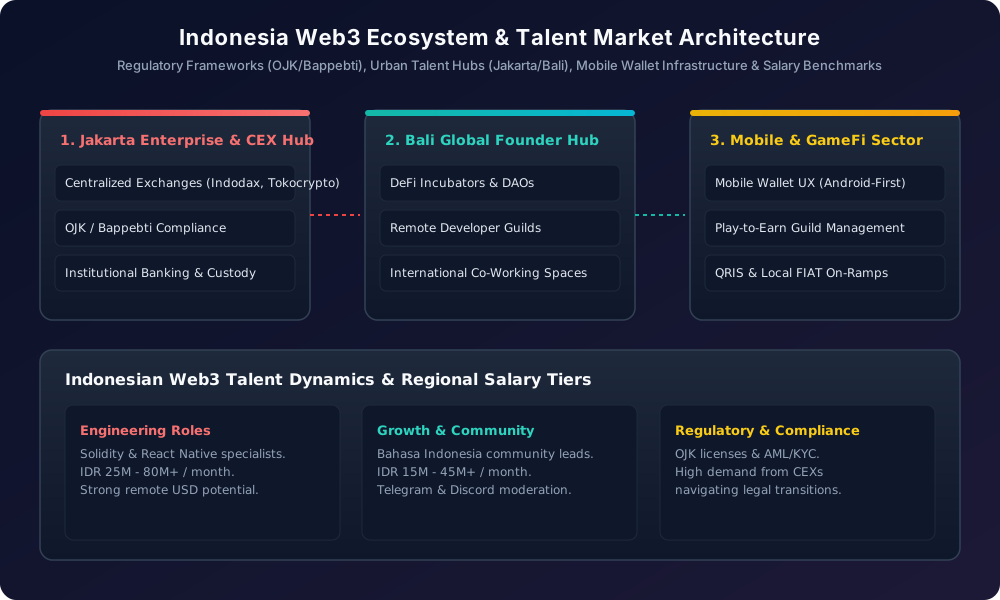
The Indonesian Web3 employment landscape exhibits unique regional characteristics. While Jakarta serves as the commercial, regulatory, and corporate exchange headquarters, Bali has transformed into a premier global hub for crypto nomads, protocol founders, and remote developer DAOs.
Several structural factors accelerate Indonesia's transition toward decentralized finance and Web3 applications.
Despite rapid economic growth, tens of millions of Indonesian adults lack access to traditional banking services. Mobile non-custodial crypto wallets and decentralized lending protocols offer direct financial inclusion without requiring physical bank branch infrastructure.
The regulatory environment in Indonesia is undergoing a major structural transition. Traditionally supervised by Bappebti (the Commodity Futures Trading Regulatory Agency) as crypto commodities, regulatory oversight for digital financial assets is shifting to the OJK (Financial Services Authority).
Navigating the Web3 job market in Indonesia requires understanding the distinct functional divisions between its major urban centers.
As the nation's political and financial capital, Jakarta hosts corporate offices for licensed crypto exchanges, institutional custody providers, and corporate venture funds. Engineering and operational roles in Jakarta emphasize:
Bali - particularly the Canggu, Ubud, and Seminyak corridors - has evolved into one of the world's most dynamic crypto nomad destinations. Web3 professionals in Bali frequently work for international protocols based in Singapore, Europe, or North America, earning USD-denominated salaries while residing locally.
Key activities in Bali include:
Salaries in Indonesia's domestic Web3 sector comfortably exceed traditional tech averages in Jakarta and Surabaya. However, candidates working remotely for international protocols often earn global benchmark rates paid in stablecoins ($USDC, $USDT) or fiat.
Below are baseline compensation ranges for domestic Indonesian companies (values expressed in Indonesian Rupiah / IDR per month):
| Technical / Operational Role | Mid-Level Salary (IDR / Month) | Senior Salary (IDR / Month) | Remote Global Equivalent (USD / Year) |
|---|---|---|---|
| Smart Contract Developer (Solidity) | 25,000,000 - 45,000,000 | 45,000,000 - 85,000,000+ | $60,000 - $140,000 |
| Mobile Engineer (React Native / Flutter / Android) | 20,000,000 - 38,000,000 | 38,000,000 - 70,000,000+ | $50,000 - $110,000 |
| Backend Engineer (Go / Rust) | 22,000,000 - 40,000,000 | 40,000,000 - 75,000,000+ | $55,000 - $120,000 |
| Community Manager (Bahasa Indonesia & English) | 15,000,000 - 30,000,000 | 30,000,000 - 50,000,000+ | $30,000 - $70,000 |
| Growth & Marketing Lead | 20,000,000 - 42,000,000 | 42,000,000 - 80,000,000+ | $45,000 - $95,000 |
| Regulatory & Compliance Officer | 25,000,000 - 48,000,000 | 48,000,000 - 90,000,000+ | $40,000 - $85,000 |
Note: 10,000,000 IDR is approximately $630 - $650 USD depending on prevailing exchange rates.
To secure high-paying engineering or product roles in the Indonesian Web3 ecosystem, candidates must master specialized technical domains.
Over 85% of crypto transactions in Indonesia occur via mobile devices. Companies prioritize software engineers proficient in:
ethers.js, viem, and WalletConnect v2 protocols within native mobile environments.Local exchanges and DeFi projects actively recruit Solidity developers capable of building custom tokenomic contracts, staking pools, and NFT marketplaces:
// SPDX-License-Identifier: MIT
pragma solidity ^0.8.20;

import "@openzeppelin/contracts/token/ERC20/ERC20.sol";
import "@openzeppelin/contracts/access/Ownable.sol";

contract IndonesianRupiahStablecoin is ERC20, Ownable {
    mapping(address => bool) public blacklistedAddresses;

    event AddressBlacklisted(address indexed account);
    event AddressUnblacklisted(address indexed account);

    constructor(address initialOwner)
        ERC20("Indonesian Digital Rupiah", "IDRT")
        Ownable(initialOwner)
    {}

    function mint(address to, uint256 amount) external onlyOwner {
        require(!blacklistedAddresses[to], "IDRT: Address is blacklisted");
        _mint(to, amount);
    }

    function setBlacklistStatus(address account, bool status) external onlyOwner {
        blacklistedAddresses[account] = status;
        if (status) {
            emit AddressBlacklisted(account);
        } else {
            emit AddressUnblacklisted(account);
        }
    }

    function _update(address from, address to, uint256 value) internal override {
        require(!blacklistedAddresses[from], "IDRT: Sender blacklisted");
        require(!blacklistedAddresses[to], "IDRT: Recipient blacklisted");
        super._update(from, to, value);
    }
}
Non-technical roles require deep cultural context. Indonesian crypto users heavily rely on Telegram channels, Discord servers, X (Twitter), and TikTok for news and alpha discovery. Community managers must:
Navigating tax obligations is a critical aspect of working in Indonesia's crypto sector. The Indonesian Ministry of Finance enforces a dual tax structure on crypto asset transactions (PMK 68/PMK.03/2022).
For local Indonesian professionals receiving remote salaries in stablecoins ($USDC, $USDT) or native protocol tokens ($ETH, $SOL):
A major area of hiring for Indonesian fintech and Web3 companies is integrating traditional instant payment rails with blockchain smart contracts.
Indonesia's universal QR payment standard, QRIS, connects major digital e-wallets (GoPay, OVO, Dana, ShopeePay) and banking apps. Web3 startups engineer backend bridges allowing users to top up crypto wallet balances or purchase digital collectibles instantly using QRIS codes.
// Go implementation pattern for QRIS Payment Gateway Callback
package main

import (
	"crypto/hmac"
	"crypto/sha256"
	"encoding/hex"
	"encoding/json"
	"fmt"
	"net/http"
)

type QRISCallbackPayload struct {
	TransactionID string  `json:"transaction_id"`
	UserWallet    string  `json:"user_wallet"`
	AmountIDR     float64 `json:"amount_idr"`
	Signature     string  `json:"signature"`
}

func VerifyQRISCallback(secretKey string, payload QRISCallbackPayload) bool {
	data := fmt.Sprintf("%s|%s|%.2f", payload.TransactionID, payload.UserWallet, payload.AmountIDR)
	h := hmac.New(sha256.New, []byte(secretKey))
	h.Write([]byte(data))
	expectedSignature := hex.EncodeToString(h.Sum(nil))
	return hmac.Equal([]byte(expectedSignature), []byte(payload.Signature))
}

func CallbackHandler(w http.ResponseWriter, r *http.Request) {
	var payload QRISCallbackPayload
	if err := json.NewDecoder(r.Body).Decode(&payload); err != nil {
		http.Error(w, "Invalid payload", http.StatusBadRequest)
		return
	}

	if !VerifyQRISCallback("my_secret_api_key", payload) {
		http.Error(w, "Invalid signature", http.StatusUnauthorized)
		return
	}

	// Trigger smart contract mint / release off-chain
	fmt.Printf("Payment verified for wallet %s: IDR %.2f\n", payload.UserWallet, payload.AmountIDR)
	w.WriteHeader(http.StatusOK)
}
Whether you are a local Indonesian software developer transitioning from traditional tech (e.g., Gojek, Tokopedia, Traveloka) or an international candidate seeking a remote or Bali-based placement, follow this structured action plan:
[ Step 1: Open Source & Portfolio Construction ]
                      |
                      v
[ Step 2: Active Participation in Local Guilds ]
                      |
                      v
[ Step 3: Hackathon Submissions (ETHBali / Jakarta Devcon) ]
                      |
                      v
[ Step 4: Direct Application & Remote Networking ]
Traditional resume PDFs carry less weight in Web3 than verified code repositories and on-chain activity:
Attend regional Web3 events such as ETHBali, Coinfest Asia, and local Ethereum Jakarta developer meetups. Hackathons provide direct access to protocol founders, VC talent scouts, and engineering leads looking to hire proven builders on the spot.
While Bahasa Indonesia is critical for local exchange roles, international remote jobs require fluent written and spoken English. Proficiency with asynchronous collaboration tools (GitHub, Notion, Discord, Linear) is essential for securing USD-denominated remote positions while living in Indonesia.
Avoid relying solely on traditional legacy job boards. Utilize specialized Web3 job platforms, join regional Web3 developer Discord servers, and network directly with founders on X (Twitter) and LinkedIn.
When interviewing with local crypto exchanges or remote Web3 startups operating in Indonesia:
To understand real-world engineering and product opportunities in Indonesia, examine three defining platform case studies:
Founded in Jakarta, Tokocrypto established itself as the first registered crypto exchange under Bappebti. Following its acquisition by Binance, Tokocrypto launched the Tokocrypto Token ($TKO), integrating exchange trading fee discounts, DeFi yield farming pools, and offline shopping incentives. Building and maintaining Tokocrypto's infrastructure required scaling backend microservices to handle millions of registered users while maintaining sub-second order book matching during market volatility.
As one of Southeast Asia's oldest crypto exchanges, Indodax pioneered early IDR fiat liquidity pairs. Its engineering team built custom bank API integrations across major Indonesian financial institutions (Bank Mandiri, BCA, BRI, BNI), managing instant fiat deposit and withdrawal pipelines. Indodax provides continuous career opportunities for backend engineers skilled in Java, Go, and high-availability database replication.
During the peak of Web3 gaming adoption, Indonesian gaming guilds (such as Yield Guild Games SEA / YGG SEA) mobilized thousands of local players across Axie Infinity, Pegaxy, and Pixels. Guild managers developed custom dashboards to track NFT asset delegation, scholar performance metrics, and automated daily payout distributions in stablecoins. This created a new category of Web3 operations, data analytics, and community management jobs across the country.
For job seekers and hiring managers evaluating opportunities in Indonesia:
Beyond the major financial capitals of Jakarta and Bali, Indonesia's software engineering talent is distributed across key university hubs on Java island:
Building Web3 applications for users in Southeast Asia requires addressing network latency challenges. Web3 engineering teams deploy local RPC node relays, WebSocket servers, and CDN caches across Jakarta data centers (such as Biznet, Telkom Indonesia, and AWS jakarta region ap-southeast-3). Operating localized RPC infrastructure reduces transaction broadcast latency from 300ms (routing through Tokyo or Singapore) down to under 30ms, ensuring snappy mobile wallet interactions.
Indonesia's combination of favorable demographics, high crypto adoption, regulatory clarity, and dynamic developer communities positions it as a major growth engine for Web3 careers across Asia-Pacific.