Loading article...

Complete guide to Web3 jobs in Bangalore, salary benchmarks across engineering and protocol roles, top crypto companies, and hiring hubs in 2026.
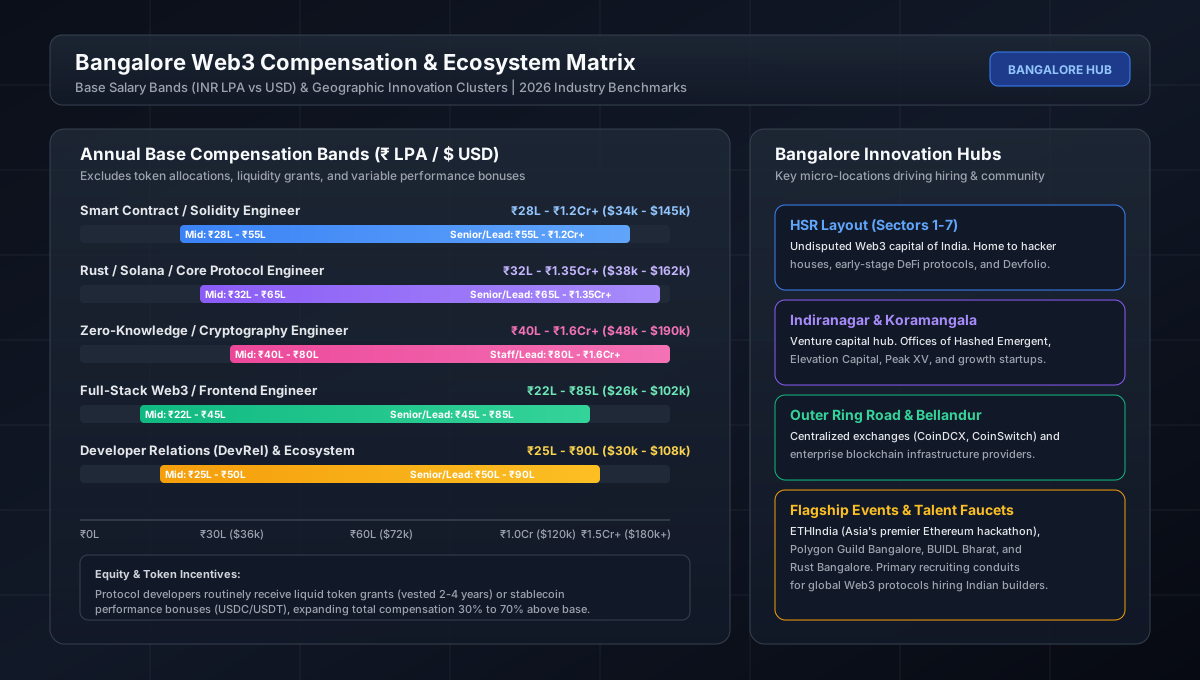
Bangalore stands as the undisputed technology and engineering capital of India, and over the past decade, it has evolved into one of the most critical epicenters for global blockchain engineering and Web3 innovation. Known colloquially as the Silicon Valley of India, Bangalore combines an extraordinary density of distributed systems talent, an active venture capital ecosystem, and a grassroots developer community that routinely wins global hackathons.
The emergence of India on the international Web3 stage is anchored directly in Bangalore. This is the city that produced the foundational engineering leadership of Polygon, transformed decentralized notifications with Push Protocol, pioneered account abstraction and cross-chain execution with Biconomy, and built high-performance decentralized asset management with Instadapp.
For software engineers, protocol architects, cryptography researchers, and growth leads seeking high-impact careers in the decentralized digital economy, Bangalore offers a dynamic job market where compensation packages compete favorably with global standards while offering unique localized operational advantages.
Understanding the Web3 job landscape in Bangalore requires examining the confluence of engineering history, demographic scale, and decentralized protocol adoption across the Indian subcontinent.
For more than thirty years, Bangalore served as the offshore research and development backbone for global Fortune 500 technology conglomerates, enterprise software leaders, and semiconductor design firms. Institutions such as the Indian Institute of Science (IISc) Bangalore, International Institute of Information Technology Bangalore (IIIT-B), and top regional engineering colleges have continuously generated thousands of computer science graduates with rigorous foundations in algorithms, distributed systems, operating systems, and cryptography.
As traditional IT services reached maturity, an ambitious cohort of Indian software engineers transitioned into venture-backed product startups during the consumer internet boom led by Flipkart, Swiggy, and Ola. When decentralized finance and smart contract platforms gained global traction, these seasoned systems architects were uniquely positioned to tackle complex protocol engineering challenges:
Unlike many regional technology markets that merely consume applications built elsewhere, Bangalore functions as an origin hub for foundational Web3 protocols:
Compensation in the Bangalore Web3 job market is bifurcated between local Indian Rupee (INR) base salaries and globally indexed compensation structures incorporating US Dollar-pegged stablecoins (USDC/USDT), equity stock options, and liquid token incentive grants.
Top Web3 engineers in Bangalore frequently earn cash compensation that is two to three times higher than equivalent roles in conventional domestic IT services firms, with total compensation for senior protocol architects rivaling mid-tier Western European rates.
Beyond annual base salaries, hiring contracts in the Bangalore Web3 market incorporate specific incentive mechanisms:
Token Grant Allocations: Token options or direct token grants represent a substantial portion of total upside. These grants typically follow a four-year vesting schedule with a one-year cliff. For early-stage protocols, token allocations can range from 0.25% to 2.0% of total token supply for senior technical hires.
Stablecoin Denomination and Global Contracts: Many Bangalore developers work as remote contributors or independent consultants for international foundations registered in jurisdictions such as Switzerland, Singapore, or the Cayman Islands. These contributors are frequently paid directly in USDC or USDT through platforms like Rise or Deel, shielding them from local fiat currency volatility.
Performance Bounties and Bug Bounties: Security auditors and smart contract engineers based in Bangalore actively supplement their income by participating in competitive audit contests on Code4rena, Sherlock, and Immunefi, where top local researchers regularly secure payouts ranging from $5,000 to over $100,000 per vulnerability finding.
Employers in Bangalore evaluate technical candidates through rigorous practical assessments rather than theoretical whiteboard quizzes. The core functional responsibilities and technical expectations for primary roles include:
Smart contract engineers build decentralized financial primitives, automated market makers, lending markets, and governance protocols. In Bangalore, demand is highest for engineers who possess deep understanding of the EVM execution model rather than those who simply write basic token contracts.
As non-EVM ecosystems have matured, Bangalore has experienced a surge in hiring for systems engineers proficient in Rust. These developers build consensus clients, rollups, and high-throughput decentralized applications on architectures like Solana and Cosmos.
Zero-knowledge cryptography represents the fastest-growing and highest-compensated technical discipline in the Bangalore market. With Polygon investing heavily in ZK-rollups (such as Polygon zkEVM) and research labs establishing local centers, demand for circuit developers far outstrips supply.
Full-stack engineers bridge decentralized smart contracts with end-user interfaces. These developers must be adept at handling asynchronous blockchain state, wallet connection flows, and indexing layers.
Bangalore is a sprawling metropolitan center where specific neighborhoods have evolved into specialized clusters for tech innovation, networking, and hacker culture.
HSR Layout, particularly Sectors 1 through 5, is widely recognized by founders and investors as the primary physical hub for Web3 in India. The neighborhood features a dense concentration of startup villas converted into co-working spaces and hacker houses where engineering teams live and build together.
Walking through 27th Main Road or 19th Main Road, one routinely encounters informal technical meetups, crypto founders demoing new testnets, and developer gatherings organized by community platforms like Devfolio.
Indiranagar and Koramangala serve as the nexus between technical talent and institutional capital. These neighborhoods house the regional headquarters and scout offices of prominent venture capital firms focused on Web3:
The Outer Ring Road tech corridor hosts large institutional crypto companies, centralized exchange headquarters, and enterprise blockchain research divisions. Platforms requiring large-scale engineering operations, compliance teams, customer support, and institutional security infrastructure often locate in modern tech parks along Bellandur and Marathahalli.
Bangalore's developer ecosystem is energized by world-class hackathons, community meetups, and open-source fellowships that serve as the primary hiring pipeline for international protocols.
Organized annually by Devfolio at the Karnataka Trade Promotion Organization (KTPO) in Whitefield, ETHIndia is part of the global ETHGlobal circuit and represents the largest Ethereum hackathon in Asia.
Every year, over 2,000 developers, protocol researchers, and founders gather for 36 hours of intensive smart contract hacking. International protocols such as Ethereum Foundation, Polygon, Arbitrum, Optimism, Base, and Uniswap send core engineering teams to mentor and recruit. Winning or building an impactful project at ETHIndia is one of the most reliable catalysts for landing a high-paying Web3 job in Bangalore.
The grassroots technical community in Bangalore is maintained through active developer groups:
Navigating the transition from traditional software engineering to Web3 in Bangalore requires a targeted strategy focused on verifiable on-chain proof of work.
In decentralized engineering, a resume is secondary to an open-source GitHub profile and verified contract deployments on block explorers like Etherscan or Polygonscan.
To stand out to hiring managers in Bangalore:
Hiring managers in Bangalore frequently evaluate candidate problem-solving skills using established security war-games. Completing the following benchmarks demonstrates practical proficiency:
Proficiency in legacy tooling like Truffle is no longer competitive. Candidates must demonstrate fluency with the modern Web3 developer stack:
Because HSR Layout and Koramangala host frequent developer gatherings, personal networking is a primary channel for unlisted roles. Founders and engineering leads often hire candidates they meet at community demo days, hackathon project tables, or co-working spaces before publicly listing positions.
While general platforms like LinkedIn and AngelList feature occasional crypto postings, dedicated platforms like Hashtag Web3 provide curated, pre-vetted positions across leading protocols, DAOs, and infrastructure startups hiring talent in Bangalore and for remote-first positions.
The trajectory of Web3 engineering in Bangalore is accelerating. As global institutional adoption expands and decentralized technologies integrate with artificial intelligence and decentralized physical infrastructure (DePIN), Bangalore is uniquely positioned to lead several emerging domains:
For ambitious engineers and operators, Bangalore offers an unmatched combination of challenging technical problems, competitive global compensation, and a collaborative peer network that is shaping the open financial system.