Loading article...

Tether said its Q3 2026 attestation shows $1.5 billion in net operating profit and a reserve buffer of $7.95 billion, up from $4.1 billion at the end of June, with most income coming from US Treasury bills and reverse repurchase agreements.
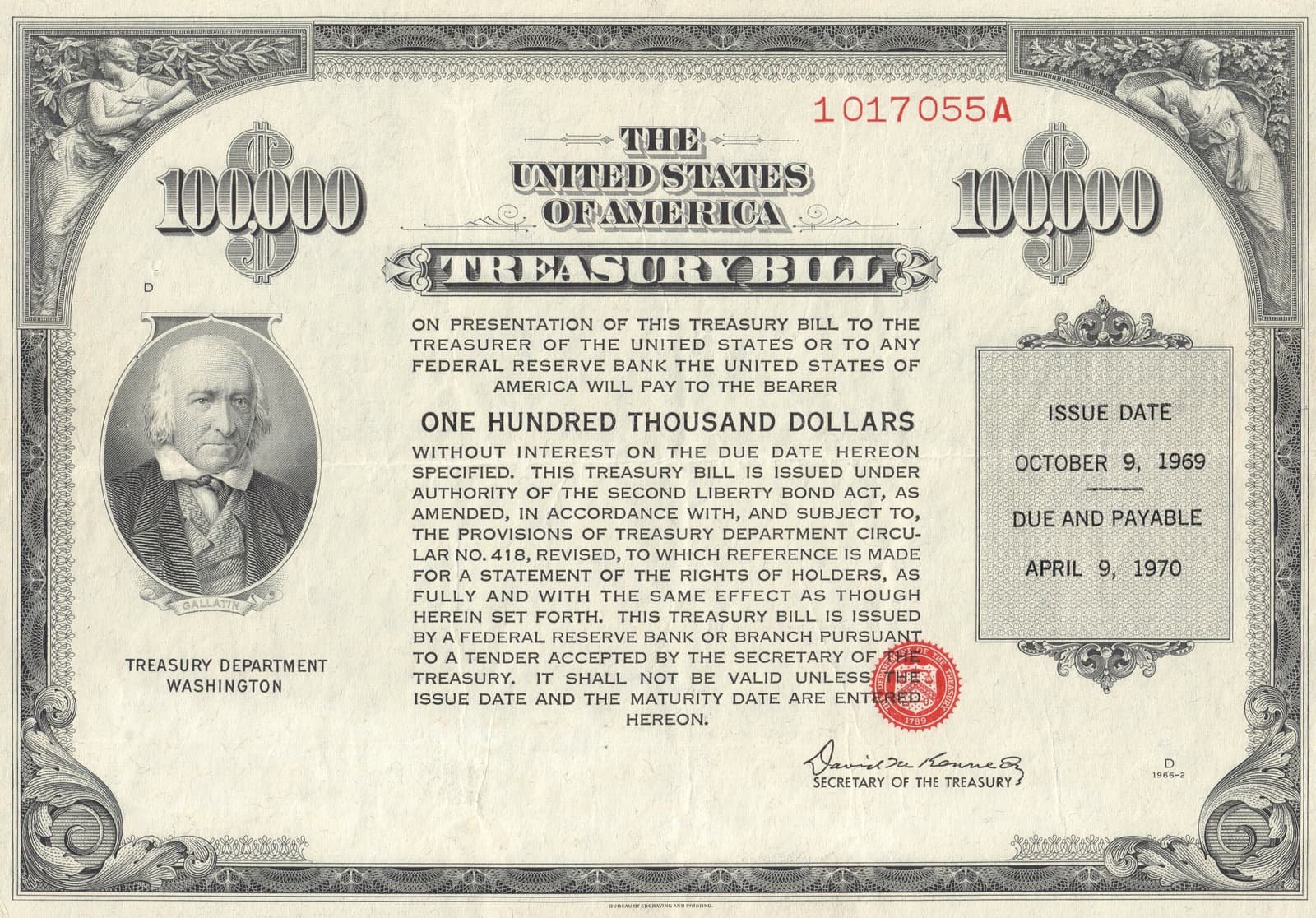
A 1969 $100,000 US Treasury bill certificate. Photo: JHerbstman via Wikimedia Commons (Public domain). Source
Tether published its third-quarter 2026 attestation on Oct. 30, reporting about $1.5 billion in net operating profit and a reserve buffer of $7.95 billion, nearly double the $4.1 billion it reported at the end of June. The stablecoin issuer's own release said the figures come from a report prepared by BDO covering the company's financial position as of Sept. 30.
USDT issuance held broadly steady at about $184 billion across the first three quarters of 2026, according to the release. Over that stretch Tether generated $4.5 billion in net operating profit, with the $1.5 billion in the third quarter consistent with the prior quarter. US Treasury bills and reverse repurchase agreements, short loans backed by government paper, produced most of that income. Direct and indirect holdings of US Treasury bills total $132.4 billion, the company said.
Management asserted total assets of $191,451,091,374 and total liabilities of $183,496,460,904, of which $183,469,787,261 relate to digital tokens issued. The difference, $7,954,630,470, is the buffer that has become the headline number in each quarterly attestation. Total reserve assets stood at $191.5 billion at quarter-end, with the majority held in liquid, short-duration instruments, the release stated.
"Our responsibility is to make sure USDT remains dependable when people need it most, including when markets and financial systems come under pressure," CEO Paolo Ardoino said in the release. He added that "generating $1.5 billion in net operating profit while maintaining nearly $8.0 billion in excess reserves gives us a strong foundation for that work," and said the company is building Tether for the long term with the liquidity to meet redemptions.
Independent coverage of the attestation turned on what sits inside the buffer. Coindaro calculated that the bitcoin and gold lines in Tether's reserves grew by about $2.8 billion over the quarter, roughly 73 percent of the $3.85 billion rise in the buffer, using line-by-line comparisons of the June and September reports. Tether publishes no bridge between quarters, so that breakdown is the outlet's arithmetic rather than the company's. Bitcoin in the September report is valued at its Sept. 30 price of $83,621; it traded about 8 percent lower, near $77,100, on Oct. 30, which would put the implied holding about $0.65 billion below the reported figure at that afternoon's price, the outlet estimated.
The buffer had moved sharply in the quarters before this one. Coindaro reported that the June attestation, published July 31, showed the buffer at $4.11 billion, down from $8.23 billion in the March report, even as Tether still headlined roughly $1.5 billion of quarterly profit in each. The gold and bitcoin lines lost about $1.8 billion between those two reports on the outlet's reading, which is why the composition of the Q3 rise matters as much as its size.
BDO's assurance report covers a single moment, Sept. 30 at 23:59 UTC, and is not an audit of the company's financial statements, a limit both the firm and Tether state. BDO worked under the ISAE 3000 Revised standard, took confirmation letters from banks and depositaries, tested a sample of gold, reconciled the books to blockchains and reviewed collateral on a sample of secured loans, according to the outlet's summary of the document. In Tether's own words, the report "does not represent the financial statements" of the company.
The same analysis also noted that Tether's 2025 audit, completed by KPMG US with an unqualified opinion announced in August, moved the starting equity figure in the September report by $476 million compared with earlier 2026 reports, a change the outlet derived by comparing documents. The June and March buffers have not been restated on that audited basis. The release does not define net operating profit, and the outlet found the nine-month figure of $4.5 billion does not reconcile with the $1.66 billion financial result in the September equity table without an unstated definitional gap.