Loading article...

An empirical thesis on why the Rust programming language has become the industry standard for high-performance blockchain nodes, parallel execution virtual machines, and zero-knowledge prover pipelines.
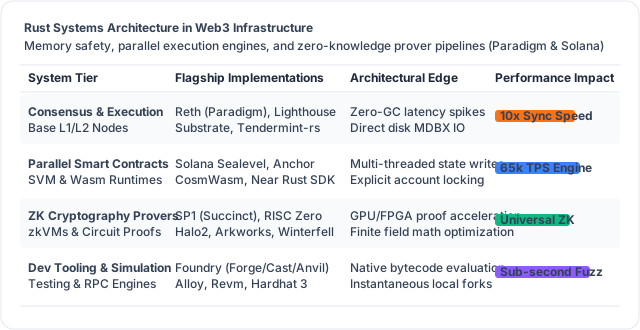
Distributed consensus networks operate under computational constraints that punish runtime inefficiency and memory instability. In centralized cloud environments, an unhandled memory exception or intermittent garbage collection pause manifests as temporary tail-latency degradation. In decentralized blockchain infrastructure, a ten-millisecond stop-the-world garbage collection pause can cause a validator node to miss its block proposal slot, triggering consensus slashing penalties. A single concurrency data race can result in non-deterministic state divergence across validator nodes, splitting a global blockchain network into competing forks.
Over the past decade, the Rust Programming Language has emerged as the premier systems language for mission-critical Web3 infrastructure. From execution clients and consensus engines to parallel smart contract virtual machines and zero-knowledge cryptographic provers, Rust provides memory safety, thread safety, and predictable execution without a runtime garbage collector.
According to metrics from the Electric Capital Developer Report, developer adoption of Rust across crypto ecosystems tracked across DefiLlama and Dune Analytics has grown faster than any other systems language, powering high-throughput networks like the Solana Foundation, the Polkadot Developer Portal, and next-generation Ethereum clients developed by Paradigm. Understanding why Rust dominates blockchain engineering requires analyzing its memory model, zero-cost abstractions, deterministic execution characteristics, and asynchronous concurrency frameworks.
Rust was designed around three foundational objectives documented in The Rust Book: zero-cost abstractions, memory safety without garbage collection, and guaranteed concurrency without data races. These properties map directly to the technical requirements of distributed ledgers.
Languages like Go and Java manage memory allocation using automated garbage collectors. While garbage collection simplifies application development, it introduces unpredictable pauses as the runtime sweeps heap memory. In high-frequency blockchain consensus protocols operating with sub-second slot times, these pauses are unacceptable.
C and C++ offer manual memory management with zero runtime overhead, but expose developers to buffer overflows, use-after-free errors, and dangling pointers. In blockchain state machines, an unhandled memory corruption bug can lead to catastrophic state trie desynchronization.
Rust resolves this dilemma through its affine type system, commonly known as the ownership and borrowing model:
Each value in Rust possesses a unique owner variable.
When the owner goes out of scope, the memory is immediately deallocated via the deterministic Drop trait.
Data can be borrowed immutably through multiple shared references (&T), or mutably through a single exclusive reference (&mut T), but never both simultaneously.
By enforcing these constraints during compilation via the borrow checker, Rust eliminates memory corruption bugs, null pointer exceptions, and concurrent data races before code is ever deployed to production validator networks.
Rust provides expressive, high-level functional abstractions, including iterators, pattern matching, closures, and algebraic data types, that compile down to assembly code equivalent to hand-optimized C. The compiler leverages LLVM optimizations, vectorizing numerical loops through Single Instruction Multiple Data (SIMD) instruction sets.
This optimization is critical for cryptographic operations. Computing hundreds of thousands of Keccak-256 hashes, Elliptic Curve Digital Signature Algorithm (ECDSA) verifications, or polynomial evaluations per second requires maximizing processor throughput without abstraction penalties.
// Cryptographic verification loop optimized via zero-cost iterators and Rayon
use rayon::prelude::*;

pub fn verify_signature_batch(signatures: &[Signature], messages: &[Message], pubkeys: &[PublicKey]) -> bool {
    signatures
        .par_iter()
        .zip(messages.par_iter())
        .zip(pubkeys.par_iter())
        .all(|((sig, msg), pk)| pk.verify(msg, sig).is_ok())
}
Libraries like Rayon Parallelism permit effortless multi-core work-stealing parallelism, allowing validator nodes to verify batches of incoming transactions across available CPU threads simultaneously.
The shift toward Rust is most visible at the core infrastructure layer of base protocol clients:
Historically, the Ethereum network relied almost exclusively on Geth, an execution client written in Go. While Geth proved dependable, its reliance on Go garbage collection and complex memory management created performance bottlenecks during high-throughput state synchronization.
In response, Paradigm built Reth by Paradigm, an execution client engineered from first principles in Rust. Reth utilizes Alloy by Paradigm for type-safe Ethereum primitives and Revm as an embedded, ultra-fast EVM interpreter.
By integrating the high-performance MDBX Key-Value Store and designing lock-free pipelined state stages, Reth achieves full-node sync speeds up to ten times faster than legacy Go clients while maintaining a drastically smaller disk footprint. The entire codebase guarantees memory safety without garbage collector latency spikes.
On the consensus layer of Ethereum, Lighthouse by Sigma Prime serves as a primary validator client. Written entirely in Rust, Lighthouse coordinates validator attestations, block proposals, and BLS signature aggregations across millions of staked ether.
Lighthouse leverages the Tokio Asynchronous Runtime to handle thousands of concurrent peer-to-peer network connections via libp2p, ensuring that network message propagation remains deterministic even during major denial-of-service stress periods.
In the multi-chain ecosystem, the Substrate Developer Hub provides a modular Rust framework for constructing sovereign blockchains. Substrate separates base consensus logic from runtime business logic.
The runtime compiles directly to WebAssembly (Wasm) using Rust compilation targets, enabling on-chain forkless runtime upgrades. Validators can update protocol transaction rules, token mechanics, and governance parameters without requiring coordinated node operator hard forks.
Beyond base-layer clients, Rust has become the preeminent language for writing high-performance smart contracts on alternative Layer 1 networks like the Ethereum Foundation research rollups and the Solana Explorer mainnet:
On traditional EVM chains, smart contracts execute sequentially in a single-threaded virtual machine. Even if a physical validator server possesses 64 CPU cores, contract execution runs on one core at a time, limiting throughput to 15 to 30 transactions per second.
The Solana Foundation engineered Sealevel, a parallelized runtime that executes non-conflicting smart contracts concurrently across all physical CPU cores. Solana programs are written in Rust and compiled down to Berkeley Packet Filter (eBPF) bytecode.
Solana enforces a strict separation of code and state. Programs are completely stateless. All state data lives in external Accounts passed into the program via explicit memory slices during transaction execution. Because each transaction declares all accounts it intends to read or write upfront, the scheduler processes non-overlapping transactions in parallel:
// Solana on-chain program written using the Anchor Framework
use anchor_lang::prelude::*;

declare_id!("8rZ12E3x5h6Pq3wK9vU7jY4zB8nC2mA1x4D5e6F7g8H9");

#[program]
pub mod token_escrow {
    use super::*;

    pub fn deposit_collateral(ctx: Context<DepositCollateral>, amount: u64) -> Result<()> {
        let escrow = &mut ctx.accounts.escrow_account;
        escrow.owner = ctx.accounts.depositor.key();
        escrow.amount = escrow.amount.checked_add(amount).ok_or(ErrorCode::NumericalOverflow)?;
        Ok(())
    }
}

#[derive(Accounts)]
pub struct DepositCollateral<'info> {
    #[account(init, payer = depositor, space = 8 + 32 + 8)]
    pub escrow_account: Account<'info, EscrowState>,
    #[account(mut)]
    pub depositor: Signer<'info>,
    pub system_program: Program<'info, System>,
}

#[account]
pub struct EscrowState {
    pub owner: Pubkey,
    pub amount: u64,
}

#[error_code]
pub enum ErrorCode {
    #[msg("Calculation resulted in numerical overflow")]
    NumericalOverflow,
}
The Anchor Framework uses Rust procedural macros via the Syn Procedural Macros and Quote Crate libraries. These macros generate automatic account serialization, discriminator verification, and security bounds checks using Borsh Serialization, drastically reducing boilerplate code and preventing common account confusion exploits.
Security audit firms specializing in Rust, including OtterSec, Neodyme, and Sec3, emphasize that while the Rust compiler eliminates memory bugs, developers must remain vigilant against logic vulnerabilities such as missing signer checks or unvalidated account ownership.
In the Cosmos ecosystem, decentralized applications deploy using CosmWasm, a secure smart contract module executing WebAssembly bytecode compiled from Rust. CosmWasm prevents reentrancy by design using an actor-based execution model where contracts cannot call each other synchronously; instead, contracts return messages dispatched sequentially by the base blockchain.
Similarly, Near Protocol utilizes the Near Rust SDK, offering asynchronous cross-contract promise calls with fine-grained gas budgeting. Alternative execution environments like Fuel Network also employ Rust-inspired domain-specific languages (Sway) to achieve parallel UTXO smart contract validation.
The most intellectually demanding frontier of blockchain engineering is Zero-Knowledge (ZK) cryptography. Generating cryptographic proofs (SNARKs and STARKs) requires immense mathematical throughput, including elliptic curve multi-scalar multiplications (MSM), Fast Fourier Transforms (FFT), and number-theoretic transforms (NTT) over large finite fields.
Rust is the undisputed language of zero-knowledge infrastructure:
General-Purpose zkVMs: RISC Zero and SP1 by Succinct allow developers to write standard Rust application code, compile it to a RISC-V binary, and generate a verifiable zero-knowledge proof of correct program execution. This allows any arbitrary algorithm to be proven off-chain and verified cheaply on Ethereum Layer 1.
Cryptographic Circuit Libraries: Frameworks like Arkworks, Halo2 by Zcash, and Winterfell provide modular Rust building blocks for constructing custom cryptographic circuits and polynomial commitment schemes.
Rust's ability to interface directly with low-level CUDA, Vulkan, and Metal GPU acceleration drivers while preserving strict type safety makes it uniquely suited for scaling prover infrastructure.
Understanding smart contract development in Rust requires mastering the execution mechanics of the Solana runtime. While EVM contracts maintain internal state storage slots, Solana programs operate on external AccountInfo memory structures passed into entrypoints:
Because Solana programs are stateless, they cannot possess private cryptographic keys. To allow programs to sign transactions, own liquidity vaults, or authorize token mints autonomously, the runtime utilizes Program Derived Addresses (PDAs).
A PDA is an address derived deterministically using a collection of user-defined seeds and the program's unique ID. The runtime iterates through a descending nonce (bump seed, from 255 down to 0) until it finds a 32-byte hash that falls off the ed25519 elliptic curve. Because the address lacks a corresponding private key, no external actor can forge signatures for it.
Only the program whose ID was used to derive the address can sign for it during runtime execution via the invoke_signed syscall.
// Program Derived Address derivation and CPI execution in Anchor
pub fn transfer_escrow_tokens(ctx: Context<TransferTokens>, bump: u8) -> Result<()> {
    let seeds = &[
        b"vault".as_ref(),
        ctx.accounts.initializer.key.as_ref(),
        &[bump],
    ];
    let signer = &[&seeds[..]];

    let cpi_accounts = anchor_spl::token::Transfer {
        from: ctx.accounts.vault_token_account.to_account_info(),
        to: ctx.accounts.recipient_token_account.to_account_info(),
        authority: ctx.accounts.vault_authority.to_account_info(),
    };
    let cpi_program = ctx.accounts.token_program.to_account_info();
    let cpi_ctx = CpiContext::new_with_signer(cpi_program, cpi_accounts, signer);

    anchor_spl::token::transfer(cpi_ctx, ctx.accounts.escrow.amount)?;
    Ok(())
}
In distributed protocols, modular contracts constantly interact. A Cross-Program Invocation occurs when one Solana program calls another. During a CPI, account privileges (signer status and mutability flags) are extended to the callee program.
Security researchers at firms like OtterSec, Neodyme, and Sec3 note that improper CPI verification represents one of the most common exploit vectors in Solana protocols. If a program fails to verify that the invoked target program matches the expected official program ID, an attacker can pass in a malicious mock program that returns success without performing required state mutations.
The Rust compiler guarantees absence of data races and memory corruption, but it cannot prevent business logic flaws or economic design bugs. To achieve institutional-grade assurance, protocol teams employ dedicated verification tooling:
Invariant Model Checking with Kani: The Kani Rust Verifier from Amazon Web Services is a model checker based on bounded model checking. Kani verifies user-defined assertions across all possible input paths up to a specified recursion bound, mathematically proving the absence of arithmetic panics and out-of-bounds array access.
Property-Based Fuzzing with cargo-fuzz: Developers use libFuzzer via cargo-fuzz to test deserialization routines and state transitions. By feeding billions of mutated binary payloads into Borsh Serialization and Serde Framework parsers, fuzzers discover unexpected edge-case panics that could cause validator nodes to crash.
Static Security Linters: Automated security tools, including linters developed by Trail of Bits and CertiK, scan Rust ASTs for missing signer checks, unvalidated account discriminators, and unsafe transmute operations.
Bounties and competitive reviews on platforms like Immunefi, Code4rena, and Sherlock consistently demonstrate that pairing the strict type safety of Rust with property-based fuzzing yields significantly lower exploit frequencies compared to legacy dynamic languages.
Rust has not only reshaped the runtime layer; it has revolutionized smart contract developer tooling. Historically, Ethereum developers tested contracts using JavaScript-based test runners like Truffle and Hardhat. These suites suffered from slow execution speeds and cumbersome TypeScript type conversions.
The introduction of Foundry by Paradigm replaced the legacy stack. Foundry comprises Forge, Cast, and Anvil, written entirely in Rust. Forge executes Solidity test suites up to twenty times faster than node-based frameworks, enabling continuous invariant fuzzing across millions of transactions within minutes.
By embedding Revm natively, Foundry eliminates RPC serialization overhead, providing instantaneous mainnet state forking and sub-second test execution. The modern Web3 developer stack is increasingly Rust from top to bottom.
The learning curve for Rust is notoriously steep. Developers transitioning from Python, JavaScript, or Solidity must adjust to compile-time lifetime annotations, strict borrow checker rules, and complex type hierarchies. However, mastering Rust unlocks the highest compensation brackets in the software industry.
According to recruitment data from Pantera Capital and Web3.career:
Junior to Mid-Level Rust Blockchain Engineers: Developers with 1 to 3 years of Rust experience working on Solana programs, CosmWasm contracts, or node infrastructure command base salaries between $120,000 and $170,000 USD.
Senior Systems and Protocol Architects: Engineers building consensus engines, rollups, or parallel virtual machines earn base salaries from $180,000 to $275,000 USD, often augmented by substantial token allocations vesting over four years.
Zero-Knowledge Cryptography Engineers: Specialists who combine Rust systems engineering with advanced finite field mathematics command premium compensation, with base salaries routinely exceeding $250,000 to $350,000 USD plus equity or token incentives.
To transition into Rust blockchain engineering, software professionals should pursue a disciplined learning trajectory:
Master Core Rust Fundamentals: Read The Rust Programming Language thoroughly using Cargo Documentation, completing exercises in the official Rustlings repository to gain intuitive fluency with the borrow checker.
Build Asynchronous Networking Applications: Develop command-line utilities using Tokio, Serde, and Reqwest to understand asynchronous event loops and data serialization.
Select a Specialization: Focus on Solana program development using the Anchor framework, or dive into Ethereum node engineering by contributing to open issues on the Reth or Lighthouse repositories.
Study Open-Source Protocol Codebases: Read production repositories from established protocols, analyzing how veteran engineers structure state transitions and guard against arithmetic overflows.
By combining zero-cost abstraction performance with rigorous mathematical memory safety, Rust provides the architectural foundation upon which the future of global, decentralized computing is being constructed.
Explore more guides and career playbooks