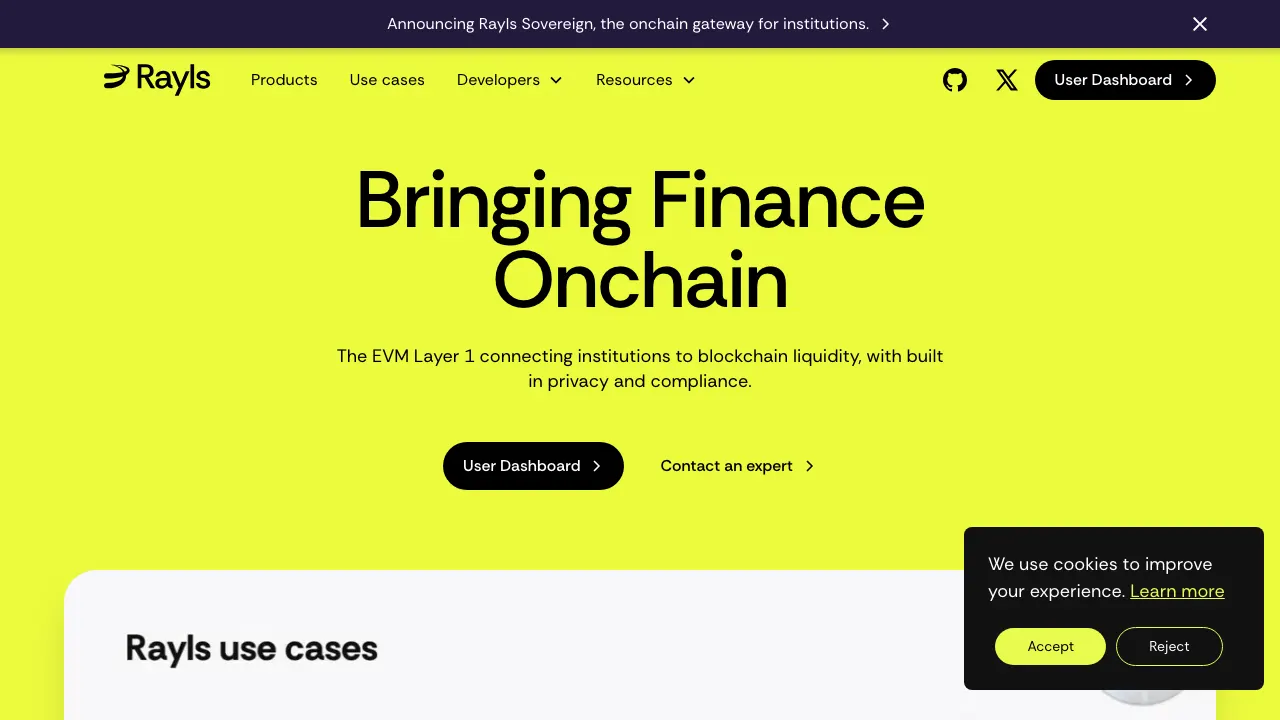
Rayls brings its privacy-focused interbank blockchain protocol to Seoul on September 30, 2026, for demonstrations and partner meetings timed to Korea Blockchain Week. For anyone tracking how banks actually put finance on-chain, it is a rare chance to see the machinery up close.
The blockchain for banks, in town for the week
Rayls bills itself plainly: the blockchain for banks. Its EVM-compatible Layer 1 is built to connect financial institutions to on-chain liquidity while keeping privacy and compliance baked into the base layer rather than bolted on afterward. During KBW, the team is hosting demonstrations and partner meetings rather than a stage show, which suits the product. This is infrastructure meant to be inspected, not applauded.
The Seoul trip lands amid visible momentum. The company launched its public chain mainnet on April 30, opened its Axyl Consensus Protocol code to the public in July, and used late August to announce Rayls Sovereign, described as the onchain gateway for institutions. Visitors in September will therefore be looking at shipped software and a fresh product line, not vaporware slides.
What the demonstrations cover
The stack on display maps to three concrete use cases. Tokenised deposits let banks mint fiat balances as EVM-standard tokens inside a sovereign Privacy Node, keeping the deposit on the bank's balance sheet while making it programmable. Yield-bearing asset vaults extend institutional products to suitable investors with public chains serving as secondary markets. Cross-border payments use what the team calls a stablecoin sandwich: tokenised deposit converted to stablecoin, moved privately via the Rayls Enygma system, converted back, settling in seconds instead of days.
That last mechanism is the demo most bankers ask about, because correspondent banking delays are a shared pain across every market. Seeing the path from deposit token to settled cross-border transfer in one session explains more than any litepaper.
Momentum worth weighing before a meeting
The company's ecosystem page reads like a central banker's contact list, with Banco Central do Brasil, the BIS, Mastercard, Accenture, Tether, XP, and LayerZero among listed partners, alongside Brazilian credit and tokenization firms such as AmFi and Nuclea whose executives appear in testimonials about building private networks on the stack. Backers named on the site include Framework, ParaFi, Valor Capital, Alexia Ventures, and Accenture.
Recent operational signals matter too. Parfin, the company behind Rayls, extended the lock-up on its RLS allocation by a year and migrated it on-chain in August, and the consensus layer went open source weeks earlier. Whether or not you buy the thesis, the team is behaving like it plans to stay.
Context for newcomers: the interbank angle is not marketing garnish. The protocol emerged from Parfin's work on Latin American financial infrastructure, and its design choices, permissioned participation at the edges with public-chain settlement at the center, reflect years of sitting in rooms with bank CTOs rather than DeFi summits. That lineage shows in the product decisions, for better and occasionally for worse if you arrive expecting crypto-native defaults.
Who should request time
Digital asset teams at banks evaluating tokenized deposits, payment companies wrestling with FX settlement, and regulators studying privacy-preserving compliance models form the obvious meeting list. Korean institutions in particular have been methodical about interbank pilots, and a working EVM chain with privacy nodes answers several questions they usually raise.
Meetings during KBW book out fast, so reach out through rayls.com well ahead of the week. If you cannot secure a slot, the transparency portal and published documentation offer a reasonable substitute, though neither replaces watching a cross-border settlement complete in front of you.