Loading article...

Network School is taking over Farcaster from Neynar and asking users to accept new client rules, while promising to keep the protocol open.
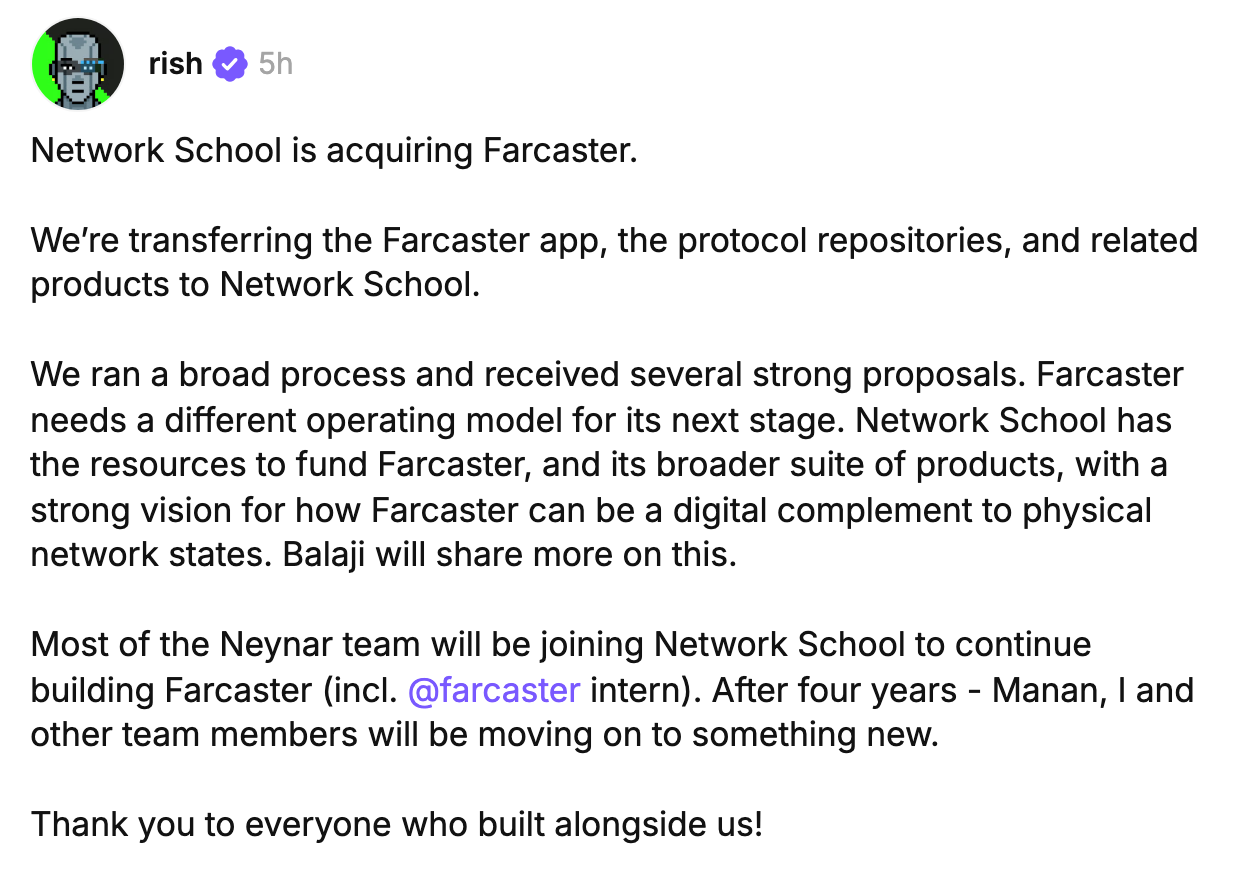
Rish's October 15 acquisition announcement on Farcaster. Screenshot: Hashtag Web3; original content: Rish / Farcaster. Copyright retained by the rights holders; no open license stated. Source
Network School, led by Balaji Srinivasan, has acquired Farcaster from Neynar. In an October 15 announcement, Neynar co-founder Rish said the transfer covers the Farcaster app, protocol repositories and related products. The handover comes with a new participation agreement for the main app, while Network School says the underlying protocol will remain open.
Rish said Neynar considered several proposals before choosing Network School, arguing that Farcaster needed a different operating model. He said most of Neynar's team would join the buyer to continue developing Farcaster, while he, fellow co-founder Manan and other team members would move on. His announcement did not disclose a purchase price.
Crypto Briefing reported that Farcaster is set to become the Network State Protocol. Network School's stated aim is to connect voluntarily joined online societies with communities in the physical world.
On its current website, Network School describes a residential community offering technical learning and coworking in Astana, Kazakhstan. It identifies its campus as the fifth floor of Astana Hub.
The in-app acquisition notice, a screenshot of which was supplied to Hashtag Web3, separates access to the protocol from participation in the client. Network School says it will moderate the app to build a community for people who share its techno-optimist outlook. Users who want to remain active are asked to sign what it calls a Social Smart Contract setting the community's terms.
According to the notice, users who do not agree will have read-only accounts within that client. Their accounts are not deleted, and they keep their keys, wallet and funds. They can use another client or fork the open-source client to build their own.
The Block's account of the change also describes the choice between accepting the agreement and retaining read-only access. It reports that users who opt in receive an access NFT recording their choice. The public Social Smart Contract page says voting to stay is a vote for the Network School Farcaster core team to update its rules.
The public Social Smart Contract page, reviewed by Hashtag Web3, calls its written digital rules the Network Code. It describes an open-weights AI model applying AI prompts to posts and accounts, with reproducible results as its goal.
Under the code, bans can follow hate speech, threats or wishes of serious harm, scams, repeated harassment or repeatedly passing off AI writing as one's own. Fighting and flooding feeds with low-quality posts can bring suspensions; spreading clear hoaxes as facts and repeated token-price hype can bring warnings.
The page also describes rewarding helpful contributions and evidence-based corrections. It reserves manual judgment for the core team. Warnings shown before posting are a planned feature, with no launch date given.
The Block reported that some users said they had been banned over months-old posts. The outlet said it had not independently verified those bans; Hashtag Web3 has not verified them either. Its report also describes plans to introduce human-verification requirements gradually to reduce bot activity.
This is Farcaster's second ownership change announced in 2026. In its January 21 acquisition announcement, Neynar said it was taking over from Merkle, with responsibility for maintaining the protocol, running the clients and operating token launchpad Clanker. Neynar's stated focus then was helping builders turn ideas into products and recurring revenue, supported by software tools and crypto payment infrastructure.
That earlier announcement explicitly included Clanker. Rish's October 15 post refers more broadly to related products without naming it, so the post does not establish Clanker's treatment in the Network School transaction.
The option to build another client has a published codebase behind it. Farcaster's official client repository contains a snapshot of its mobile and web client code and invites developers to fork it. The repository describes each update as replacing its main branch with a fresh snapshot; changes pushed directly to that branch are overwritten. Its README also sets out two practical limits: both clients point to Farcaster's current production API, and the snapshot excludes the Farcaster Wallet implementation.