Loading article...

An operational manual for crypto recruiters: sourcing across GitHub and hackathons, screening pseudonymous candidates, detecting infiltration malware, and closing token packages.
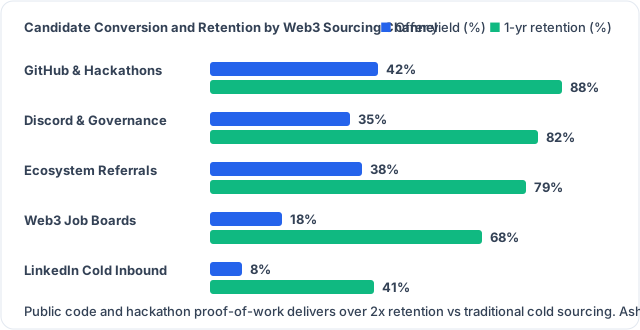
Recruiting in crypto exposes traditional staffing agencies to rapid failure. The candidates most capable of building resilient protocols do not respond to automated InMail messages on LinkedIn. Many operate under cryptographic pseudonyms, maintain no formal educational credentials on public record, and evaluate hiring teams through code reviews of the hiring protocol itself. Data from Electric Capital developer report shows that 74% of active open-source crypto developers live outside North America, creating a hyper-distributed, international candidate pool where geographic location correlates poorly with technical contribution.
To fill senior protocol engineering, security auditing, DevRel, and tokenomics roles, recruiters must discard standard agency playbooks. Success requires running five operational motions: hunting talent through public repositories and hackathons, evaluating on-chain proof of work, securing the hiring pipeline against state-sponsored fraud and infostealer malware, running respectful technical screening loops, and structuring competitive token compensation packages across complex cross-border tax regimes.
Recruiters who rely solely on commercial resume databases encounter low response rates. Ashby recruiting benchmark report demonstrates that cold outreach on LinkedIn generates an interview yield under 8% in crypto engineering, while candidates sourced from public code repositories convert at 42%.
The most productive hunting grounds are open-source repositories. Recruiters can monitor pull requests and issue trackers on foundational repositories including Foundry testing framework, Hardhat development suite, Slither static analyzer by Trail of Bits, and OpenZeppelin contract library docs. A developer who contributes gas-saving pull requests or improves EVM instruction execution in these codebases has already cleared the technical bar that standard recruiting screens struggle to measure.
Competitive hackathons deliver pre-screened talent working in intense collaborative settings. ETHGlobal hackathon builder metrics indicate that hundreds of new decentralized applications debut at each flagship event. Hackathon finalists demonstrate practical shipping speed, composability knowledge, and team execution. Recruiters who attend hackathon demo days or review finalist project repositories on GitHub connect with developers at the exact moment they complete a project and begin evaluating full-time protocol opportunities.
Ecosystem micro-grants and bounty platforms reveal self-directed problem solvers. Gitcoin grants round explorer, Dework Web3 bounty board, and Layer3 credential and quest protocol host thousands of contributors executing discrete bounties in contract engineering, technical writing, and frontend integration. Reviewing contributor history on these platforms reveals how candidates handle asynchronous feedback, revision cycles, and deadline commitments.
Analytical talent concentrates on public query dashboards. Recruiters seeking token economists, protocol researchers, and growth analysts should browse query creators on Dune Analytics query engine, Flipside Crypto analytics platform, Artemis institutional blockchain data, and DeFiLlama protocol TVL tracker. A candidate who created public dashboards tracking Uniswap fee distributions or rollup sequencer margins has demonstrated both data manipulation proficiency and deep protocol mechanics comprehension.
A significant portion of elite Web3 contributors maintain pseudonymous identities on public platforms. Rejecting pseudonymous candidates disqualifies many of the most capable protocol architects and security researchers in the ecosystem. Recruiters must establish rigorous processes for evaluating anon profiles while satisfying compliance and KYC requirements prior to offer signing.
Evaluating an anonymous candidate begins with on-chain and git forensics. Review the candidate's public wallet interactions using block explorers like Etherscan Ethereum block explorer, Solscan Solana blockchain explorer, Basescan L2 explorer, and Arbiscan Arbitrum explorer. Check whether the wallet has deployed contracts to testnets or mainnets, interacted with decentralized governance voting protocols on Snapshot, or participated in multi-signature custody arrangements.
Examine commit patterns on public git profiles. Look for long-term contribution consistency, clean git commit messages, and comprehensive test suites. Repositories that lack unit tests or rely exclusively on cloned boilerplates indicate superficial technical exposure. Conversely, candidates who write comprehensive Foundry or Hardhat test suites with fuzzing and invariant testing demonstrate mature software engineering discipline.
For security auditing roles, verify performance on competitive auditing platforms. Code4rena competitive auditing platform, Sherlock smart contract coverage protocol, Cantina security review network, and Immunefi Web3 bug bounty registry maintain public leaderboards documenting verified vulnerability submissions. A candidate with top-50 rankings on these platforms possesses verifiable domain expertise vetted by independent protocol sponsors.
When examining a candidate's deployed contracts, surface-level code reviews miss critical engineering signals. Senior recruiters and engineering managers evaluate four concrete indicators directly on block explorers:
First, inspect storage slot layout in upgradeable contracts. Candidates who understand the EVM know that inserting a new state variable before existing storage variables in an upgradeable contract causes storage collisions, corrupting critical protocol balances. A candidate who documents storage gaps (uint256[50] private __gap;) in OpenZeppelin upgradeable contracts demonstrates production-grade knowledge.
Second, examine test coverage and invariant testing depth. Standard unit tests verify that functions work under happy-path conditions. High-caliber protocol engineers write invariant tests that subject state machines to thousands of random calls using Foundry fuzzers. Invariant test suites verify that protocol balance invariants hold true regardless of call ordering or flash loan liquidity shocks.
Third, review gas optimization patterns. Contracts that deploy redundant storage writes or fail to utilize calldata for read-only array parameters incur unnecessary transaction fees for users. Candidates who structure struct packing to optimize 32-byte storage slots demonstrate awareness of real-world user costs.
Fourth, examine on-chain incident response and multisig operations. Checking whether a candidate has participated as a signer on a protocol Safe reveals practical operational discipline under stress. Contributor histories that include emergency pause executions or white-hat rescue transactions represent the highest form of verifiable reliability.
Prior to extending a formal legal contract or disbursing payroll, compliance mandates identity verification. Protocols reconcile pseudonymity with legal compliance through a two-step process: candidates complete technical interviews pseudonymously with cameras off or voice-only setups. Once both parties agree on terms, a confidential background check through a licensed verification firm confirms real-world identity, national sanctions compliance, and banking credentials. The candidate's legal identity remains confidential within HR and legal leadership, allowing them to retain their public pseudonymous persona across the community.
Recruitment workflows in Web3 represent an active attack surface. Threat actors exploit the hiring process to deploy info-stealing malware or place fraudulent remote operatives inside crypto engineering departments. Recruiters who fail to implement strict operational security endanger the entire company treasury and codebase.
Nation-state infiltration schemes systematically target remote crypto startups. FBI Internet Crime Complaint Center advisory on remote workers and US Department of Justice DPRK IT sanctions alert detail coordinated operations where fraudulent remote workers use stolen identities and proxy residential IP addresses to gain employment. KnowBe4 incident autopsy on fraudulent candidate documented how an operative utilized AI-generated headshots, passed multiple technical screening rounds, and attempted to execute malware scripts immediately after onboarding.
Further investigation by CrowdStrike Global Threat Report and Mandiant threat intelligence on insider threats shows that fraudulent workers route company laptops through proxy laptop farms located in North America to disguise overseas connections. Once inside, these operatives attempt to extract private keys, commit unauthorized repository backdoors, or facilitate subsequent cyber extortion.
To neutralize these threats, recruiters must require live, high-definition video interviews with unscheduled technical questions that test spontaneous problem solving. Background checks must verify residential history, tax identity, and previous employment references through direct human-to-human calls rather than digital email confirmations.
A parallel threat targets hiring managers and recruiters through malicious applicant submissions. Check Point Research on fake candidate resumes and trojans and Bitdefender Labs investigation into Lazarus BeaverTail disclose that attackers distribute PDF resumes and GitHub repositories laced with BeaverTail and InvisibleFerret infostealers. When a recruiter opens a weaponized PDF or a hiring manager runs npm install on a candidate's test project, scripts execute in the background to scrape browser passwords, Discord session tokens, and local wallet private keys. Kaspersky Labs analysis of GhostCall and GhostHire malware reports similar campaigns disguised as coding assessments.
Recruiters must enforce non-negotiable operational hygiene:
Top crypto builders rarely stay on the market for more than two to three weeks. Greenhouse recruiting funnel data and Lever tech talent acquisition study show that lengthy, five-round interview processes suffer high candidate drop-off rates in specialized engineering roles. High-performing crypto teams condense their interview process into a fast, four-stage loop completed within ten to fourteen days.
Stage one consists of a 30-minute introductory conversation. The recruiter evaluates alignment with the protocol's mission, confirms compensation expectations, and assesses communication clarity. Recruiters should articulate the project's funding runway, tokenomics architecture, and technical challenges clearly during this initial call.
Stage two is a 60-minute technical architecture discussion with a senior engineer. Rather than asking generic algorithmic riddles, the interviewer walks through an actual architectural challenge faced by the protocol. Topics include gas optimization tradeoffs in Solidity, reentrancy defense mechanisms using Consensys Diligence smart contract best practices, or data synchronization bottlenecks in indexers.
Stage three is a paid, practical take-home assignment capped at three to four hours of effort. The assignment must mirror real production work: auditing a vulnerable 150-line smart contract, writing a Foundry test suite with invariant checks, or designing a subgraph schema for an on-chain lending market. Protocols should compensate candidates with $300 to $500 in USDC upon submission. Paying candidates demonstrates respect for their time and increases completion rates past 85%.
Stage four is a 45-minute culture and leadership review with the founders. The founders present the long-term vision, discuss decentralized governance realities, and address candidate questions regarding treasury management and token distributions.
Throughout the loop, recruiters must provide feedback within 24 to 48 hours of each step. Rapid communication signals operational excellence and distinguishes the hiring team from disorganized competitors.
Closing top crypto candidates requires fluency in tokenomics, liquidity mechanics, and global compensation structuring. Pantera Capital blockchain compensation survey 2024 and Blockworks crypto salary index document that compensation packages consist of two distinct layers: a cash or stablecoin base salary and an equity or token incentive grant.
Base salaries for senior protocol engineers average $160,000 to $240,000, while lead architects and cryptographers command $220,000 to $320,000. For security researchers and senior auditors, CertiK Web3 security report notes compensation bands exceeding $300,000 base pay due to critical industry demand.
Base salaries are increasingly disbursed via stablecoins. CoinDesk crypto compensation trends indicates that over 90% of cryptocurrency payroll volume uses USDC or USDT. Contributors value stablecoins because they offer stable purchasing power without immediate volatility risk.
Token grants provide the primary upside. Toku token grant best practices and Toku guide to token vesting schedules establish that 88% of Web3 token packages follow a four-year vesting schedule with a 12-month cliff. A senior engineer joining a Series A protocol typically receives between 0.25% and 0.75% of the total token supply, while founding engineers at seed stage receive between 1.0% and 2.5%. Variant Fund token distribution models and Dragonfly Capital Web3 compensation survey advise teams to explain both circulating market cap and fully diluted valuation (FDV) transparently, helping candidates understand the realistic value trajectory of their grants.
Recruiters must guide candidates through the legal and tax realities of token awards. Blockchain Capital token compensation primer and Toku tax compliance for global crypto teams emphasize that receiving tokens can trigger severe taxable events. In the United States, candidates must evaluate filing an IRS Section 83b election procedure within 30 days of receiving restricted token units to avoid paying ordinary income tax on appreciated token valuations at each vesting milestone under IRS Notice 2014-21 virtual currency rules. European candidates must navigate token classifications under ESMA Markets in Crypto-Assets regulation, while UK and Singapore contributors comply with UK HMRC cryptoassets manual and Monetary Authority of Singapore digital token rules.
To manage international disbursement legally, protocols deploy hybrid payroll rails. Services like Request Finance crypto payroll comparison, Rise Works 2025 crypto payroll report, and Bitwage remote payroll solutions handle mass multi-chain payments and contractor tax invoicing. When hiring full-time international employees, protocols partner with Employer of Record (EOR) providers like Deel global contractor compliance guide, Deel crypto payroll and EOR overview, and Remote.com guide to contractor classification to eliminate worker misclassification risks. For on-chain native contributors, programmatic streaming protocols like Sablier token streaming docs automated via Safe multisig smart contracts disburse compensation per second with verifiable public solvency.
Recruiters who master these operational frameworks, understand on-chain technical proof of work, and safeguard their pipelines against digital threats consistently secure the engineering talent that powers decentralized protocols.