Loading article...

The Web3 job market had 66,494 new roles in 2025. How hiring works, what to build in 90 days, and what juniors earn.
Junior hires at Web3 teams rarely arrive with a prior crypto title. The ones who get offers arrive with public proof that they can do the work.
The market is bigger than most people think. Coincub counted 66,494 new Web3 roles in 2025, up 47% from 2024, though still below the 2022 peak. Engineers take about a third of listings. One analysis of 18,000 postings puts them at 32%, so most openings are not engineering roles. Gate Research puts the global crypto workforce at 1.6 million professionals with pay up 18% in a year. Tiger Research ties a 20% rise in postings to the January 2024 Bitcoin ETF approvals, with Asia at 20% of roles against Europe's 15%.
Remote numbers need care. Web3.Career reports remote listings down by half as teams go hybrid, while Coincub counts 26,925 remote roles, up 40%. Both can hold at once. They define remote differently. YouGov's survey of 498 workers found 73% saying newcomers lack technical knowledge first, and 77% working remotely themselves. Placement data from Plexus shows the same tilt toward experienced specialists.
This guide is for marketers, writers, community managers, ops generalists, and developers moving from Web2 to Web3. It lays out how hiring really works, what to build in 90 days, and what the pay looks like.
Teams hire from public evidence first and resumes second. ArtofBlockchain puts it plainly: GitHub history, testing depth, and proof tied to the spec beat generic claims. Their CV review finds most resumes die in about ten seconds without verifiable output up top.
The loop reflects it. Most teams run one to three weeks ending in live contract review and a four-to-eight-hour take-home. Cold applications convert poorly. Cold direct messages get 5 to 15% replies against about 2% for blind posts, over a typical three to six months. Hired3 makes the same point: community help and a visible presence beat mass applying.
So the strategy is simple. Spend 90 days building checkable work, then apply through warm paths with links attached.
Days 1 to 30 go to immersion. You cannot contribute until you understand how people coordinate. Remote3's 30-day plan starts the same way: fork a repo, add tests, write a threat note, fix docs. Set up a wallet, try a lending pool and a swap with small amounts, vote in one DAO poll. GM.careers suggests first pull requests to ethereum.org or OpenZeppelin libraries as starter proof. Write down everything that confuses you. Those notes become your first posts.
Days 31 to 60 go to shipping three artifacts in one lane. Pick non-technical or developer work and produce three linked items. Superteam's handbook shows the cadence: bounties with first prizes typically over $1,000, finished in days. Their FAQ documents seven-day payouts and an 80/60/50 XP split for the top three. Three finished artifacts beat thirty half-started ones.
Days 61 to 90 go to getting paid once. One DAO guild or one bounty board. One completed, linkable bounty. Then rewrite your resume around it. Web3Vacancy's portfolio guide stresses the 15-second scan rule: lead with relevant work and test coverage signals.
Most 2025 postings are not code roles. Coincub's data shows non-technical functions as the majority, with listed averages around $139k for HR, $170k for legal, and $172k for product. Blockchain Council counts over 1,400 community listings with bands from $83k to $210k. Web3FuturePro puts remote non-technical entry pay at $40k to $90k with a six to twelve month landing window.
Four lanes absorb most career switchers. Start with community: run calls, write recaps, moderate, track retention and reply rate. Scribe work is the classic wedge. Attend a DAO's weekly call three weeks straight, post a sub-200-word recap within two hours each time, and you become visible to the people who allocate contributor roles. Marketing and content come next: explainers, threads, teardowns, docs fixes. One 500-word explainer with a definition up front, three steps, and one stated limitation teaches more than ten hype posts. Then operations and support: bounty ops, onboarding flows, governance logistics. DAOs always need people who keep the machine running. Finally design and research: dashboards, user interviews, callback summaries. Transition data suggests three to six months at ten to fifteen hours a week is enough to cross over with a mapped skill set.
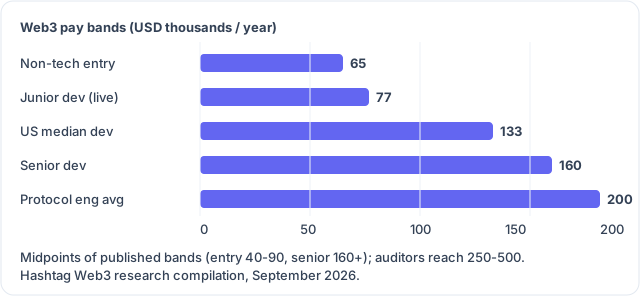
Solidity still dominates hiring. It appears in over 40% of postings, about 2.5 times Rust, though Rust has less competition per applicant. Senior pay for both tracks reaches $200k to $400k and above. Metana's role table puts smart contract engineers near $190k on average and protocol engineers near $200k.
Build a three-project portfolio. iTokenly recommends a flagship dApp plus one depth piece plus one merged pull request, all with verified contracts. ArtofBlockchain adds the case-study layer: gas before and after, proof-of-concept diffs, measurable outcomes. Their proof-stack checklist insists the top half of your resume carry two to three projects with outcome, decision, and verification bullets. Web3Vacancy adds a wallet section with ENS and on-chain links, plus TVL and gas metrics where honest. For broader structure, see the guide on building a Web3 portfolio and the basics of smart contracts.
Bounty platforms are the fastest paid line a newcomer can earn. Superteam Earn routes Solana bounties, freelance projects, and grants through one profile. Design, development, and content bounties there pay in USDC or SOL (bounties), grants fund builders without taking equity (grants), and open Solana projects list remote roles by function (projects). The network runs on local chapters across dozens of countries (about).
Gitcoin works the same way for public goods. Its bounty flow runs define, post, claim, review, release across docs, bug, and UX tasks. Gitcoin Passport adds Sybil resistance with a Trust Bonus near 1.5 times. Matching guides put the practical threshold near a score of 20.
Security bounties pay the most but demand real skill, and the money concentrates brutally at the top. The chart below shows the split: nearly nine dollars in ten go to critical findings, and more than three in four go to smart contracts. That shape dictates strategy. Generalist bug hunting pays coffee money at a median near $2k. Deep, severity-grade contract review is the actual profession.
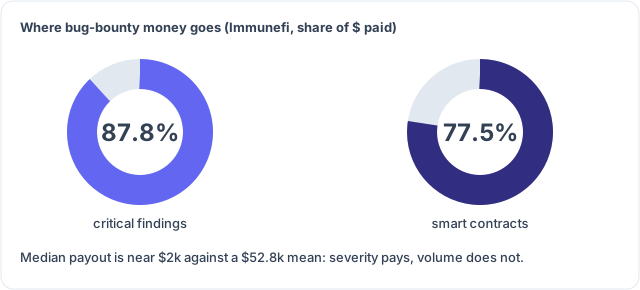 Figure: payout concentration on Immunefi. Data: program, GlobeNewswire, SQ Magazine.
Immunefi protects over $190B across its programs. The Block reports more than $100M paid across 3,000-plus reports from about 45,000 researchers, estimated to have saved $25B. Early research totals $65.9M with Wormhole's $10M and Aurora's $6M at the top. Payouts skew hard: 87.8% to critical findings, 77.5% to smart contracts (distribution). Cumulative payouts reached about $134M by early 2026 (SQ Magazine), and live boards advertise up to $3M from Ethena (bounties). Immunefi's guide stresses severity around economic damage plus scope discipline. Beginners should treat this lane as a twelve-month goal, not a first step.
DAOs let you earn before anyone hires you. DeFi Planet maps the route: find DAOs through DeepDAO, DAOhaus, and Snapshot, then start with votes and small bounties. LedgerMind reports joining costs from $50 to $10k-plus in tokens, recommends three to five DAOs, and puts the path to core contributor at three to six months. DXdao documents a concrete trial: one month at 50% pay, two months at 80%, then a full on-chain vote. MoonDAO runs a Level 0 community to Level 1 project ladder with retroactive rewards.
Join one DAO, not five. Lurk for a week, read a month of proposals, then ask for a good first issue in one guild channel. Ship it fast.
Put a Web3 Contributions section above work history. Link everything. Reframe Web2 bullets with numbers hiring managers recognize: shipped, moderated, measured, documented, deployed, tested.
LastRound adds context: expect four to six rounds with questions separating memorized definitions from shipped work, like call versus delegatecall. From there the loop itself is standard:
Question banks run past fifty items across Solidity, DeFi mechanics, and security scenarios including MEV and reentrancy cases. CryptoRecruit adds tokenomics design and live $10M-exploit scenarios. Aipplify surveyed thirty-plus companies and found Uniswap, Aave, and Chainlink loops converging on the same prep table. About 60% of teams still use LeetCode mediums with live coding and protocol deep-dives (developer guide). Axiom documents the open-book trend: most leads accept AI-assisted coding and score clarifying before coding. HiredPrep's blueprint centers reentrancy with checks-effects-interactions, rollup trade-offs, gas reasoning, and oracle failure modes.
Prepare three stories: one thing you shipped, one thing you broke and fixed, one decision you made with incomplete data. Bring links to all three.
Five numbers anchor the whole market, and the shape matters more than any single figure: a steep climb from junior to senior, then a jump to protocol and audit specialties. Blockchain Magazine puts US developers at $120k to $180k on average, $80k to $110k at entry, $200k-plus at senior, $250k at the top, freelance at $50 to $150 an hour. FindFi runs smart contract $90k to $300k and auditors $90k to $400k from junior to lead. LinkedIn data from 350 interviews clusters Asia-based engineers with two to five years at $6.5k to $7.5k a month with a security premium. Orbyt's 2026 data gives a $133k US median ranging $103k to $169k with San Jose at $189k. TheBlockopedia reports a $152k global average, up 12%, with the US at $189k and offshore at $60k to $120k. Live web3.career bands show juniors near $77k and seniors near $160k. CBT Nuggets lists San Francisco near $150k, New York near $145k, remote-USA near $130k, entry at $85k to $110k.
Negotiate with competing evidence, not adjectives. Two written bounties plus one explainer with traffic beats any claim about passion. For remote-specific mechanics see remote work in Web3.
Theory is cheap. Here is a concrete ten-hour week, the kind working contributors actually run. It assumes a day job and no prior audience.
Monday is for listening. Read your DAO's last week of proposals or your target project's changelog. Find one decision with a reason you can explain. Write ten bullets, post the recap where the community lives, and cross-post a short thread. Link both from a pinned index thread so every future artifact compounds in one place.
Tuesday is for building in public. Developers add the test, fix the typo in docs, or deploy the tutorial contract to a testnet and post the address. Non-technical folks draft the explainer or teardown. Publish rough. Finished artifacts beat polished drafts, which is exactly what the fifteen-second resume scan rewards.
Wednesday is for reviewing someone else's work. Comment thoughtfully on one pull request, governance post, or bounty submission. Reviewing teaches the codebase and the politics faster than consuming. Maintainers remember careful reviewers when contributor slots open.
Thursday pushes the artifact over the line. Finish the explainer, submit the bounty, or open the pull request. Every submission states what changed, how to verify it, and what comes next. That format mirrors what audit-grade reviewers expect: scope, severity reasoning, verification steps.
Friday applies the proof. Send two warm messages that reference this week's artifact. Update the resume's contributions section the same day so it never goes stale.
The weekend goes deep on one mechanism. Pick whatever confused you most and read the primary docs until you can explain it in five sentences. Protocol docs from teams like Aave and Uniswap are written for exactly this purpose. Next week's explainer writes itself.
Repeat twelve times. That is the whole playbook: listen, ship, review, submit, apply, learn. People who do this visibly for a quarter rarely stay unknown. Hiring data keeps confirming it: teams pay for demonstrated skill, protocol and security roles most of all.
Spreading across five DAOs is the classic one. LedgerMind suggests three to five for experienced contributors, but beginners should join exactly one. Ten hours split five ways makes five weak impressions. One group gets your full attention and your name becomes known.
Collecting courses instead of shipping is next. Courses feel productive and hiring managers cannot verify them. Proof-based hiring research is blunt: a merged pull request or a paid bounty beats any certificate. One finished tutorial plus one public artifact beats five half-finished courses.
Hiding work behind logins wastes the rest. Permission-walled pages, private repos, screenshots nobody can open. Portfolio guides agree: if a hiring manager cannot click it in fifteen seconds, it does not exist. Public posts, public repos, public threads.
Applying before building fails against the math. Roughly 450 applicants chase each developer posting, and non-technical posts still draw 60 to 120 each (Zipmex). Build first, apply warm second.
Chasing security bounties on day one burns a year. Nearly 88% of Immunefi money goes to critical findings (distribution data). Without audit-level skill, months of hunting return nothing. Do content, community, or dev bounties first. Add security in year two.
Ignoring the money mechanics stings later. Crypto pay is spreading: from 3% of workers in 2023 past 9% in 2024, almost all in USDC and USDT (Blockworks). Understand vesting and tax in your country before signing. Vesting guides document the standard four-year schedule with a one-year cliff and the phantom-income trap.
Coding as a requirement No, for most roles. Engineers take about a third of listings; community, marketing, operations, support, and design absorb the rest. Community listings alone number in the thousands with wide bands. Code only for an engineering lane, where Solidity still leads Rust by more than two to one.
Ten to fifteen focused hours. Transition guides put the switch at three to six months on that schedule. One artifact a week compounds fast.
Quitting before the offer No. Everything here fits around a job: testnet transactions, recaps, threads, small bounties. Bounty platforms pay first prizes in days (Superteam handbook), which suits people with bills. Quit after an offer, not before proof.
Yes, with narrower gates. Trial structures like DXdao's one month at half pay plus two at reduced pay show professionalization. Start with bounties, earn a trial, then propose.
Resume top line Three linked items with outcomes: one bounty with payout proof, one explainer with read counts, one repo or recap series with dates. Recruiters decide in about ten seconds (CV review), so those links sit above work history.
Live code or contract review, a paid four-to-eight-hour take-home, and a founder values chat. Most loops close in one to three weeks (GM.careers). Open-book, AI-assisted coding is now normal (Axiom).
Entry-level pay Entry pay runs roughly $40k to $90k for remote non-technical roles (Web3FuturePro); live junior bands sit near $77k. Asia-based engineers with a few years cluster near $6.5k to $7.5k monthly with a security premium. Rates rise fast once shipped work exists on-chain.
Timelines vary: six to twelve months of steady proof is normal for a first role, and three to six months at ten to fifteen hours a week for a focused switch. Start this week with one small, checkable contribution. The next one gets easier because people already know your name. Twelve weeks of visible work turns a stranger into a known contributor, and known contributors get hired. Keep every artifact linked from one pinned index. Track shipped artifacts weekly, and never let two quiet weeks pass in a row.