Loading article...

A practical manual for earning in decentralized organizations: finding bounties, submitting governance proposals, navigating streaming payroll, and managing self-custody taxes.
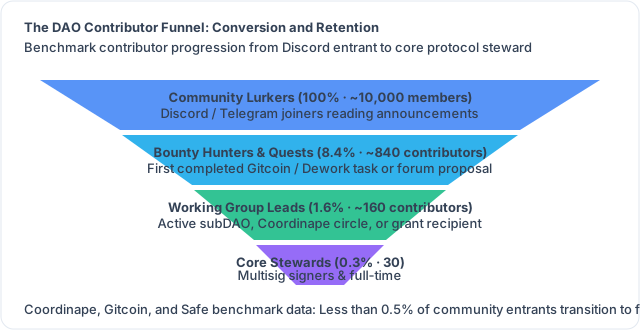
Contributing to a Decentralized Autonomous Organization and receiving on-chain compensation represents a structural departure from traditional corporate employment. In a conventional company, an applicant responds to a static job description, completes private interviews with human resources managers, signs a bilateral legal agreement, and receives fiat currency deposited through centralized commercial banks. In a DAO, the organization operates through transparent smart contracts deployed to public blockchains, where funds are controlled by decentralized token holders rather than executive boards.
Data tracked by DeepDAO ecosystem analytics and DeFiLlama DAO treasury rankings reveals that decentralized organizations coordinate over $25 billion in on-chain treasury assets. Getting paid by a DAO means delivering measurable value (such as protocol engineering, economic modeling, smart contract auditing, technical documentation, community moderation, or governance risk analysis) and receiving compensation disbursed directly from multi-signature vaults or governance contracts. Understanding how to navigate this landscape requires mastering five operational phases: identifying where paid tasks originate, navigating decentralized governance approval flows, executing public proof of work, managing on-chain streaming payroll, and complying with international tax and contractor regulations.
Payment in a decentralized organization does not originate from a corporate bank account managed by an accounting department. Payouts execute directly from smart contract treasuries governed by cryptographic rules.
Treasury management data from Safe multisig deployment guide documents that over $100 billion in digital assets across 18 EVM-compatible blockchains are secured by multi-signature vaults. In major protocols such as Uniswap Foundation contributor grants, Aave governance portal, Optimism Collective governance manual, and Arbitrum DAO governance documentation, community treasuries are custody-managed through Safe multisigs requiring a defined quorum of signers (typically 4-of-7 or 5-of-9 independent signers) to approve any outgoing transaction.
Contributors receive compensation across three distinct payment models:
First, discrete bounties. These are fixed-scope, single-deliverable tasks created by working groups. Examples include fixing a frontend rendering bug for $800 in USDC, translating developer documentation into Spanish for $400, or writing an explanatory tutorial for $350. Bounties execute rapidly because working groups hold pre-approved seasonal budgets, eliminating the need for protocol-wide token holder votes.
Second, milestone-based governance grants. These represent larger research, development, or marketing initiatives requiring between $5,000 and $100,000 or more in capital. A contributor or team posts a detailed proposal on governance forums, completes off-chain signaling votes on Snapshot gasless voting documentation, and advances to binding on-chain votes via Tally on-chain DAO governance platform or Compound Finance governance docs architectures. Funds disburse in tranches upon verifiable milestone completions verified on Etherscan Ethereum block explorer, Basescan Layer 2 explorer, or Arbiscan Arbitrum explorer.
Third, continuous streaming retainers. Core contributors, working group leads, and long-term maintainers receive monthly stipends or continuous per-second payment streams disbursed through protocols like Sablier continuous token streaming and Superfluid real-time streaming finance. Streaming payroll allows contributors to withdraw accrued earnings at any second while giving DAO delegates the cryptographic ability to pause or cancel payment streams if deliverables lapse.
Prospective contributors who wait for public job postings on traditional career boards miss the majority of decentralized opportunities. Paid work in DAOs surfaces within open-source task managers, governance forums, and community channels.
High-throughput platforms host thousands of active protocol bounties:
Securing significant grant funding or full-time contributor status requires mastering the formal governance pipeline. Protocol governance is deliberately slow and transparent, designed to protect treasury capital from impulsive spending and adversarial attacks.
The standard governance lifecycle spans four rigorous steps:
Stage one begins with the Request for Comment (RFC) phase on the protocol forum. The applicant posts a detailed draft proposal. Over a mandatory discussion window lasting seven to fourteen days, community members, delegates, and risk analysts scrutinize the submission. Successful applicants actively respond to technical feedback, refine deliverable milestones, and adjust budget figures based on delegate concerns.
Stage two moves to off-chain temperature checks. Once forum feedback reaches consensus, the author creates a proposal on Snapshot gasless voting documentation. Snapshot enables token holders to cast cryptographic vote signatures without incurring gas fees, verifying token balances against a historical snapshot block. Passing a temperature check requires meeting minimum quorum thresholds (such as 10 million UNI tokens voting in favor on Uniswap).
Stage three initiates the binding on-chain proposal. If the temperature check succeeds, an on-chain proposal is submitted to smart contracts based on OpenZeppelin Governor contract documentation or Compound Governor Bravo. Submitting an on-chain proposal typically requires holding or being delegated a substantial token threshold (such as 1 million UNI or 100,000 AAVE). Contributors partner with prominent institutional delegates or foundation leads who support the proposal to execute the submission.
Stage four executes via timelock contracts. After the on-chain vote passes by meeting required voter quorums, contracts enforce a mandatory timelock delay (typically 48 to 72 hours). This delay gives protocol participants an opportunity to review the bytecode transaction before the Safe multisig contract automatically releases capital to the recipient address.
In decentralized protocols, verifiable proof of work supersedes traditional credentials such as university diplomas or corporate job titles. Contributors often operate under pseudonyms, allowing engineers, writers, and researchers to earn income without disclosing physical identities.
Building an authoritative on-chain identity requires verifiable artifacts:
When working under a pseudonym, operational security is critical. Contributors must follow security guidelines outlined by OWASP Web3 OpSec handbook and Security Alliance SEAL 911 incident network:
Receiving cryptocurrency payments directly to a self-custody wallet does not exempt a contributor from tax liabilities or legal contractor responsibilities. In nearly all jurisdictions, revenue earned from decentralized organizations is classified as self-employment income or independent contractor compensation.
Navigating cross-border compliance requires proactive operational discipline: Contributors operate as independent contractors. Because DAOs rarely operate centralized human resources entities, contributors are personally responsible for tracking gross receipts, filing self-employment taxes, and maintaining local business licenses. Guidelines from Remote.com contractor misclassification guide and Deel global contractor compliance note that independent contractors must retain discretion over their working hours, tools, and methodologies.
In the United States, crypto compensation is taxed based on fair market value at the exact timestamp funds are received under IRS Notice 2014-21 virtual currency taxation. If a contributor receives $5,000 worth of governance tokens that subsequently decline by 50%, their ordinary income tax obligation remains calculated against the original $5,000 valuation. If they receive unvested tokens with continuous vesting schedules, they must consult tax counsel regarding filing an IRS Section 83b election regulations within 30 days of grant to mitigate phantom income exposure.
Protocols increasingly partner with enterprise compliance engines like Toku DAO contributor compensation compliance, Request Finance crypto payroll report, Rise Works 2025 crypto payroll report, and Bitwage remote contributor payroll to issue automated invoices, execute KYC checks, and generate annual tax documentation (such as Form 1099 in the US).
Understanding the DAO's legal wrapper protects contributors from personal liability. Contributor documentation prepared under a16z crypto DAO legal frameworks and Paradigm legal guide to DAOs notes that unincorporated DAOs risk being classified as general partnerships, potentially exposing individual contributors to joint liability for protocol obligations. Contributors prefer working with DAOs that maintain established legal wrappers:
A common misconception among early DAO contributors is assuming that on-chain votes are determined by retail token holders clicking vote buttons on Tally. In reality, large protocols operate under liquid delegation models where millions of voting tokens are concentrated among institutional delegates: venture funds, university blockchain clubs, professional governance advisory firms, and active protocol researchers.
Securing approval for substantial grant proposals requires direct engagement with institutional delegates: First, identify top delegates by voting weight. On platforms like Tally and Agora, delegates publish their governance philosophy, active voting track record, and delegate statements. Understanding whether a delegate prioritizes conservative risk parameters, aggressive growth grants, or protocol revenue diversification allows proposal authors to tailor their submissions.
Second, schedule office hours and community debriefs. Major delegates host regular open office hours on Discord or Google Meet. Presenting a proposal draft to delegates prior to posting the formal Request for Comment allows authors to incorporate feedback on key deliverables, risk mitigations, and budget sizing before public debate begins.
Third, publish independent risk assessments. When requesting capital for technical integrations, including a risk review that evaluates contract upgradability, oracle dependencies, and liquidation mechanisms builds trust with conservative delegates whose mandate is protecting protocol solvency.
Receiving compensation in native governance tokens introduces currency volatility that contributors must manage deliberately. If a contributor receives payment exclusively in volatile protocol tokens, a 50% market drop can severely impact their ability to cover living expenses and tax liabilities.
Contributors manage treasury diversification through three operational strategies: First, negotiate stablecoin-denominated base agreements. Requesting that core compensation be denominated and disbursed in dollar-pegged stablecoins (USDC or USDT) protects purchasing power. Protocols with diversified treasuries readily accommodate stablecoin requests for operational labor.
Second, understand token liquidity depth. Before accepting native governance tokens as compensation, evaluate secondary market liquidity on decentralized exchanges. If an automated market maker pool holds only $200,000 in total liquidity, attempting to liquidate a $10,000 monthly grant will incur significant price slippage.
Third, automate dollar-cost averaging conversions. For contributors holding native tokens, setting up programmatic limit orders or automated dollar-cost averaging on decentralized exchanges enables orderly liquidations without triggering community price panic or large market impact.
Operating in decentralized environments presents unique psychological challenges that can lead to contributor exhaustion. Unlike traditional corporate jobs with fixed hours and clear managerial boundaries, DAOs operate around the clock across global time zones. Governance debates, emergency forum threads, and Discord notifications can create continuous cognitive strain.
Sustainable contributors establish disciplined boundary frameworks:
As documented in Variant Fund progressive decentralization framework and Variant Fund token distribution design, participating in decentralized work bridges open-source community passion with programmatic capital allocation. Contributors who build transparent public proof of work, master governance proposals, and manage operational security build resilient, sovereign careers across the decentralized economy.