Loading article...

An empirical thesis and comprehensive roadmap for engineering distributed ledger protocols, smart contract execution systems, cryptographic primitives, and decentralized application infrastructure.
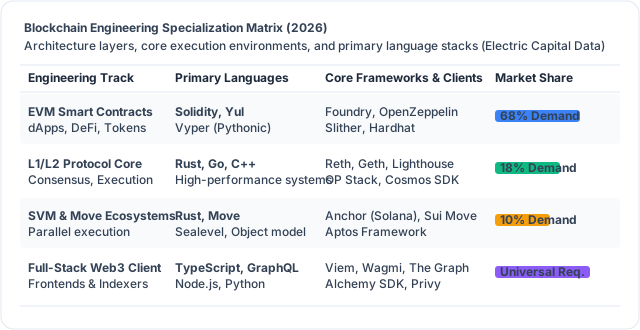
Software engineering on distributed ledgers requires an inversion of conventional systems architecture. In centralized server infrastructure, systems engineers operate with privileged database access, asynchronous transaction processing, and mutable state storage that can be rolled back or patched through continuous deployment pipelines. Distributed consensus networks discard these assumptions entirely. In decentralized computing, execution environments are publicly exposed, code execution is irreversible, state updates demand Byzantine fault tolerant consensus across thousands of independent nodes, and computational throughput is constrained by strict cryptographic validation costs.
According to the Electric Capital Developer Report, over 20,000 monthly active open-source developers work across the blockchain ecosystem, with full-time contributors maintaining multichain infrastructure supporting hundreds of billions of dollars in economic value. Yet entering this field requires navigating a fragmented landscape of protocol layers, execution virtual machines, and specialized programming languages.
A modern blockchain developer does not simply write high-level user interface code. They operate across two distinct architectural disciplines: core protocol systems engineering and smart contract application engineering.
Entering the blockchain industry requires choosing between two fundamentally different engineering specializations, each demanding distinct technical skills, language proficiencies, and system mental models.
Protocol systems engineers build, optimize, and maintain the base-layer blockchain nodes that form consensus networks. They work directly on distributed peer-to-peer networking (such as libp2p), cryptographic signature schemes, state database serialization (such as Merkle Patricia Tries or Verkle Trees), transaction mempool gossip protocols, and consensus engines.
This tier of development relies on low-level, high-performance systems languages. Go Programming Language powers execution clients such as Geth (Go-Ethereum) and consensus clients like Prysmatic Labs. The Rust Language has become the dominant choice for next-generation consensus infrastructure, powering clients like Reth by Paradigm, Lighthouse by Sigma Prime, and the entire Solana Foundation validator validator codebase. In the Bitcoin Core repository, C++ remains the foundational language maintaining the reference node implementation.
Protocol engineers focus on node synchronization throughput, state storage footprint reduction, multi-threading, memory safety, and networking latency. A minor concurrency race condition or state divergence bug in a protocol client can split a blockchain into competing forks, halting transaction finality.
Smart contract developers, in contrast, write software that executes inside a decentralized virtual machine. Rather than managing sockets and disk I/O, they write immutable business logic, automated market makers, decentralized lending pools, non-fungible token registries, and governance voting engines.
The primary execution environment is the Ethereum Virtual Machine, where developers write contracts in Solidity or Vyper. On non-EVM networks like Solana, smart contracts are referred to as on-chain programs, written in Rust utilizing frameworks like Anchor Framework. Newer layer 1 networks like Sui Network and Aptos utilize Move, a language designed around resource-oriented programming with formal verification capabilities.
Smart contract developers must master state variable packing, gas economics, reentrancy guards, oracle integration, and adversarial game theory. Once their code deploys to a public network, it cannot be recalled.
Before writing a single line of smart contract code or spinning up a local node, an engineer must grasp the mathematical and architectural pillars that underpin decentralized computing:
Cryptographic Hashing Functions: Algorithms like SHA-256 and Keccak-256 are collision-resistant, deterministic, and one-way. They are used to verify block headers, hash transactions into Merkle trees, and compute storage slot keys.
Asymmetric Public Key Cryptography: Digital signature schemes, particularly ECDSA using the secp256k1 elliptic curve in Bitcoin and Ethereum, and Ed25519 in Solana, allow actors to prove ownership and authorize state mutations without disclosing private keys.
Merkle Trees and State Serialization: Blockchains verify large datasets without requiring full node data downloads. By computing cryptographic proofs through Merkle Patricia Tries, light clients verify whether an individual transaction or account balance exists within the global state root.
Consensus Mechanics and Finality: In traditional distributed databases like Raft or Paxos, nodes assume a cooperative, non-malicious environment. Blockchains solve consensus across adversarial networks where unknown participants may collude or exhibit Byzantine behavior. Ethereum achieves consensus using Proof of Stake (PoS) with Casper FFG and LMD-GHOST, dividing time into 12-second slots and 32-slot epochs. Solana utilizes Proof of History (PoH) coupled with Tower BFT to serialize transactions through cryptographic clock sequencing before committing them to parallel validator pipelines.
Understanding finality is essential for application developers. A transaction included in an Ethereum block is subject to short-term reorganization risks until finalized across two checkpoint epochs, approximately 12.8 minutes. Applications requiring high-assurance value transfers must adjust settlement assumptions based on finality metrics.
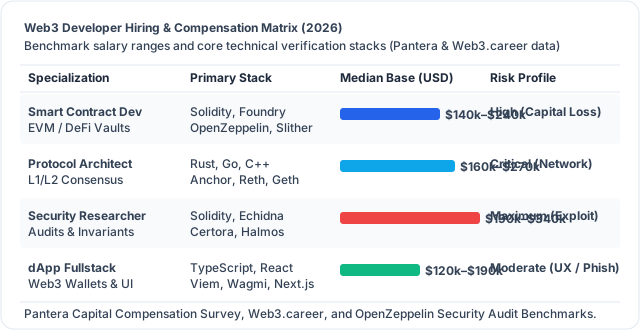 Figure 2: Comparative salary brackets, verification frameworks, and capital risk profiles across core Web3 engineering specializations.
The Ethereum Virtual Machine represents the largest market share in decentralized application development. Writing code for the EVM requires specialized tooling, testing methodologies, and architectural standards.
The contemporary standard for EVM development is Foundry, an ultra-fast Rust-based framework containing Forge, Cast, and Anvil. Foundry replaces legacy Node.js environments like Hardhat for high-stakes protocol engineering, allowing developers to write both contracts and test suites natively in Solidity.
// SPDX-License-Identifier: MIT
pragma solidity 0.8.28;

import {Test} from "forge-std/Test.sol";
import {IERC20} from "@openzeppelin/contracts/token/ERC20/IERC20.sol";

contract ProtocolYieldTest is Test {
    IERC20 public constant USDC = IERC20(0xA0b86991c6218b36c1d19D4a2e9Eb0cE3606eB48);
    address public liquidityProvider = makeAddr("liquidityProvider");

    function setUp() public {
/ Fork live Ethereum mainnet state at specific block
        vm.createSelectFork("https://eth.llamarpc.com", 21_850_000);
    }

    function testFork_VerifyWhaleLiquidityDeposit() public {
        uint256 whaleBalance = USDC.balanceOf(0x47ac0Fb4F2D84898e4D9E7b4DaB3C24507a6D503);
        assertGt(whaleBalance, 1_000_000 * 1e6);
    }
}
Production contract engineering relies on audited component libraries maintained by OpenZeppelin. These libraries establish reference implementations for token standards, including the ERC-20 Specification, ERC-721 Specification, ERC-1155 Multi Token Standard, and the ERC-4626 Tokenized Vault Standard.
Beyond unit testing, engineers implement property-based fuzzing and invariant tests. Static analysis tools like Slither parse abstract syntax trees to flag vulnerable patterns. Candidates demonstrate proficiency by solving smart contract security wargames like Ethernaut and Damn Vulnerable DeFi.
While EVM compatibility dominates general decentralized finance, high-throughput consumer applications, decentralized physical infrastructure networks (DePIN), and high-frequency trading increasingly deploy on the Solana Virtual Machine (SVM).
Solana replaces the EVM's sequential single-threaded execution model with Sealevel, a parallelized transaction processing engine. In Solana, programs (smart contracts) are completely stateless. All persistent data lives in external accounts passed into the program via array references during transaction execution. Because every transaction declares all accounts it intends to read or write in advance, the validator runtime processes non-overlapping transactions concurrently across CPU cores.
Developers write Solana programs in Rust using the Anchor Framework. Anchor provides procedural macros that handle account serialization, deserialization, and security constraint checks:
use anchor_lang::prelude::*;

declare_id!("Fg6PaFpoGXkYsidMpWTK6W2BeZ7FEfcYkg476zPFsLnS");

#[program]
pub mod token_vault {
    use super::*;

    pub fn initialize_vault(ctx: Context<InitializeVault>, initial_deposit: u64) -> Result<()> {
        let vault_account = &mut ctx.accounts.vault;
        vault_account.authority = ctx.accounts.signer.key();
        vault_account.balance = initial_deposit;
        Ok(())
    }
}

#[derive(Accounts)]
pub struct InitializeVault<'info> {
    #[account(init, payer = signer, space = 8 + 32 + 8)]
    pub vault: Account<'info, VaultState>,
    #[account(mut)]
    pub signer: Signer<'info>,
    pub system_program: Program<'info, System>,
}

#[account]
pub struct VaultState {
    pub authority: Pubkey,
    pub balance: u64,
}
Learning Solana requires understanding rent exemption, program-derived addresses (PDAs) used for autonomous program state authorization, and compute budget units. Explorer tools like Solana Explorer and RPC providers like QuickNode facilitate testnet debugging.
Beyond Solana, developer interest is growing around Move on Sui Network and Aptos. Move enforces linear logic, meaning digital assets cannot be copied, discarded, or implicitly created, eliminating entire categories of reentrancy and token duplication vulnerabilities. Multi-chain protocol architects also adopt the Cosmos SDK for application-specific sovereign blockchains, or build within the Polkadot Developer Portal and Near Protocol environments.
A blockchain protocol is inaccessible without robust client infrastructure connecting decentralized consensus networks to end users. Full-stack Web3 engineers build the middle tier connecting web applications to smart contracts.
Developers connect frontend applications to user wallets using modern TypeScript libraries. Viem provides a type-safe interface for encoding contract calls and decoding ABI responses, while Wagmi provides React hooks for managing wallet connections, balance queries, and transaction state changes. Embedded onboarding platforms like Privy and Dynamic allow non-crypto users to generate wallets using social logins, utilizing secure multiparty computation (MPC).
On-chain data queries present unique scaling challenges. Reading historical events or complex relational data directly from node JSON-RPC endpoints is slow and rate-limited. Production applications utilize indexing protocols like The Graph to deploy Subgraphs. Subgraphs monitor blockchain logs, transform on-chain events via AssemblyScript handlers, and store data in relational databases queryable via GraphQL.
Decentralized storage networks like IPFS and Arweave guarantee that application frontends, token metadata, and whitepapers remain tamper-resistant and permanently available without central server dependencies.
Data analysts and backend engineers also utilize Dune Analytics and DefiLlama to monitor protocol total value locked (TVL), liquidity depth, user retention, and contract call volumes using SQL. Real-time simulation suites such as Tenderly empower developers to trace transaction execution opcodes, reproduce mainnet revert errors, and debug transaction execution failures locally.
The blockchain industry has shifted from monolithic Layer 1 architectures to modular execution layers. In a monolithic blockchain like Ethereum L1 or Solana, a single network handles execution, consensus, data availability, and settlement. Modular architectures disaggregate these responsibilities into specialized protocol layers.
Layer 2 rollups execute transactions off-chain, batch thousands of user interactions together, and post cryptographic proofs or transaction data back to Ethereum Layer 1 for settlement and finality. Rollups are divided into two main categories:
Optimistic Rollups: These rely on fraud proofs, assuming transactions are valid unless challenged during a seven-day challenge window. Major implementations include the OP Stack, which powers the Optimism Superchain and Base, and Arbitrum Nitro.
Zero-Knowledge Rollups: These utilize validity proofs generated through advanced zero-knowledge cryptography (SNARKs and STARKs). These proofs mathematically guarantee that execution adhered to protocol rules before being posted to L1, enabling immediate settlement without challenge delay.
The implementation of EIP-4844 introduced temporary data blobs, drastically reducing data availability posting costs for rollups on Ethereum. Specialized modular data availability layers such as Celestia and Avail Project provide dedicated, high-throughput ordering and storage layers for sovereign rollups.
At the staking and shared security layer, protocols like EigenLayer enable restaking, allowing Ethereum validators to repurpose their staked ETH to secure secondary distributed systems, including bridges, oracle networks, and coprocessors.
Concurrently, user account architecture is modernizing through ERC-4337 Account Abstraction and EIP-7702, converting conventional private-key accounts into programmable smart accounts capable of gasless transactions, batched calls, and automated session authorizations.
Security engineering is not a secondary concern in blockchain development. It is the core operational constraint. Because smart contracts manage permissionless financial value, they operate in an adversarial environment where malicious searchers and exploiters automate transaction attacks.
Leading security research firms like Trail of Bits emphasize that developers must write defensive code that adheres to standard security patterns:
Checks-Effects-Interactions Pattern: State mutations must always occur before external contract calls to prevent recursive reentrancy attacks.
Access Control Validation: Sensitive governance and minting functions must strictly enforce role-based permissions using OpenZeppelin AccessControl.
Decentralized Oracles: Price calculations must rely on decentralized oracle infrastructure such as Chainlink Documentation or extensive time-weighted average price (TWAP) filters, rather than spot liquidity pool balances susceptible to single-block flash loan manipulations.
Developers validate their security skills by participating in competitive audit contests hosted on platforms like Code4rena and Sherlock, or hunting vulnerabilities on bug bounty aggregators like Immunefi. Free educational resources like Cyfrin Updraft provide structured curricula covering secure protocol patterns.
Hiring dynamics in blockchain engineering prioritize verified on-chain output and open-source contributions over institutional credentials. According to compensation reports from Pantera Capital and Web3.career, blockchain engineering commands premium compensation across all experience levels.
Entry-level blockchain developers with solid programming fundamentals and verified Foundry or Anchor test projects typically earn between $80,000 and $125,000 USD. Mid-level developers with production mainnet contracts, protocol integrations, and security experience command $130,000 to $185,000 USD. Senior protocol architects, cryptographic systems engineers, and lead smart contract engineers earn between $185,000 and $280,000 USD in base salary, frequently augmented by token allocations vesting over three to four years.
Independent security auditors and formal verification specialists represent the highest earning tier, frequently earning in excess of $300,000 annually through private audit retainers and bug bounty rewards.
To land a role as a blockchain developer, engineers should build a focused portfolio displaying proof of work:
Deploy a complete, fork-tested protocol repository on GitHub showcasing Foundry or Anchor tests, fuzzing runs, and automated CI pipelines.
Build a full-stack decentralized application incorporating Viem, Wagmi, or Privy for onboarding, interacting with contracts deployed on an L2 testnet like Base or Arbitrum Sepolia.
Write and deploy an indexed GraphQL subgraph on The Graph that aggregates on-chain events into structured analytics data.
Publish a detailed security review, post-mortem writeup, or competitive audit submission breaking down a real-world protocol vulnerability.
By mastering distributed systems fundamentals, developing deep competency in native execution frameworks like Foundry or Anchor, and prioritizing defensive security practices, software engineers can build lasting, high-impact careers shaping the future of global decentralized infrastructure.
Explore more guides and career playbooks