Filecoin Explained and How Cryptographic Storage Proofs Work
Public blockchains such as the Ethereum Foundation network, Solana Protocol, and the Bitcoin Network excel at achieving global consensus across compact state variables: account balances, cryptographic public keys, and smart contract execution parameters. However, their underlying consensus engines are fundamentally unsuited for storing large digital files. Storing a single gigabyte of video data or machine learning weights directly on Ethereum mainnet would cost millions of dollars in gas fees and trigger state bloat that would paralyze validating nodes globally.
Early decentralized applications addressed this limitation by utilizing the InterPlanetary File System (IPFS), pioneered by Juan Benet and Protocol Labs. While IPFS revolutionized content addressing by replacing location-based URLs with cryptographic content identifiers (CIDs), natively integrated into web browsers like Brave Browser and Opera Browser, it lacked a native incentive mechanism. If an IPFS node hosting a critical dataset goes offline or clears its local garbage collection cache, the data becomes permanently inaccessible across the peer-to-peer network.
Filecoin was engineered to solve this incentive dilemma. Launched as an open-source decentralized storage network, Filecoin wraps an algorithmic incentive layer around peer-to-peer content storage. Through advanced zero-knowledge cryptography, verifiable storage proofs, and automated collateral pledges, Filecoin converts commodity hard drive capacity across global data centers into an auditable, decentralized cloud storage market. This guide provides an in-depth technical analysis of Filecoin storage architecture, mathematical replication proofs, the Filecoin Virtual Machine (FVM), and its cryptoeconomic security models.
The Cryptographic Foundations: PoRep and PoSt
The core engineering challenge of decentralized storage is verification: How does an on-chain smart contract verify that an untrusted off-chain storage provider is actually storing a specific 100-gigabyte file across physical magnetic disks, without requiring the entire blockchain to download that file?
Naive challenge-response schemes fail in adversarial environments:
- Generation Attack: A malicious provider does not store the file. When challenged, it rapidly downloads or regenerates the data on-the-fly, answers the query, and discards the file.
- Deduplication Attack (Sybil Attack): A provider claims to store ten independent backup copies of a client dataset, earning ten times the reward, while actually storing only one physical copy on disk.
- Outsourcing Attack: A provider offloads storage to a centralized cloud provider like Amazon Web Services S3 and forwards challenges in real-time.
Filecoin resolves these failure modes through two cryptographic primitives: Proof of Replication (PoRep) and Proof of Spacetime (PoSt).
1. Proof of Replication (PoRep) and the SDR Algorithm
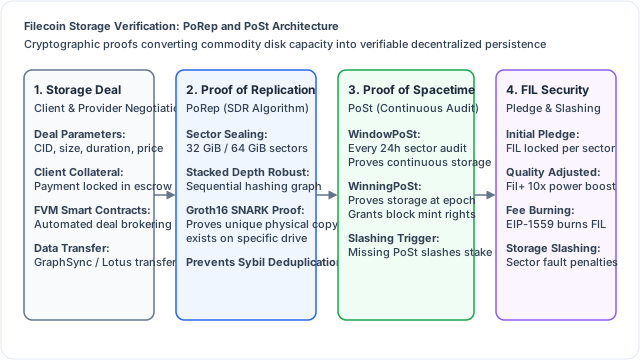
Proof of Replication is executed when a Storage Provider (SP) commits a sector of data (standardized at 32 GiB or 64 GiB). PoRep mathematically proves that a dedicated, unique physical replica of the data was generated and stored on the provider hardware.
To prevent generation attacks, Filecoin employs the Stacked Depth Robust (SDR) graph algorithm:
- Sequential Graph Encoding: The raw client data is transformed through a directed acyclic graph composed of multiple layered graphs (typically 11 layers for 32 GiB sectors). Each node in layer $l$ is derived deterministically from parents in layer $l$ and layer $l-1$ using cryptographic hashes (such as Poseidon Hashing and SHA-256).
- Time-Asymmetric Computation: Sealing an SDR sector requires hours of intensive, sequential computation that cannot be parallelized. Because regenerating the replica requires hours, a provider cannot fake storage by generating data on-the-fly when challenged in a seconds-long challenge window.
- zk-SNARK Compression: Once the sector is sealed, verifying the massive SDR graph on-chain would consume prohibitive gas. The provider generates a succinct Groth16 zk-SNARK proof using pairing-friendly BLS12-381 elliptic curves. The resulting proof is only a few hundred bytes, allowing on-chain validators to confirm sector replication in milliseconds.
2. Proof of Spacetime (PoSt)
Proving that a sector was sealed at time $t_0$ does not guarantee that the hard drive did not fail or delete the file at time $t_1$. Filecoin enforces continuous auditing through Proof of Spacetime (PoSt), which requires providers to repeatedly prove that they still hold the intact sealed replica over extended time durations.
PoSt operates via two complementary mechanisms:
- WindowPoSt (Integrity Audits): Every 24-hour day is divided into 48 non-overlapping 30-minute deadlines. A storage provider entire storage portfolio is partitioned across these deadlines. During each deadline, the provider must prove custody of a randomly selected subset of sectors by evaluating random Merkle challenges generated from recent block hashes. If a provider misses a WindowPoSt deadline, their sector is declared faulty, their storage power is suspended, and their pledged collateral is slashed.
- WinningPoSt (Consensus & Block Production): When a block generation epoch arrives, the consensus engine challenges candidate miners. If an elected provider successfully generates a WinningPoSt proof for a randomly challenged sector within the brief epoch window (25 seconds), the miner earns the right to produce a new block and receive the associated block minting reward.
Storage Power and Expected Consensus (EC)
Unlike the Bitcoin Network which measures hash rates, or Ethereum Proof-of-Stake which measures deposited coin weight, Filecoin consensus relies on Storage Power Consensus (Expected Consensus).
A storage provider voting weight and probability of being elected block leader in epoch $t$ is directly proportional to its verified storage power relative to the total storage capacity of the entire global network:
$$P( ext{Leader}) = �rac{ ext{Provider Storage Power}}{ ext{Total Network Storage Power}}$$
Through the Filecoin Plus (Fil+) initiative governed by the Filecoin Foundation and community notaries, open-source projects funded by Gitcoin Grants, scientific archives, and academic institutions receive DataCap allocations. When an enterprise stores DataCap-verified data, the storage provider receives a 10-fold multiplier on its consensus power, dramatically accelerating block rewards and driving enterprise adoption.
The Filecoin Virtual Machine (FVM) and Programmable Storage
Historically, Filecoin operated strictly as a two-sided marketplace for storage deals negotiated through the off-chain Lotus Node CLI.
In 2023, the protocol underwent an architectural upgrade with the launch of the Filecoin Virtual Machine (FVM), developed by Protocol Labs. Built on a WebAssembly (Wasm) core with complete Ethereum Virtual Machine (FEVM) compatibility, the FVM allows developers to deploy standard Solidity smart contracts directly onto the Filecoin network, interacting natively with Layer 2 ecosystems like Polygon, Arbitrum, and Optimism, and cross-chain oracles like Chainlink and indexing rails from The Graph.
Transformative Use Cases Enabled by FVM
- DataDAOs and Curated Data Collectives: Decentralized Autonomous Organizations can govern sovereign, shared datasets (such as genomic databases, machine learning training corpuses, or public history archives like the Internet Archive). The DataDAO smart contract controls a treasury that programmatically finances ongoing storage deals across multiple global storage providers, guaranteeing permanent availability.
- Automated Repair and Replication Contracts: An FVM smart contract can monitor storage deals continuously. If a storage provider drops off-chain and fails its WindowPoSt audits, the contract automatically invokes secondary storage providers, draws capital from an escrow reserve, and initiates fresh deals without requiring human administrator intervention.
- Undercollateralized Storage Provider Lending: Storage providers require massive amounts of liquid FIL to lock as initial pledge collateral before they can onboard new sectors. Protocols like GLIF Protocol utilize FVM smart contracts to pool FIL from passive liquidity providers and lend it to enterprise storage operators, earning stable protocol yield.
Cryptoeconomics: FIL Minting, Pledges, and Slashing
The Filecoin token economy balances hardware expansion against long-term operational reliability through a dual-mechanism minting model and rigorous collateral locking.
1. Dual Minting: Simple vs Baseline
To avoid hyperinflation during early network phases when storage capacity was modest, Filecoin partitions block rewards:
- Simple Minting: 30% of storage rewards are distributed on a standard exponential half-life schedule, ensuring baseline rewards for early hardware adopters.
- Baseline Minting: 70% of rewards are tied to the global storage capacity target. If global network storage capacity lags behind the mathematical baseline curve, reward emissions are withheld, shifting future inflation outward until hardware expansion catches up.
2. Collateral Pledges and Slashing Penalties
Storage providers must lock significant collateral to ensure good behavior:
- Initial Pledge Collateral: Before sealing a 32 GiB sector, a provider must lock a quantity of FIL calculated based on circulating supply, network capacity, and projected 20-day earnings.
- Fault Fee: If a sector fails WindowPoSt verification, the provider is assessed a daily fault fee until the sector is repaired.
- Termination Penalty: If a provider permanently loses data or abandons a sector before the contract deal expiration, its entire initial pledge collateral is slashed and permanently burned, guaranteeing that abandoning client data is financially ruinous.
The Storage Deal Lifecycle: From Client File to Sealed Sector
Understanding how data moves from a local user hard drive into a cryptographically secured Filecoin sector requires examining the four-phase sector lifecycle:
Data Preparation with UnixFS and IPLD
Before a client transmits raw bytes to a storage provider, the file is processed using the InterPlanetary Linked Data (IPLD) data model and UnixFS format, developed within the Multiformats standard by Protocol Labs Research:
- Chunking: The file is split into 256 KiB blocks.
- Directed Acyclic Graph (DAG): Blocks are structured into a Merkle DAG, deriving a Content Identifier (CID).
- Piece Commitment (CommP): The raw data is padded into a power-of-two sector representation, generating a piece commitment hash (
CommP) that represents the exact root of the data Merkle tree.
- Data Transfer: Small datasets are transmitted over the internet via the GraphSync Protocol and libp2p Networking Stack. For petabyte-scale archives, enterprise clients ship encrypted physical hard drives directly to data centers through the Filecoin Slingshot Program.
The Node Client Ecosystem: Lotus, Venus, and Forest
Filecoin consensus does not depend upon a single monolithic client implementation. Multiple independent software implementations protect the network against consensus-breaking bugs:
- Lotus Node: The canonical reference implementation written in Go, maintaining full validation of actor states, sealing pipelines, and WindowPoSt scheduler routines.
- Venus: A distributed implementation designed specifically for large-scale mining pools. Venus decouples the node daemon from the storage sealing workers, allowing multiple independent data centers to share a single on-chain validator identity.
- ChainSafe Forest: An independent implementation written in Rust by ChainSafe, optimizing memory safety, concurrency, and sync speeds across consumer hardware.
Developer Tooling and Storage APIs
For software engineers building decentralized applications, interacting directly with low-level Lotus daemons can be complex. Modern developers utilize high-level abstractions:
- Web3.Storage and Lighthouse Storage: Developer APIs that automate IPFS pinning and Filecoin deal brokering in a single API call.
- Pinata Cloud and Infura IPFS: Managed pinning services providing low-latency gateway caching and persistent IPFS storage.
- Cloudflare Web3 IPFS Gateway: Enterprise edge caching providing sub-50ms HTTP gateway resolution for decentralized content.
- Foundry and Hardhat: Smart contract frameworks used to deploy Solidity contracts to the Filecoin Virtual Machine (FEVM), interacting with client libraries like Viem and Ethers.js.
- OpenZeppelin Contracts: Standardized ERC-20 and AccessControl libraries utilized across FVM DataDAO governance architectures.
Architectural Comparison: Filecoin vs Arweave vs IPFS vs AWS S3
Decentralized storage protocols operate across distinct technical dimensions, each optimized for different data lifecycles:
While Arweave, bundled via protocols like Irys, uses an upfront endowment model, and networks like Storj Cloud and Sia Network focus on erasure-coded object caching to fund permanent data retention indefinitely, Filecoin operates like a decentralized commodity exchange suitable for exabyte-scale datasets where time-bound contracts, custom replication factors, and geographic data sovereignty are required.
The Road Ahead for Filecoin and Web3 Storage
Filecoin continues to advance its core cryptographic and scaling infrastructure:
- Fast Retrieval and Interplanetary CDN (Saturn): Projects like Filecoin Saturn establish a decentralized Content Delivery Network (CDN) of micro-nodes that cache hot Filecoin data, delivering sub-100-millisecond retrieval latencies that rival centralized CDNs like Cloudflare.
- Decentralized Compute-Over-Data (Bacalhau): Developed by Protocol Labs, Bacalhau enables developers to run distributed computational jobs (such as machine learning training, video transcoding supported by Livepeer Network, and decentralized GPU compute managed by Akash Network and Render Network) directly on the nodes where the data physically resides, eliminating expensive network transfer bandwidth.
- Proof-of-Data Consensus for AI: As artificial intelligence models demand vast, auditable training sets, Filecoin cryptographic proofs provide immutable guarantees of dataset provenance, preventing training corpus tampering.
By combining verifiable zero-knowledge replication proofs, continuous spacetime auditing, and smart contract execution via the FVM, Filecoin provides the essential persistence layer powering the decentralized internet.