Loading article...

A comprehensive career roadmap for Web3 oracle engineers, examining node reliability operations, defensive smart contract integration, protocol architecture, compensation benchmarks, and interview design challenges.
In the decentralized finance ecosystem, smart contracts manage tens of billions of dollars in collateral, automated lending pools, perpetual futures, and cross-chain liquidity bridges. Yet, every smart contract deployed on the Ethereum Foundation network, Solana Protocol, or Arbitrum Layer 2 is essentially blind, deaf, and mute without external data. Blockchains are deterministic state machines that cannot connect to the internet, read external APIs, or observe real-world market movements natively.
Decentralized oracles provide the critical sensory infrastructure of the decentralized web. When an oracle operates smoothly, billions of dollars in global capital clear seamlessly across protocols like Aave, MakerDAO, and GMX. But when an oracle malfunctions, delays an update, or reports a distorted price, the consequences are catastrophic: automated lending pools suffer instant multi-million-dollar insolvencies, solvent borrowers face erroneous liquidations, and protocols freeze.
Because the financial stakes are exceptionally high, organizations across the Web3 ecosystem, including core infrastructure firms like Chainlink Labs, Pyth Data Association, and RedStone Finance, as well as tier-1 DeFi protocols and institutional node operators, compete aggressively for specialized engineering talent. This career roadmap provides an empirical guide to the technical competencies, core specialization tracks, compensation benchmarks, interview frameworks, and portfolio requirements needed to forge an elite career in Web3 oracle engineering.
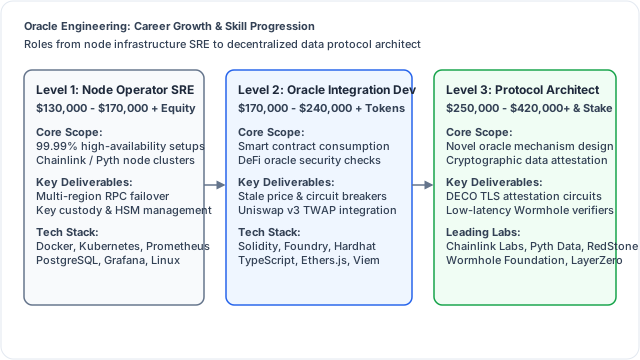
Oracle engineering is not a single, homogeneous job description. The industry divides into three distinct technical specializations, each requiring a specific blend of low-level systems engineering, applied cryptography, or smart contract expertise.
Oracle nodes are mission-critical financial servers. If an enterprise node fails to sign observations during an Off-Chain Reporting (OCR) consensus round, the node operator faces slashing penalties and reputational loss.
While node operators keep the servers running off-chain, integration specialists ensure that downstream smart contracts consume data safely on-chain.
answeredInRound >= roundId), checking for non-positive prices, and handling token decimal normalization (converting 8-decimal USD feeds to 18-decimal ERC-20 balances).Protocol architects work at the bleeding edge of distributed systems, applied cryptography, and market microstructure.
To succeed in technical interviews and contribute effectively to production protocols, an oracle engineer must master competencies across five core engineering domains:
Every smart contract engineer must know how to implement defensive oracle consumption:
// SPDX-License-Identifier: MIT
pragma solidity ^0.8.24;

interface AggregatorV3Interface {
    function decimals() external view returns (uint8);
    function latestRoundData() external view returns (
        uint80 roundId,
        int256 answer,
        uint256 startedAt,
        uint256 updatedAt,
        uint80 answeredInRound
    );
}

interface ISequencerFeed {
    function latestRoundData() external view returns (
        uint80 roundId,
        int256 answer,
        uint256 startedAt,
        uint256 updatedAt,
        uint80 answeredInRound
    );
}

/// @notice Defensive Oracle consumer library guarding against staleness and L2 halts
contract DefensiveOracleConsumer {
    AggregatorV3Interface public immutable priceFeed;
    ISequencerFeed public immutable sequencerUptimeFeed;

    uint256 public constant TIMEOUT = 3600; // 1 hour max allowable staleness
    uint256 public constant GRACE_PERIOD = 3600; // 1 hour buffer after sequencer reboot

    error OraclePriceStale();
    error OraclePriceNonPositive();
    error OracleRoundIncomplete();
    error SequencerOffline();
    error GracePeriodActive();

    constructor(address _priceFeed, address _sequencerFeed) {
        priceFeed = AggregatorV3Interface(_priceFeed);
        sequencerUptimeFeed = ISequencerFeed(_sequencerFeed);
    }

// @notice Returns validated price safely with multiple defensive assertions
    function getSafePrice() external view returns (uint256) {
/ 1. Validate L2 Sequencer Uptime if deployed on Arbitrum / Optimism / Base
        if (address(sequencerUptimeFeed) != address(0)) {
            (, int256 status, , uint256 startedAt, ) = sequencerUptimeFeed.latestRoundData();
            if (status == 1) revert SequencerOffline();
            if (block.timestamp - startedAt < GRACE_PERIOD) revert GracePeriodActive();
        }

/ 2. Fetch round data from primary decentralized aggregator
        (
            uint80 roundId,
            int256 rawPrice,
            ,
            uint256 updatedAt,
            uint80 answeredInRound
        ) = priceFeed.latestRoundData();

/ 3. Defensive sanity assertions
        if (rawPrice <= 0) revert OraclePriceNonPositive();
        if (block.timestamp - updatedAt > TIMEOUT) revert OraclePriceStale();
        if (answeredInRound < roundId) revert OracleRoundIncomplete();

        return uint256(rawPrice);
    }
}
Engineers specializing in oracles and data feeds find opportunities across several categories of organizations:
To evaluate whether to pursue an infrastructure or SRE role within an oracle enterprise, engineers must understand the underlying unit economics of decentralized data validation.
Enterprise node operators such as Deutsche Telekom MMS, Swisscom Digital Assets, and Staking Facilities operate as capital-intensive validation businesses. A single operator may participate in dozens of independent OCR round committees simultaneously across Ethereum, Avalanche, Polygon, Arbitrum, and Base.
In high-congestion environments, node SREs must ensure transactions never get stuck in mempools:
Technical interviews for oracle roles focus heavily on failure recovery, latency optimization, and economic attack vectors. Candidates must be prepared to solve complex architectural challenges:
Question: "Your Chainlink node's transaction is stuck in the Ethereum public mempool during a sudden gas spike where base fees surged from 20 gwei to 300 gwei. Subsequent rounds are blocked because the transaction nonce has not confirmed. How does your node architecture handle this without missing OCR rounds?"
Model Answer: An enterprise oracle node must decouple transaction submission from round participation. Under modern OCR 2.0 architectures, node consensus occurs off-chain over libp2p, meaning round consensus is not blocked by a single node's transaction queue.
For on-chain submission, the node uses an automated Gas Price Bumper Daemon. The daemon monitors unconfirmed transactions: if a transaction remains pending after $N$ blocks, the daemon broadcasts a replacement transaction using the exact same nonce but with a 15% to 20% higher priority fee (EIP-1559 maxPriorityFeePerGas), replacing the stuck transaction in validator mempools. Additionally, enterprise operators maintain multiple independent hot-wallet signing keys to ensure that a stuck nonce on one key does not block separate reporting feeds.
Question: "A perpetual futures exchange on Arbitrum requires sub-second price updates for 100 assets. Explain why a traditional push oracle is economically infeasible, and design an alternative pull architecture."
Model Answer: A push oracle updating 100 asset feeds on a 0.5% deviation or 1-second heartbeat would require millions of transactions per day, costing tens of thousands of dollars in gas fees even on a Layer 2 rollup.
The optimal design is a Pull Oracle Model (such as Pyth Network or Chainlink Data Streams):
Hiring managers in the decentralized data space value verifiable open-source code and operational proof-of-work above academic credentials. To stand out, build and publish the following portfolio projects:
As decentralized ledgers integrate with traditional capital markets, the demand for oracle engineering will continue to accelerate:
Engineers who master the intersection of high-availability infrastructure, applied cryptography, and defensive smart contract engineering will remain at the forefront of building the foundational data layer of the decentralized internet.