Loading article...

A final Department of Labor rule that would give 401(k) fiduciaries a safe harbor for offering crypto and other alternative assets entered White House review on Nov. 5.
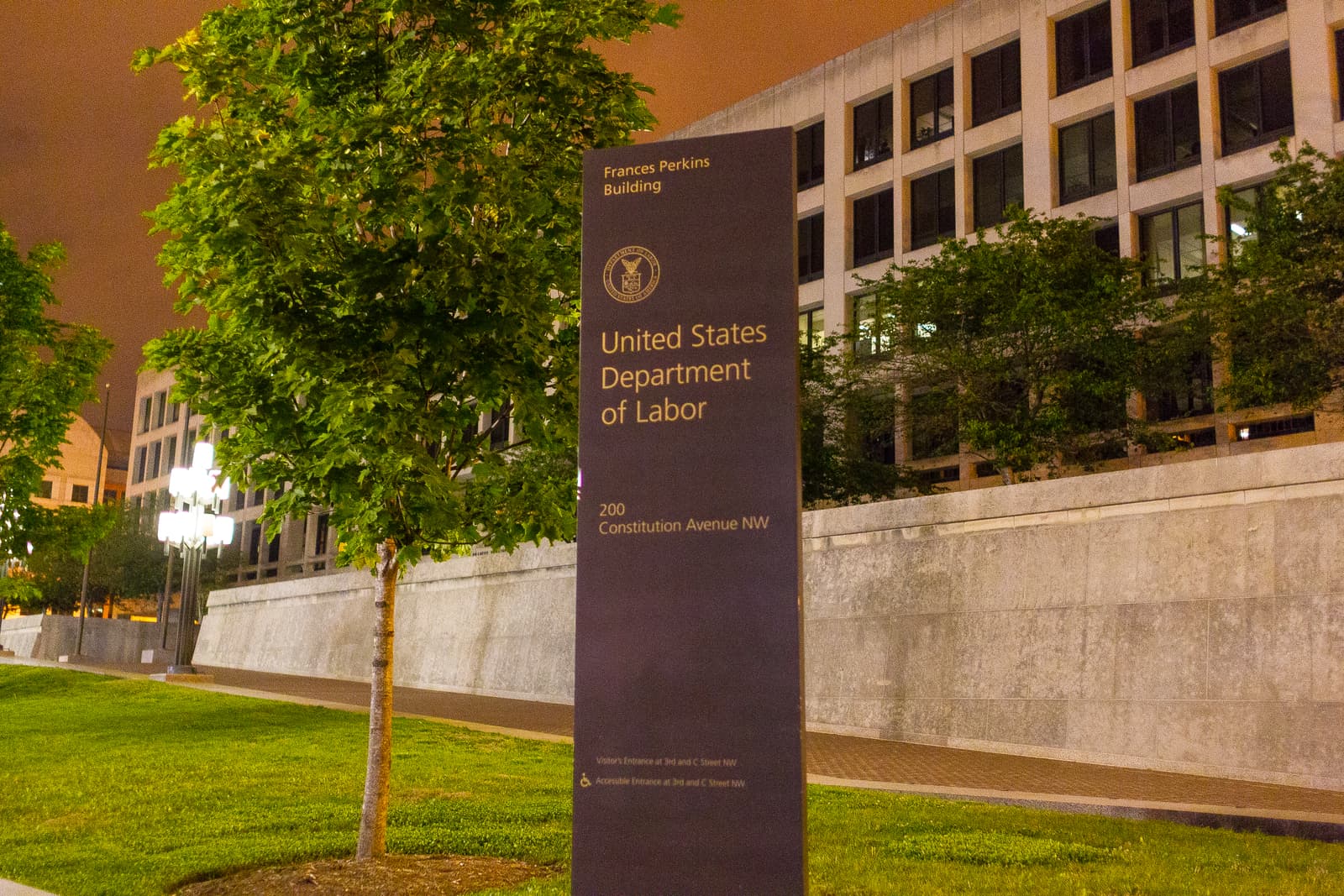
The Frances Perkins Building, headquarters of the U.S. Department of Labor, in Washington, D.C. Photo: US Department of Labor via Wikimedia Commons (CC BY 2.0). Source
A final Department of Labor rule that would make it easier for 401(k) plans to offer crypto and other alternative assets arrived at the White House on Nov. 5 for review, a procedural step that usually precedes public release. The Office of Information and Regulatory Affairs logged the package that day under the title "Fiduciary Duties in Selecting Designated Investment Alternatives," RIN 1210-AC38, the government filing shows. Bitcoin Magazine reported the arrival, citing Bloomberg Law.
The filing lists the DOL's Employee Benefits Security Administration as the authoring office, marks the stage as a final rule, flags it as economically significant and notes that there is no legal deadline for completion. OIRA review under Executive Order 12866 is the last interagency checkpoint before a final rule can be published in the Federal Register, Bitcoin Magazine wrote. The same office cleared the proposed version in late March before the department published it.
Bitbo noted that OMB clearance is the last step before the DOL can publish the rule, and that there is no deadline for clearing it, though the Insured Retirement Institute expects the review to take between 60 and 90 days. The final regulation is expected to take effect toward the end of the first quarter of 2027.
The department first proposed the rule in March to implement President Donald Trump's Aug. 7, 2025 executive order, "Democratizing Access to Alternative Assets for 401(k) Investors," which directed the Labor secretary to reexamine ERISA guidance and, where appropriate, propose rules with "appropriately calibrated safe harbors." That order defined alternative assets to include private-market equity and debt, real estate, holdings in actively managed vehicles that invest in digital assets, commodities, infrastructure and lifetime-income strategies.
Under the proposal, plan fiduciaries who follow a documented process when adding private assets to a 401(k) menu would get a legal safe harbor under the Employee Retirement Income Security Act of 1974. The six factors named in the draft are performance, fees, liquidity, valuation, performance benchmarks and complexity. Meeting them does not force plans to offer crypto. It lowers the litigation risk for employers that decide they want to. A DOL fact sheet said prudence under ERISA is process-based and that fiduciaries keep discretion to select any designated investment alternative if they follow the outlined review.
Deputy Labor Secretary Keith Sonderling cast the approach as neutral. "The department's days of picking winners and losers are over," Sonderling said when the proposal was unveiled, adding that the rule "clearly spells out that managers must evaluate any and all potential product offerings by following a prudent process."
The stance reverses an earlier warning. In May 2025 the DOL rescinded its March 2022 compliance release, which had told fiduciaries to use "extreme care" before putting cryptocurrency on a 401(k) menu, and said that phrase was not found in ERISA. Sens. Bernie Sanders and Elizabeth Warren later pressed the department to abandon the crypto-friendly path, arguing the rule would expose investors to volatile assets, and House Republicans have separately pushed to codify Trump's order in statute.
The proposal drew more than 47,000 public comments, and House and Senate committee leaders called for investigations after thousands of near-identical comments were submitted in support. Industry and labor groups have argued opposite sides of the prudence standard for months.
In its filing, the DOL said the clarification must aim to identify the criteria fiduciaries should use to prudently balance potentially higher expenses against the objectives of seeking greater long-term net returns and broader diversification of investments. The stakes sit in plan menus rather than spot ETF flows: Bitcoin Magazine framed digital assets as a retirement-access issue for more than 90 million defined-contribution savers in a 401(k) market of roughly $12 trillion. A finalized safe harbor would not put bitcoin and crypto on every lineup overnight. It would give plan committees a clearer path if they want exposure through an asset-allocation sleeve that holds digital assets.
What is not yet public is the final text. Whether the six-factor safe harbor survived comment intact, how digital-asset vehicles are described and what effective date the DOL chose will only become clear when OIRA returns the rule and the department posts it. The expected effective date sits toward the end of the first quarter of 2027.