Loading article...

An empirical technical thesis on the Cosmos ecosystem and the Inter-Blockchain Communication protocol, exploring CometBFT consensus, light-client verification, interchain accounts, and sovereign app-chain topology.
The foundational architectural divide in distributed ledger technology centers on a fundamental philosophical choice: should decentralized applications exist as smart contract tenants on a shared, monolithic virtual machine, or should each application operate its own sovereign, purpose-built blockchain?
While the Ethereum Foundation prioritized a unified global state machine, the creators of the Cosmos Network introduced an alternative paradigm: the "Internet of Blockchains." Under this model, scalability, customizability, and sovereignty are achieved not by forcing applications to compete for execution bandwidth on a single base layer, but by enabling an interconnected web of autonomous, application-specific blockchains (app-chains) communicating trustlessly through the Inter-Blockchain Communication (IBC) protocol.
As decentralized exchanges, derivative platforms, and modular data availability layers experience extreme transaction volumes, the Cosmos architectural model has emerged as a premier framework for sovereign decentralized infrastructure.
To understand why protocols migrate to sovereign blockchains, one must examine the operational bottlenecks inherent to multi-tenant smart contract environments:
When an application runs as a smart contract on a shared chain, it inherits the execution rules, cryptographic primitives, and economic parameters of that chain. If the base chain experiences congestion, transaction fees escalate unpredictably. Furthermore, complex state transitions (such as frequent limit order matching or continuous oracle updates) become economically prohibitive due to high gas costs.
An application-specific blockchain eliminates these trade-offs:
A prominent empirical demonstration of this principle was the migration of dYdX from an Ethereum Layer 2 rollup to a sovereign Cosmos app-chain (dYdX Chain). By operating its own CometBFT consensus network, dYdX achieved off-chain in-memory orderbook matching capable of processing thousands of orders per second with zero gas fees for placing or canceling orders.
The foundational consensus layer powering the Cosmos ecosystem is CometBFT, the open-source successor to the original Tendermint Core engine, maintained by the Interchain Foundation.
CometBFT is a Byzantine Fault Tolerant (BFT) consensus engine and peer-to-peer networking stack designed to replicate a deterministic state machine across distributed nodes. It guarantees safety and liveness under the standard BFT assumption: the network remains fully secure as long as less than one-third (33.3%) of voting power is Byzantine (malicious or offline).
The consensus mechanism operates in deterministic rounds consisting of three distinct phases:
A critical property of CometBFT is absolute, deterministic finality. Unlike Proof of Work networks (such as Bitcoin) or probabilistic Proof of Stake chains that experience temporary forks and require probabilistic confirmation windows (such as waiting 6 to 12 blocks), CometBFT never forks under normal operating conditions.
Once a block receives signatures from two-thirds of voting power, it is immutable. There are no uncle blocks or chain reorganizations. This deterministic finality is the strict prerequisite that makes trustless cross-chain communication via light clients mathematically feasible.
If individual blockchains operate as isolated state machines, the ecosystem risks devolving into fragmented digital silos. The breakthrough innovation that connects the Cosmos ecosystem is the Inter-Blockchain Communication (IBC) protocol, specified through the Interchain Standards (ICS) published by the Cosmos Developer Portal.
IBC functions as the TCP/IP of decentralized ledgers: a standardized, end-to-end transport protocol that enables independent, sovereign state machines to exchange data payloads, tokens, and smart contract messages without requiring any trusted intermediary or centralized multisig bridge.
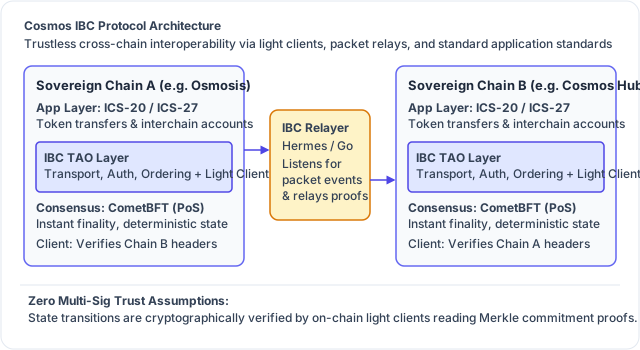
IBC is architected into two foundational layers: the TAO (Transport, Authentication, and Ordering) layer and the Application layer.
On-Chain Light Clients: Each IBC-enabled blockchain runs an on-chain light client of the counterparty blockchain. The light client continuously tracks the block headers and validator set transitions of the remote chain. When Chain A receives a message from Chain B, Chain A does not trust an external oracle; its internal light client verifies the cryptographic validator signatures and Merkle commitment proofs directly against the recorded state root of Chain B.
Connections: A connection encapsulates two counterparty light clients, establishing a verified cryptographic communication pipeline between the two networks.
Channels and Ports: Channels route data packets between specific application modules on either side of the connection. Channels can be configured as ordered (guaranteeing that packets execute strictly in sequential order) or unordered (allowing packets to execute as soon as they arrive).
Packets: An IBC packet is an opaque byte envelope containing a sequence number, timeout timestamp, source port/channel, destination port/channel, and the arbitrary application payload.
Blockchains cannot initiate outbound internet requests or monitor external networks; they are passive state machines that only react when transactions are submitted to their RPC interfaces.
To transport packets between chains, the IBC ecosystem relies on off-chain relayers, such as the open-source Hermes relayer written in Rust by Informal Systems or the Go relayer maintained by the Strangelove Ventures engineering team:
Crucially, relayers are completely unprivileged actors. A relayer cannot steal funds, forge state transitions, or alter transaction contents. If a relayer submits an invalid packet, the on-chain light client mathematically rejects it. If a relayer goes offline, any other relayer (or the user themselves) can submit the transaction, ensuring absolute censorship resistance.
Above the TAO layer sit the Interchain Standards that define how applications interact across chains:
ICS-20 defines the standard protocol for transferring fungible tokens across chains. When tokens move from their origin chain (Chain A) to a destination chain (Chain B), Chain A locks the native tokens in an escrow account, and Chain B mints an equivalent number of IBC voucher tokens denominated by their cryptographic hash path: ibc/{hash(trace/denom)}.
When the voucher tokens are transferred back, Chain B burns the synthetic vouchers, and Chain A unlocks the original native assets. Because token balances are authenticated by light clients, there is zero reliance on centralized bridge custodians.
While ICS-20 enables cross-chain asset movement, ICS-27 unlocks cross-chain execution composability. Interchain Accounts allow an account or smart contract on Chain A (the controller chain) to securely register and control an account on Chain B (the host chain).
Using ICS-27, a decentralized autonomous organization on the Cosmos Hub can vote to stake tokens, supply liquidity into an automated market maker on Osmosis, or borrow assets on a lending platform, broadcasting the execution instruction across IBC without the DAO members ever leaving their home chain.
Historically, launching an independent Proof of Stake app-chain required bootstrapping a dedicated validator set and attracting hundreds of millions of dollars in staked capital to prevent 51% consensus attacks. For early-stage protocols, this economic hurdle was significant.
To solve this cold-start problem, the Cosmos ecosystem introduced Interchain Security (ICS), also known as Replicated Security:
Under Replicated Security, consumer chains (such as Neutron for smart contracts and Stride for liquid staking) borrow the full economic security of the Cosmos Hub. The Hub validators produce blocks for both the Hub and the consumer chains. If a validator misbehaves or double-signs on a consumer chain, their staked ATOM on the Cosmos Hub is slashed.
In addition to Replicated Security, the ecosystem is deploying Mesh Security, a bidirectional staking model developed by Osmosis and Axelar Network that allows validators on multiple independent chains to cross-stake their collateral, reinforcing each other's economic security without requiring a strict parent-child hierarchy.
The superiority of the IBC security model is evidenced by historical security benchmarks across Web3:
While centralized and multisig bridges have lost billions of dollars to stolen private keys and signature forgery (documented by security research firms like Trail of Bits and CertiK), the core IBC transport layer has maintained a flawless cryptographic record. If an IBC-connected chain experiences a consensus failure or halts, IBC timeout packets automatically trigger, refunding the user escrowed assets on their origin chain.
The Cosmos network has evolved into an expansive federation of specialized blockchains:
The reach of the Inter-Blockchain Communication protocol is no longer restricted to CometBFT-based chains. Engineering initiatives are extending native IBC verification across heterogeneous networks:
IBC to Ethereum and EVM Networks: Protocols like Union Build and Polymer Labs utilize zero-knowledge state proofs to verify CometBFT headers inside Ethereum smart contracts, enabling trustless IBC connections between Cosmos app-chains and Ethereum Layer 2 rollups.
IBC to Polkadot and Solana: Through light client implementations and zero-knowledge coprocessors, developers are linking the Cosmos ecosystem directly into Substrate and Solana runtimes, unifying fragmented on-chain liquidity into a cohesive multichain mesh.
By decoupling execution into sovereign state machines and connecting them through mathematically verified cryptographic transport standards, Cosmos has proven that the future of decentralized computing is not monolithic, but an expansive, sovereign, and interoperable interchain.
Explore more guides and career playbooks