
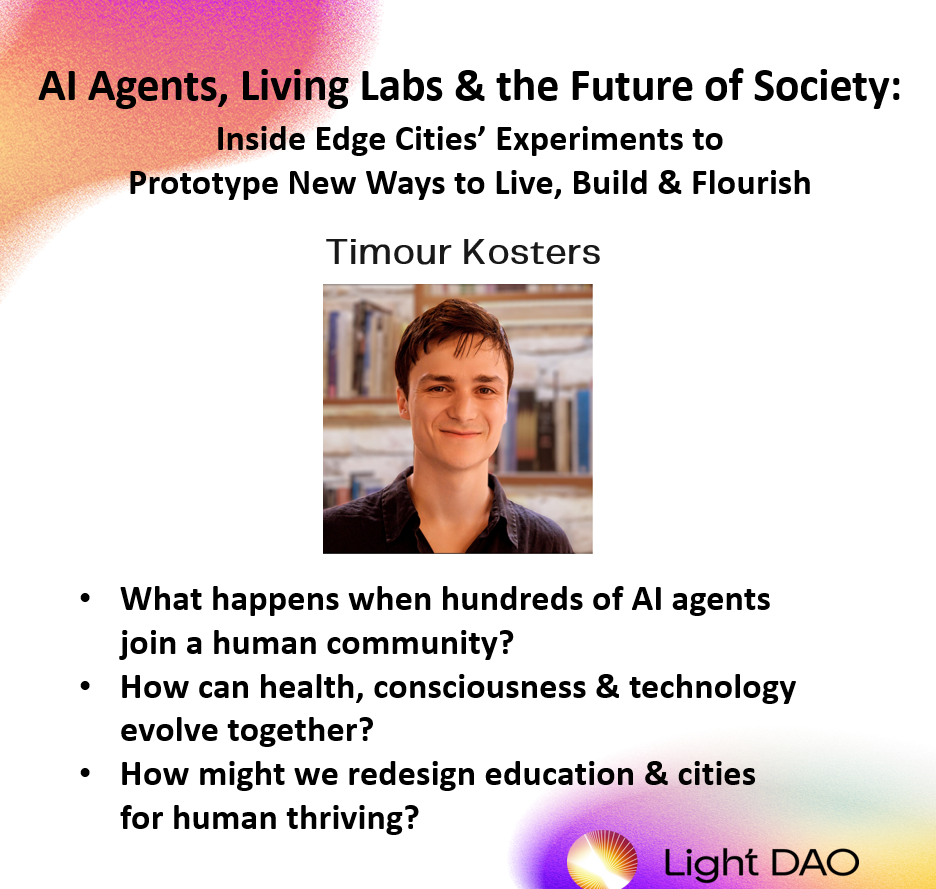
Light Dao's San Francisco salon on September 1, 2026 hands the floor to Edge Cities co-founder Timour Kosters for a fireside on living laboratories — popup villages where hundreds of innovators, and hundreds of AI agents, experiment with new ways of living together for a month at a time.
A Salon About Living in Future Tense
The premise behind Edge Cities reads like a dare to the conference-industrial complex: what happens when hundreds of the most innovative people in AI, science, technology, health, culture and art don't just meet for a few days, but live and experiment together for a month? Founder, researchers, technologists, investors, artists and families all take part, testing new ideas, technologies and ways of living side by side.
Edge has staged these living laboratories from Healdsburg to Patagonia, Chiang Mai, Cape Town and elsewhere, with each location doubling as a laboratory for possibilities in technology, community and human flourishing. Rather than talking about the future, the framing goes, participants get a place to prototype it.
For this salon evening in San Francisco, Light Dao pairs Kosters with its own co-founder Ruby Yeh for a conversation aimed squarely at founders and investors who wonder whether community design belongs in their build roadmaps.
Experiments Worth Arguing About
The material is genuinely strange in the best way. At a recent Edge City staged two hours north of the Bay Area, experiments included an Agent Village that brought hundreds of personal AI agents into the community as participants — not demos, residents. Health experts ran tests on metabolic health, wearables and bioelectricity, while a Consciousness Cohort explored neurotech, contemplative technologies and the science of consciousness, alongside tracks on the future of education, cities and governance.
Questions teed up for the fireside follow from there: what happens when hundreds of AI agents become participants in a human community? Which experiments produced the most unexpected results? What helps tech innovation and human flourishing coexist instead of compete?
Kosters brings an unusually multidisciplinary vantage point — ten years building startups including Artsy, Kama and the social brand Impact, a partnership at Seed Club Ventures, multiple large communities, and the award-winning experiential agency Excetera.
How the Evening Runs
The agenda is precise. Doors open at 6:00pm with welcome and healthy snacks, and entry closes at 7:00pm sharp. From 7:00 to 7:30 comes Light Dao's signature Connection Experience, followed by the 7:30–8:15pm fireside chat between Timour and Ruby. Every guest then delivers a one-line business intro from 8:15 to 8:30, and the room winds down from 8:30 to 9:00pm.
Scale is deliberately small — a curated salon of fewer than fifty people. Registration requires approval, and non-members should answer the application questions thoroughly; the Dao Member Owner tier costs 60 Light Tokens and unlocks gatherings across multiple cities. Plus-ones must RSVP individually, no exceptions.
Late arrivals lose more than snacks: entry stops at 7:00pm so the Connection Experience stays intact for everyone already seated. Plan transit accordingly — SOMA blocks eat time on weeknights.
Who Light Dao Thinks Should Attend
Context helps: Light Dao describes itself as a friends-of-trusted-friends global network of more than 7,000 entrepreneurs including 1,000 investors, hosting curated gatherings in LA, NYC, SF, Lisbon and Taipei among other cities. Past SF salon guests have ranged from Mayfield's Tim Chang to GoogleX founding team member Tom Chi, so the bar for the conversation is set high.
The venue sits in the SOMA district, exact address revealed after approval. Anyone allergic to structured icebreakers should know the Connection Experience is non-negotiable — but for a room engineered around whole-person connection rather than badge-swapping, that is arguably the point.