Loading article...

An in-depth technical and financial analysis of crypto launchpads, Initial DEX Offerings (IDOs), tiered staking mechanisms, smart contract vesting vaults, and project due diligence.

Capital formation in early-stage Web3 startups has evolved through distinct technological epochs. In the 2017 boom, projects raised capital through permissionless Initial Coin Offerings (ICOs), where investors transferred ETH directly to unverified smart contracts without regulatory compliance, founder identity checks, or token lockup guarantees. The lack of structured due diligence resulted in widespread security exploits, exit scams, and severe regulatory crackdowns.
To address these vulnerabilities, the Web3 ecosystem engineered Crypto Launchpads (also known as Initial DEX Offering or IDO platforms). A crypto launchpad operates as a specialized decentralized incubator and token sale platform. It acts as an intermediary layer between early-stage Web3 projects seeking development capital and a global pool of retail and institutional investors seeking early-stage token allocations.
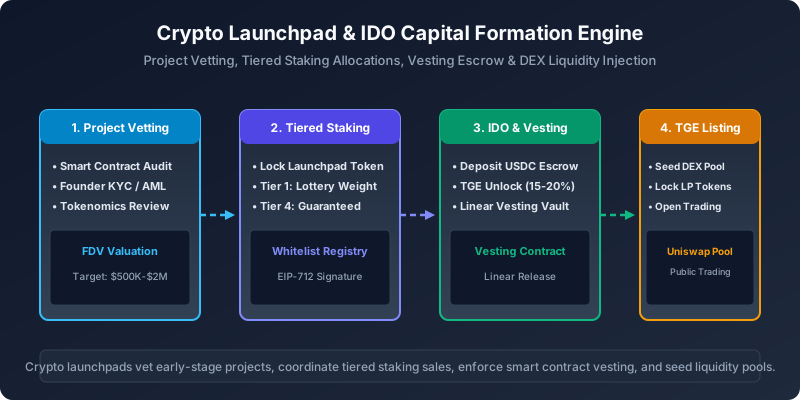
To understand the architecture of modern crypto launchpads, one must trace how crypto fundraising models evolved over the past decade.
In an ICO, a team published a whitepaper and deployed a basic crowdsale contract. Investors transferred Ethereum directly to the contract address and received new project tokens.
Centralized crypto exchanges (such as Binance Launchpad or KuCoin Spotlight) introduced IEOs to restore trust. The centralized exchange conducted due diligence on the founding team and hosted the token sale directly on its exchange engine.
Initial DEX Offerings (IDOs) combined the security auditing of IEOs with the non-custodial, permissionless ethos of Web3. Launchpads like Seedify, Polkastarter, DAO Maker, and Polkastarter host early-stage sales via self-executing smart contracts.
A production-grade crypto launchpad operates through three synchronized infrastructure layers: the Staking Allocation Engine, the Token Sale Escrow Vault, and the Smart Contract Vesting Schedule Engine.
To prevent bot manipulation, Sybil attacks, and gas wars during high-demand sales, launchpads require users to stake the launchpad's native utility token (e.g., SFUND on Seedify or POLS on Polkastarter).
// Simplified Tiered Staking Allocation Architecture
contract LaunchpadTierManager {
    IERC20 public immutable launchpadToken;

    struct Tier {
        uint256 minStakeRequired;
        uint256 poolWeight; // Higher tiers receive larger guaranteed allocation
        bool isGuaranteed;  // True = Guaranteed Allocation, False = Lottery
    }

    mapping(uint8 => Tier) public tiers;
    mapping(address => uint256) public userStakedAmount;

    constructor(address _launchpadToken) {
        launchpadToken = IERC20(_launchpadToken);

/ Tier 1: Bronze (Lottery Base)
        tiers[1] = Tier(1000 * 1e18, 10, false);
/ Tier 2: Silver (Guaranteed Medium)
        tiers[2] = Tier(5000 * 1e18, 55, true);
/ Tier 3: Gold (Guaranteed Heavy)
        tiers[3] = Tier(20000 * 1e18, 250, true);
    }

    function stake(uint256 amount) external {
        require(amount > 0, "Cannot stake zero");
        launchpadToken.transferFrom(msg.sender, address(this), amount);
        userStakedAmount[msg.sender] += amount;
    }

    function getUserTier(address user) external view returns (uint8) {
        uint256 staked = userStakedAmount[user];
        if (staked >= tiers[3].minStakeRequired) return 3;
        if (staked >= tiers[2].minStakeRequired) return 2;
        if (staked >= tiers[1].minStakeRequired) return 1;
        return 0; // Ineligible
    }
}
Investors who stake higher thresholds of the launchpad's native token unlock guaranteed allocation rights in upcoming IDOs, eliminating the stress of fast-click gas races.
One of the most critical security mechanisms provided by modern launchpads is smart contract token vesting.
In early crypto sales, project teams and seed investors received 100% of their tokens on day one, allowing insiders to dump massive supply onto secondary market buyers immediately after exchange listing.
Launchpads enforce automated vesting smart contracts:
High-reputation launchpads serve as quality filters. Before approving a project for an IDO, launchpad incubation teams perform multi-stage due diligence checks:
Launchpads require core founding team members to complete biometric KYC identity verification. If a team executes an exit scam or abandons the project maliciously, the launchpad provides legal documentation to law enforcement agencies.
Launchpads verify that all project contracts (token contracts, staking pools, custom logic) have undergone independent security audits by reputable auditing firms to prevent reentrancy attacks, minting exploits, or hidden owner backdoors.
A primary cause of IDO failure is greedy initial valuations. Launchpads negotiate with project founders to ensure seed and IDO prices represent reasonable Fully Diluted Valuations (FDV) relative to market competitors, preventing overpriced token listings.
To further insulate retail investors from poorly performing projects or sudden post-launch team defaults, leading launchpads have introduced automated refund policies.
Pioneered by platforms like DAO Maker and Seedify, the 7-day refund mechanism allows IDO participants to evaluate post-listing token performance:
For retail investors, participating in a launchpad token sale follows a standardized execution pipeline:
[ Step 1: Wallet Connection ] -> [ Step 2: KYC & Token Staking ]
                                              |
[ Step 4: TGE & Token Claim ] <- [ Step 3: IDO Allocation Purchase ]
The user connects a non-custodial Web3 wallet (such as MetaMask, Rabby, or Phantom) to the launchpad interface.
The user deposits the launchpad's native utility tokens into the staking contract to achieve a designated tier rank and submits identity verification through an integrated provider (such as Sumsub or Synaps).
During the active IDO window (typically lasting 12 to 24 hours), eligible whitelisted users approve and transfer stablecoins (USDC or USDT) into the sale contract to purchase their assigned token allocation.
Once the project team generates the token and lists the liquidity pool on a decentralized exchange (such as Uniswap or PancakeSwap), the user visits the launchpad vesting dashboard to claim their TGE percentage directly into their Web3 wallet.
The growth of launchpad platforms and decentralized Web3 incubators has created specialized career pathways across technical engineering, venture research, and quantitative risk management.
Engineers who design permissioned staking tiers, cryptographic whitelist verification logic (EIP-712 signatures / Merkle proofs), and automated linear vesting contracts.
Analysts who evaluate incoming project applications, audit financial models, assess competitive landscapes, and structure initial token distribution schedules.
Professionals who source high-quality Web3 gaming, AI, DePIN, and Layer 2 projects to launch exclusively on the platform.
To prevent expensive gas fees associated with storing thousands of whitelisted addresses in smart contract state arrays, production launchpads use Merkle Tree cryptographic proofs.
// SPDX-License-Identifier: MIT
pragma solidity ^0.8.20;

import "@openzeppelin/contracts/utils/cryptography/MerkleProof.sol";
import "@openzeppelin/contracts/token/ERC20/IERC20.sol";
import "@openzeppelin/contracts/access/Ownable.sol";

contract IDOSaleVault is Ownable {
    bytes32 public merkleRoot;
    IERC20 public immutable paymentToken; // e.g., USDC
    uint256 public immutable tokenPrice;  // Price in USDC (6 decimals)

    mapping(address => bool) public hasParticipated;

    event TokensPurchased(address indexed buyer, uint256 amountPaid);

    constructor(address _paymentToken, uint256 _tokenPrice, bytes32 _merkleRoot) Ownable(msg.sender) {
        paymentToken = IERC20(_paymentToken);
        tokenPrice = _tokenPrice;
        merkleRoot = _merkleRoot;
    }

// @notice Purchase IDO allocation using Merkle Proof verification
    function buyAllocation(uint256 allocationAmount, bytes32[] calldata merkleProof) external {
        require(!hasParticipated[msg.sender], "Address has already purchased allocation");

/ Verify leaf node: hash(msg.sender, allocationAmount)
        bytes32 leaf = keccak256(abi.encodePacked(msg.sender, allocationAmount));
        require(MerkleProof.verify(merkleProof, merkleRoot, leaf), "Invalid Merkle Whitelist Proof");

        hasParticipated[msg.sender] = true;
        uint256 totalCost = (allocationAmount * tokenPrice) / 1e18;

        require(paymentToken.transferFrom(msg.sender, address(this), totalCost), "Payment transfer failed");

        emit TokensPurchased(msg.sender, totalCost);
    }

// @notice Update Merkle Root for new IDO rounds
    function setMerkleRoot(bytes32 _newRoot) external onlyOwner {
        merkleRoot = _newRoot;
    }
}
An ICO (Initial Coin Offering) is an unvetted public token sale hosted directly on a project's custom smart contract. An IEO (Initial Exchange Offering) is hosted on a centralized exchange (like Binance) that conducts due diligence and manages custody. An IDO (Initial DEX Offering) is hosted on a decentralized launchpad platform using smart contracts, allowing non-custodial wallet participation.
Requiring users to stake the launchpad's native utility token achieves three goals: it filters out bots and automated spam attacks, it rewards loyal long-term community members with guaranteed allocations, and it creates a persistent economic demand sink for the launchpad's token.
The Token Generation Event (TGE) is the exact block timestamp when a project smart contract officially mints its token supply, distributes initial unlocked tokens to sale participants, and lists the token's initial liquidity pool on a decentralized or centralized exchange.
Not always. Lower staking tiers usually receive lottery tickets where winning tickets earn an allocation spot. Higher staking tiers provide guaranteed allocation rights, where the exact dollar amount of the allocation is proportional to the number of tokens staked.
A Liquidity Bootstrapping Pool (LBP) is a Dutch auction mechanism (pioneered by Balancer) where the token price starts artificially high and gradually declines over time according to a pre-set weight decay curve. Investors purchase tokens whenever the price reaches a level they find fair, preventing front-running bots and gas wars associated with fixed-price IDOs.
Initial Market Cap represents the total dollar value of unlocked tokens circulating on day one (TGE unlock). Fully Diluted Valuation (FDV) represents the total theoretical valuation if 100% of tokens were unlocked. Projects launching with low initial market caps relative to overall FDV often experience strong price pumps at TGE, but face sustained sell pressure as future vesting cliff unlocks occur.
Launchpads operate in a complex legal environment where token sales may be classified as unregistered securities offerings depending on jurisdiction (such as US SEC regulations). To mitigate regulatory risks, top launchpads implement strict geographic IP blocking, require non-US investor accreditation attestations, and enforce automated ONCHAINID KYC screening.
When a project lists its token on a decentralized exchange, founders deposit raised pairing capital (such as USDC or ETH) alongside project tokens into an automated market maker pool. To prevent founders from pulling liquidity (a "rug pull"), launchpads require teams to lock liquidity provider (LP) tokens inside smart contract escrow vaults (such as Team Finance or UNCX) for a minimum of 6 to 12 months.
Primary token sales occur during the IDO phase on the launchpad, where whitelisted participants purchase tokens directly from the project escrow contract at a fixed initial price. Secondary trading occurs after the TGE unlock, where tokens trade publicly on decentralized exchanges (such as Uniswap or PancakeSwap) at dynamic market prices driven by supply and demand.
Modern launchpads utilize cross-border messaging protocols (such as LayerZero, Chainlink CCIP, or Wormhole) to host token sales across multiple blockchain networks. Users can deposit payment stablecoins on Layer 2 networks like Base or Arbitrum, while receiving their target project tokens on Ethereum mainnet or Solana seamlessly.
Explore more guides and career playbooks