Loading article...

An empirical thesis on Web3 marketing: why traditional ad channels fail, on-chain attribution models, quest farming churn, developer relations as acquisition, and token-gated retention.
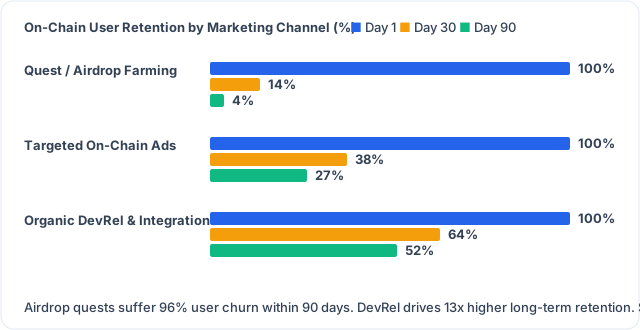
Traditional digital marketing strategies collapse when applied to decentralized protocols. Web2 marketing relies on centralized surveillance platforms, third-party browser cookies, and pay-per-click ad networks to capture prospective customers into closed sales funnels. In crypto, users interact through pseudonymous wallet addresses rather than email accounts, operate across composable public blockchains, and maintain deep skepticism toward corporate marketing copy. Attempts to port conventional ad playbooks into Web3 waste treasury capital on mercenary traffic that vanishes the moment promotional incentives expire.
Data from DappRadar 2024 industry report and Spindl Web3 attribution report illustrates the retention crisis: Web3 projects spending millions of dollars on gamified quest campaigns and airdrop point programs experience user churn rates exceeding 85% within 30 days of incentive distributions. Developing an enduring user base requires replacing superficial promotional campaigns with verifiable on-chain distribution, developer relations, organic community governance, and precision on-chain attribution.
The foundational channels of traditional digital advertising are structurally hostile to Web3 protocols. Regulatory caution and platform risk severely restrict crypto marketing on major ad networks. Google Ads crypto advertising policy and Meta advertising policies on cryptocurrency impose onerous certification requirements, restricting crypto ads to licensed financial entities while banning decentralized finance protocols, token presales, and algorithmic stablecoins entirely.
Even when crypto projects obtain permission to run paid search or social ads, cost-per-click metrics prove economically unviable. Click fraud and bot traffic plague crypto ad keywords, driving customer acquisition costs (CAC) above $150 to $300 per registered user while delivering low lifetime value (LTV). Apple App Store guideline 3.1.5 on cryptocurrency further complicates mobile consumer acquisition by prohibiting non-fungible token (NFT) unlocking mechanics that bypass in-app purchase commissions.
Beyond regulatory roadblocks, the Web3 audience possesses distinct behavioral incentives. Web3 users do not view themselves as passive consumers; they act as network participants, protocol co-owners, and liquidity providers. When a project launches flashy promotional banners, sophisticated crypto users interpret excessive ad spending as a signal of weak underlying technology. a16z crypto State of Crypto 2024 notes that sustained protocol adoption correlates with developer integration depth and smart contract composability rather than consumer advertising spend.
With third-party browser cookies deprecated across modern browsers, traditional tracking pixels cannot attribute conversions to revenue events. In crypto, attribution shifts from browser cookies to on-chain transaction ledgers. Every token transfer, swap, deposit, and contract interaction is publicly recorded with deterministic timestamps on distributed ledgers.
Modern Web3 growth teams deploy specialized attribution engines like Spindl on-chain conversion measurement, Safary Web3 growth platform report, and Cookie3 Web3 marketing analytics platform. These platforms bridge off-chain touchpoints (such as viewing a blog post, engaging with an X thread, or clicking a documentation link) with on-chain wallet signatures and transaction executions.
On-chain attribution redefines core marketing metrics:
Customer Acquisition Cost (CAC) must be calculated as total marketing spend plus token incentive emissions divided by net active wallets that maintain positive account balances past 90 days. Counting every connected wallet as a customer distorts unit economics because thousands of automated bots connect wallets without depositing capital.
Wallet Lifetime Value (LTV) measures the cumulative protocol fees generated by a wallet across its lifetime, factoring in gas fees, trading volume, and liquidity provision duration. Platforms like Bello on-chain customer intelligence and Dune Analytics public crypto dashboards allow marketers to segment users by net worth, historical transaction volume on Etherscan token holder distributions, and governance participation.
Marketers can identify "whale" liquidity providers, protocol power users, and inactive addresses with mathematical precision. Marketing teams no longer blast indiscriminate ads across the internet; they configure targeted campaigns directed at wallets that actively trade on automated market makers or supply liquidity to decentralized lending pools.
Gamified quest platforms emerged as a popular Web3 acquisition channel between 2022 and 2024. Protocols partnered with platforms like Galxe quest participant analytics, Layer3 protocol engagement metrics, Zealy community quest platform, and TaskOn Web3 campaign platform to incentivize users with points, NFTs, and promise of future airdrops for completing social tasks and on-chain interactions.
While quest campaigns generate impressive vanity metrics in the short term, empirical research reveals that they attract mercenary behavior rather than sticky users. Cookie3 airdrop Sybil study and Chainalysis report on airdrop farming and sybil behavior indicate that up to 60% to 70% of participants in open quest campaigns are automated Sybil clusters: scripts operated by single entities controlling hundreds or thousands of burner wallets to extract tokens without retaining funds.
The post-incentive retention curve shows steep attrition: Quest campaigns average a 14% 30-day retention rate and a 4% 90-day retention rate. The vast majority of participants withdraw their liquidity within 48 hours of snapshot events, moving capital to the next farming campaign. Protocols that pay $20 to $50 in token subsidies per quest user discover that their effective CAC for retained, solvent users often exceeds $500.
To protect treasuries from predatory Sybil farming, marketing teams incorporate decentralized identity and proof-of-personhood verification. Integrating Gitcoin Passport Sybil defense protocol, World ID proof of personhood protocol, or Proof of Humanity protocol filters out automated bot swarms. Imposing minimum wallet age, historical mainnet balance thresholds, and proof of non-trivial transaction history on Artemis protocol financial metrics ensures that protocol rewards accrue to genuine human participants.
In Web3 infrastructure, developer relations (DevRel) represents the highest-converting acquisition engine. Infrastructure protocols, Layer 1 blockchains, and Layer 2 rollups succeed when software developers build production decentralized applications on top of their smart contract environments. End consumers follow application utility; they do not adopt underlying infrastructure in isolation.
Data from Electric Capital developer report demonstrates that developer retention drives network value. Blockchains that maintain active developer ecosystems experience sustained TVL growth across market cycles, whereas networks relying on short-term speculative hype suffer precipitous liquidity drawdowns.
High-impact Web3 marketing teams structure DevRel as a disciplined acquisition funnel:
When a developer integrates a protocol's smart contracts, they create a persistent distribution channel. Each user interacting with that developer's application automatically drives transaction volume and liquidity to the underlying protocol, generating organic compounding growth that paid advertising cannot replicate.
Crypto discourse and distribution concentrate in crypto-native social networks and specialized media outlets. Protocol marketing teams prioritize platforms where crypto founders, researchers, and core contributors assemble.
Decentralized social graphs provide censorship-resistant distribution channels directly to engaged Web3 users. Farcaster protocol documentation and Warpcast client metrics detail how open social graphs enable interactive mini-applications known as Frames, allowing users to mint NFTs, swap tokens, or participate in governance polls directly inside social feeds without leaving the application. Similarly, Lens Protocol decentralized social graph allows creators to own their follower graphs and monetize content directly via smart contracts.
Long-form research and technical writing remain essential for establishing protocol credibility. Crypto investors, liquidity providers, and developers read deep analytical essays before committing capital. Platforms like Mirror decentralized publishing protocol and Paragraph Web3 newsletter platform enable projects to publish technical roadmaps, economic analyses, and post-mortems with on-chain permanence and crypto-native subscription mechanics.
For earned media, marketing teams engage specialized crypto media organizations. Research-driven coverage from Bankless crypto media network, Blockworks research and news, CoinDesk media analysis, Decrypt crypto journalism, The Block research dashboard, and Messari enterprise research reports shapes ecosystem narrative and institutional sentiment far more effectively than generic press releases syndicated to general business publications.
Token listing visibility also serves as a high-intent marketing touchpoint. Maintaining accurate project data, circulating supply figures, and contract audits on CoinMarketCap marketing and listings and CoinGecko crypto data API ensures that prospective users and token holders can verify protocol metrics independently.
Community building in Web3 is operational org design rather than social media management. An unmoderated Telegram channel packed with price speculation questions and spam bots degrades project reputation. Enduring communities organize around shared protocol ownership, structured governance participation, and exclusive product access.
High-functioning marketing teams deploy token-gating infrastructure to segment community spaces. Platforms like Guild.xyz token-gating infrastructure and Collab.Land Discord token gating connect user wallets to Discord and Telegram accounts, granting role permissions based on verified on-chain criteria such as holding a governance token, staking in a liquidity pool, or holding a specific commemorative NFT.
Token-gated channels filter out opportunistic spam, building high-signal discussions among invested stakeholders. Within these spaces, community members contribute to bug reporting, testnet feedback, and localization.
The community lifecycle culminates in governance participation. Platforms like Snapshot decentralized voting hub and Tally on-chain DAO governance platform allow token holders to debate and vote on governance proposals, treasury allocations, and fee parameters. Long-term discussions take place in dedicated forums such as Commonwealth Web3 discussion forum and Discourse open-source discussion forums.
As described in Variant Fund progressive decentralization framework and Variant Fund token distribution design, turning users into active governors aligns community incentives with protocol resilience. When community members hold real stakes in protocol decisions, they become active brand advocates who defend the project against competitive forks and recruit new builders to the ecosystem.
To understand why traditional funnel metrics mislead crypto marketers, examine how a user converts on-chain versus through an e-commerce checkout flow.
A Web2 consumer funnel follows a linear path: Impression -> Click -> Landing Page -> Form Fill / Credit Card -> Conversion. At each stage, browser telemetry records user behavior with zero marginal latency.
An on-chain conversion funnel introduces high-friction cryptographic checkpoints:
Every one of these six stages exhibits measurable drop-offs that traditional Google Analytics cannot observe. Web3 marketing teams that instrument frontend telemetry alongside RPC node monitoring diagnose whether friction stems from unclear positioning or confusing wallet signatures.
For decentralized finance (DeFi) protocols, marketing is deeply intertwined with capital liquidity. A lending market or decentralized exchange with shallow liquidity produces high slippage, making the product unusable regardless of brand awareness.
Consequently, Web3 marketing incorporates liquidity bootstrapping mechanisms: Protocols partner with decentralized exchanges to launch liquidity pools paired with major assets like ETH or USDC. Rather than paying flat cash sponsorships, protocols allocate token emissions to liquidity gauges on platforms like Aerodrome on Base, Velodrome on Optimism, or Curve and Convex on Ethereum. Liquidity providers deposit capital to earn a yield composed of trading fees and protocol token rewards.
The danger lies in incentive decay. Mercenary liquidity providers farm protocol rewards and immediately sell them on secondary markets, exerting downward price pressure on the native token. Sustainable protocols design dynamic emission curves that taper token rewards over time while gradually increasing real protocol fee distributions to long-term lockers. Marketing teams monitor liquidity retention metrics through Dune dashboards, assessing whether total value locked stabilizes after reward halvings or flees to competing pools.
Successful marketing in decentralized networks ultimately requires rigorous alignment between user utility, economic game theory, and transparent technical architecture. Growth leaders who build robust feedback loops with developer communities and governance delegates establish defensible protocol moats that outlive speculative market cycles.
Marketing in Web3 replaces deceptive promotional hype with verifiable on-chain transparency. Protocols that master on-chain attribution, invest in developer ecosystems, and build decentralized community governance build sustainable network effects that endure across market cycles.