Loading article...

An empirical mathematical thesis on tokenomics and cryptocurrency supply models, analyzing inflation vectors, deflationary sinks, veToken game theory, and the low-float high-FDV market trap.
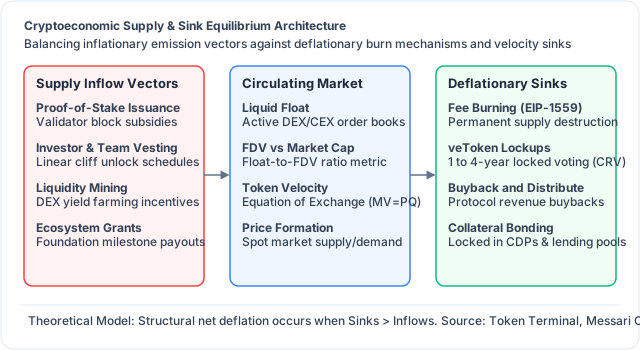
In traditional corporate finance, an equity share represents a legal claim on a company assets, cash flows, and voting power, protected by statutory company law and regulatory enforcement. In decentralized protocols, digital tokens represent programmatic economic instruments whose rights, emissions, and value accrual are governed strictly by immutable smart contract logic deployed across networks like Ethereum Foundation, Arbitrum, and Solana Foundation.
This economic architecture, known as tokenomics (a portmanteau of token and economics), determines whether a decentralized network can achieve sustainable long-term equilibrium or whether it collapses under inflationary dilution and speculative churn.
A poorly structured token model will destroy an otherwise technically superior protocol through mercenary liquidity flight, governance capture, or severe supply overhangs. Conversely, an economically sound tokenomics architecture aligns the incentives of node operators, developers, long-term capital allocators, and active users into a self-reinforcing economic network.
To analyze a token economic model, one must begin with foundational monetary economics, specifically the classical Equation of Exchange formalized by Irving Fisher:
$$M \cdot V = P \cdot Q$$
Where:
Solving for the network capitalization ($M \cdot P$):
$$M = rac{P \cdot Q}{V}$$
If a protocol designs a token purely as a medium of exchange (such as early utility tokens in 2017), velocity approaches infinity. Users acquire the token only seconds before consuming a service, and the service provider immediately dumps the token on automated market makers like Uniswap Labs for fiat or stablecoins.
Under high velocity, substantial protocol adoption can occur without creating any sustained capital demand for the underlying asset. To capture long-term value, tokenomics architects must engineer structural sinks that arrest velocity: staking lockups, fee burn mechanisms, and governance utility.
A token circulating supply expands through three distinct programmatic vectors:
In Layer 1 Proof of Stake blockchains, new tokens are minted programmatically to incentivize validators to commit economic stake and propose blocks:
For venture-backed protocols, private token sales represent the largest source of supply expansion. Analyzing vesting contracts deployed via OpenZeppelin Contracts reveals how supply overhang impacts secondary markets:
Vesting schedules must be verified on public block explorers like Etherscan or Arbiscan. When a protocol approaches its 12-month cliff date, circulating float can double overnight, creating massive market corrections if institutional liquidity cannot absorb the volume.
During the "DeFi Summer" of 2020, protocols pioneered liquidity mining: distributing unissued governance tokens to users who deposited capital into automated market maker pools on Uniswap or lending pools on Compound Finance.
While liquidity mining generates astronomical short-term Total Value Locked (TVL), it creates a fatal mercenary capital cycle:
To counterbalance programmatic supply expansion, cryptoeconomic architectures implement deflationary sinks that absorb floating supply, burn tokens, or distribute protocol cash flows:
Formalized in EIP-1559 on Ethereum and adopted across networks like Avalanche C-Chain and Polygon Technology, fee burning introduces an algorithmic supply sink directly tied to network congestion:
When transactional demand on Ethereum is high, the protocol burns more ETH than it mints to validators, rendering the asset net deflationary. This mechanism transforms network activity directly into scarcity for all token holders without requiring centralized corporate buyback decisions.
Pioneered by Michael Egorov on Curve Finance with veCRV and adapted by Balancer Protocol (veBAL), the Vote-Escrowed model aligns long-term capital commitment with governance control:
The veToken architecture introduces powerful cryptoeconomic dynamics:
Rather than distributing inflationary rewards, mature protocols generate substantial real cash flows from trading spreads, liquidation penalties, and lending interest:
The primary market failure characterizing token launches between 2022 and 2026 is the "Low Float, High Fully Diluted Valuation (FDV)" trap, analyzed extensively by research desks at Paradigm and Messari.
When a venture-backed protocol launches with only 5% of its supply circulating, early public trading volume easily pushes the token to an exorbitant Fully Diluted Valuation. However, as the remaining 95% of tokens unlock over subsequent years, hundreds of millions of dollars of net selling pressure enters the market monthly.
Unless the protocol generates proportional real revenue growth, price degradation is mathematically guaranteed. Investors and analysts evaluate this dynamic through the Float-to-FDV ratio: projects with ratios below 0.15 carry extreme structural dilution risk.
Institutional analysts evaluate protocol viability through verifiable on-chain financial metrics tracked on Token Terminal and DefiLlama:
When engineering a decentralized protocol, architects categorize token utility into distinct functional archetypes:
Work Tokens: Required by node operators or service providers to stake as collateral to earn the right to perform work within the network (e.g. The Graph GRT indexers, Chainlink LINK node operators, or Filecoin storage providers). If a worker provides invalid data or misses uptime SLA targets, their staked tokens are slashed.
Pure Governance Tokens: Grant voting rights over smart contract parameters, fee allocations, and treasury grants (e.g. UNI, ARB, OP). Pure governance tokens carry zero direct contractual entitlement to revenue, mitigating securities regulation risks under the US SEC Howey Test, but frequently suffer from low voter turnout and weak value capture.
Yield and Fee-Sharing Hybrid Tokens: Combine governance rights with direct cash-flow accrual or discounted execution fees (e.g. GMX, MakerDAO / Sky, SushiSwap xSUSHI). While highly attractive to investors, fee-sharing mechanisms require rigorous legal structuring in offshore foundations to navigate global securities laws.
Protocol architects designing a tokenomic architecture should enforce these defensive design principles:
By grounding token design in classical monetary theory, implementing robust deflationary sinks, and eliminating the predatory dynamics of low-float distributions, tokenomics engineers can construct sustainable decentralized financial economies that endure across market cycles.
Explore more guides and career playbooks