Loading article...

A comprehensive guide to the Web3 Financial Product Manager (FPM) role, exploring DeFi protocol design, quantitative risk modeling, tokenomics engineering, security audits, and career entry strategies.

Within the specialized ecosystem of Web3 Product Management, the role of the Web3 Financial Product Manager (FPM) has emerged as one of the highest-value positions across decentralized finance (DeFi), real-world asset (RWA) tokenization, and institutional Web3 platforms. Operating at the intersection of product design, quantitative finance, smart contract engineering, and tokenomics, the Financial PM acts as the primary architect of decentralized financial protocols.
Unlike generalist product managers who design consumer applications or user-facing wallet interfaces, a Web3 Financial PM constructs the underlying mathematical primitives - the "money legos" - that move billions of dollars in Total Value Locked (TVL) across global blockchains.
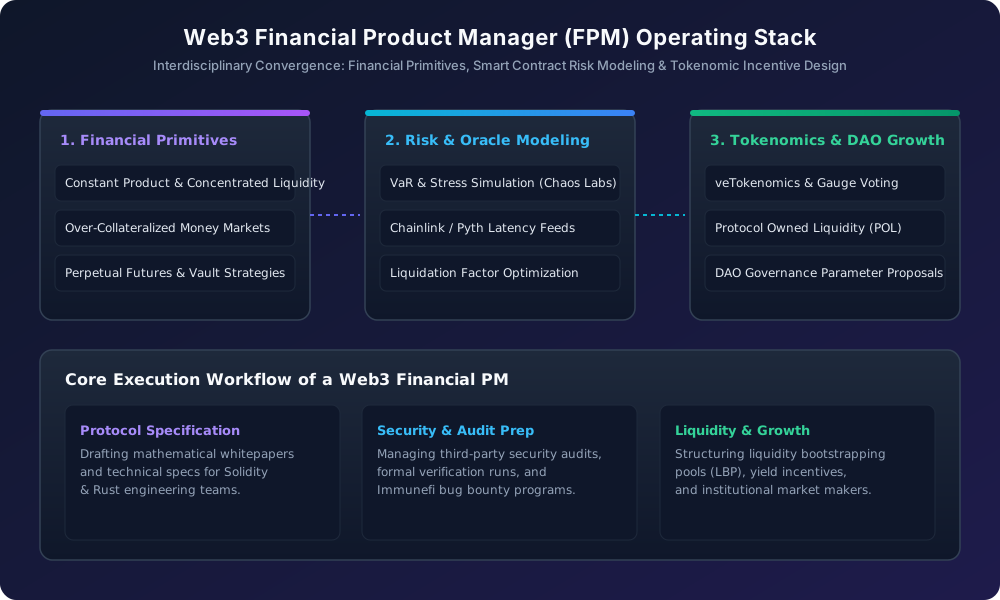
Traditional product management focuses heavily on user research, wireframing, sprint velocity, and A/B testing user flows. While those skills remain relevant, a Web3 Financial PM operates under radically different technical, financial, and risk constraints.
To understand the daily responsibilities of a Web3 Financial PM, examine the core protocol categories they design and manage.
A Financial PM designing a decentralized exchange must determine the mathematical invariant formula that governs asset swaps:
$$\text{Constant Product Invariant:} \quad x \cdot y = k$$
For concentrated liquidity protocols (such as Uniswap v3), the FPM defines custom price tick boundaries, fee tier structures (e.g., 0.01% for stablecoins vs 0.30% for volatile assets), and incentive distribution models for liquidity providers.
When designing lending protocols (such as Aave or Compound), the Financial PM specifies the interest rate curve parameters based on pool utilization rates ($U$):
$$R_{\text{borrow}} = R_0 + \left( \frac{U}{U_{\text{kink}}} \right) \cdot R_{\text{slope1}} \quad \text{when } U \leq U_{\text{kink}}$$
$$R_{\text{borrow}} = R_0 + R_{\text{slope1}} + \left( \frac{U - U_{\text{kink}}}{1 - U_{\text{kink}}} \right) \cdot R_{\text{slope2}} \quad \text{when } U > U_{\text{kink}}$$
The FPM must dynamically calibrate $U_{\text{kink}}$ and interest rate slopes to incentivize repayments when pool liquidity becomes scarce, preventing protocol insolvency.
The workflow of launching a decentralized financial product follows a rigorous multi-phase lifecycle.
The FPM translates business requirements into a formal technical whitepaper detailing contract entry points, user roles, state transition diagrams, mathematical formulas, and failure fallback modes.
Financial protocols rely on external price data to compute collateral ratios and liquidate under-collateralized positions. The FPM evaluates oracle architectures:
Unlike traditional software where bugs can be patched after launch, deployed smart contracts manage immutable capital pool reserves. A single logical flaw can lead to tens of millions of dollars drained in a single transaction block. The FPM coordinates external audits, sets up Immunefi bug bounty programs, and establishes emergency circuit breaker pause roles.
To evaluate protocol health, growth, and risk, a Financial Product Manager relies on specific quantitative indicators indexed via Dune Analytics, Nansen, or Token Terminal:
| Protocol Metric | Definition | Technical Significance |
|---|---|---|
| Total Value Locked (TVL) | Cumulative USD value of assets deposited in protocol contracts | Reflects total capital trust and liquidity capacity |
| Volume / TVL Ratio | Annualized trading volume divided by TVL | Measures capital efficiency of liquidity pools |
| Utilization Rate ($U$) | Ratio of borrowed funds to total deposited liquidity | Governs interest rate model curves and solvency risk |
| Protocol Revenue / Fee Share | Net cash flow directed to token stakers or DAO treasury | Validates long-term protocol economic sustainability |
| Value at Risk (VaR) | Statistical estimate of potential liquidation loss under tail volatility | Calibrates collateral factors and liquidation penalties |
Breaking into Web3 Financial Product Management requires proving mastery across finance, smart contract mechanics, and data analytics.
[ Traditional Background (Fintech / Quant / Banking / Web2 PM) ]
                                 |
                                 v
[ Hands-On DeFi Interaction & Protocol Mechanics Breakdown ]
                                 |
                                 v
[ Dune Analytics & Public Risk Modeling Portfolio ]
                                 |
                                 v
[ DAO Governance Proposal Submissions & Web3 PM Placement ]
Instead of submitting standard text resumes, stand out by producing verifiable Web3 artifacts:
pandas, matplotlib), Dune Analytics, Flipside Crypto, Token Terminal API.To illustrate how a Web3 Financial PM models constant-product AMM swaps and slippage before writing smart contract specifications, inspect the following Python simulation module:
import numpy as np
import matplotlib.pyplot as plt

class ConstantProductAMM:
    def __init__(self, reserve_x: float, reserve_y: float, fee_tier: float = 0.003):
        self.reserve_x = reserve_x
        self.reserve_y = reserve_y
        self.fee_tier = fee_tier
        self.k = reserve_x * reserve_y

    def get_amount_out(self, amount_in_x: float) -> float:
        # Subtract trading fee from input asset
        amount_in_with_fee = amount_in_x * (1 - self.fee_tier)
        # New reserve X after deposit
        new_reserve_x = self.reserve_x + amount_in_with_fee
        # New reserve Y calculated via constant product invariant k
        new_reserve_y = self.k / new_reserve_x
        # Output amount of Y released to trader
        amount_out_y = self.reserve_y - new_reserve_y
        return amount_out_y

    def calculate_price_impact(self, amount_in_x: float) -> float:
        spot_price = self.reserve_y / self.reserve_x
        amount_out_y = self.get_amount_out(amount_in_x)
        effective_price = amount_out_y / amount_in_x
        price_impact = (spot_price - effective_price) / spot_price
        return price_impact * 100

# Example Simulation Run by FPM
amm = ConstantProductAMM(reserve_x=10_000.0, reserve_y=30_000_000.0) # ETH/USDC pool
swap_amounts = [10, 50, 100, 500, 1000]

print("ETH Swap Amount | Received USDC | Price Impact (%)")
print("--------------------------------------------------")
for eth_in in swap_amounts:
    usdc_out = amm.get_amount_out(eth_in)
    impact = amm.calculate_price_impact(eth_in)
    print(f"{eth_in:14d} | {usdc_out:13.2f} | {impact:15.2f}%")
A core responsibility of a Web3 Financial PM is drafting standardized Product Requirement Documents (PRDs) for engineering and security teams.
# PRD: Concentrated Liquidity Automated Yield Vault (CLAY-Vault v1)

## 1. Executive Summary
The CLAY-Vault automatically rebalances LP positions across Uniswap v3 ticks to maximize trading fee yield while minimizing impermanent loss for passive depositors.

## 2. Core Functional Requirements
- **Deposit Asset:** Single-sided ETH or USDC deposit.
- **Auto-Swap Ratio:** Vault automatically swaps 50% of deposited capital to balance tick ranges using 1inch aggregator routing.
- **Rebalance Trigger:** Rebalances executed when spot price strays > 2.5% outside active tick bounds, managed via Gelato Automation relayers.
- **Management Fee:** 1.5% annualized streaming fee directed to DAO treasury; 10% performance fee on harvested yield.

## 3. Risk & Safety Guardrails
- **Emergency Circuit Breaker:** If Chainlink oracle detects > 5% price discrepancy vs Uniswap TWAP within 5 minutes, pause vault deposits and withdrawals.
- **Max Vault Capacity:** Capped at $10,000,000 TVL during 30-day initial deployment phase.
Examining historical protocol successes and failures reveals the critical impact of Financial PM decisions.
Curve Finance revolutionized DeFi tokenomics by introducing the vote-escrow ($ve$) model. Designed by team leads and product architects, users lock native $CRV tokens for up to 4 years to receive $veCRV. Holding $veCRV grants voting power to direct future token emission gauges toward specific liquidity pools, creating a massive competitive dynamic ("Curve Wars") where protocols paid bribes to $veCRV voters for liquidity direction.
Aave v3 introduced Efficiency Mode (E-Mode), enabling borrowers to access up to 97% Loan-to-Value (LTV) ratios when collateralizing assets that are correlated to the borrowed asset (e.g., liquid staking derivatives like $stETH against $ETH). This product feature required precise mathematical modeling to prevent liquidation failures while unlocking billions in capital efficiency.
When interviewing for FPM roles at top DeFi protocols (such as Uniswap Labs, Aave, Lido, or Paradigm-backed startups):
As traditional financial institutions migrate sovereign debt, corporate bonds, and real estate onto public ledgers, the scope of the Web3 Financial PM expands into Real-World Asset (RWA) Tokenization.
_beforeTokenTransfer). The FPM must design compliance hook logic that verifies whether both sender and recipient hold active on-chain KYC attestations before allowing transfers.To build a career as a Web3 Financial Product Manager:
Modern DeFi protocols operate across multiple Layer 1 blockchains and Layer 2 rollups simultaneously. A Web3 Financial PM must architect cross-chain liquidity sharing models to avoid fragmented liquidity pools across isolated chains.
The Web3 Financial Product Manager occupies a strategic, high-impact seat in modern technology. By mastering mathematical protocol design, quantitative risk modeling, and decentralized tokenomics, FPMs build the open, non-custodial financial infrastructure of the future.