Loading article...

A comprehensive guide for Web3 engineers, managers, and specialists on building technical authority, trust, and influence in decentralized and remote organizations.

Transitioning into a new professional role is a pivotal inflection point in any Web3 or software engineering career. Whether joining a core protocol team, an open-source decentralized autonomous organization (DAO), a Web3 security audit firm, or an enterprise blockchain startup, your success is dictated by how effectively you establish credibility during your first 90 days.
In traditional centralized corporate environments, credibility is often conferred hierarchically through job titles, manager endorsements, and formal organizational charts. In contrast, Web3 operating environments are predominantly remote, asynchronous, pseudonym friendly, and meritocratic. In decentralized teams, credibility cannot be requested; it must be earned through transparent execution, high-quality code contributions, rigorous security discipline, and proactive communication across public Discord channels, GitHub pull requests, and Telegram groups.
To build authority in a new Web3 position, one must understand how trust dynamics differ between Web2 corporate structures and Web3 decentralized protocols.
Decentralized teams operate across global time zones (spanning North America, Europe, Asia, and Latin America). You will rarely share synchronous office hours with your entire team. Credibility is built through comprehensive pull request descriptions, well-structured Request for Comments (RFC) engineering documents, and clear status summaries in public team channels.
In Web3 software engineering, elite academic degrees and corporate brand names hold less weight than demonstrated technical competence. Colleagues will evaluate your credibility by reading your smart contract code, inspecting your Foundry test coverage, reviewing your gas optimization PRs, and observing how you respond during critical protocol bug fixes.
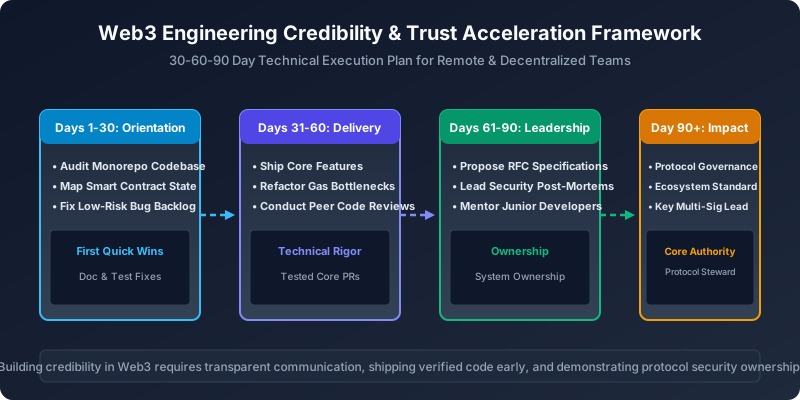
Establishing credibility requires a structured, phased approach that balances initial learning with progressive technical ownership.
The first 30 days are dedicated to building deep domain context without disrupting existing team velocity.
During the second month, transition from minor fixes to owning core feature modules.
By the third month, move from executing assigned tasks to proposing strategic system improvements.
Building technical authority in Web3 rests upon four core execution pillars: technical rigor, security discipline, radical transparency, and collaborative humility.
In Web3, smart contracts manage millions of dollars in locked value and cannot be easily patched post-deployment. Writing sloppy code damages credibility instantly.
error InsufficientBalance()) over expensive legacy require strings.Engineers who prioritize security build deep trust with protocol founders and lead architects.
ReentrancyGuard), and implement emergency pause mechanisms (Pausable) for high-risk protocol functions.In remote teams, silence is often interpreted as lack of progress or blocker confusion.
Technical competence without emotional maturity creates friction and undermines credibility.
Avoiding reputation-damaging mistakes is just as important as executing positive strategies.
Accepting aggressive feature deadlines without evaluating technical complexity frequently leads to missed launch windows and broken code. It is far better to under-promise and over-deliver by providing conservative estimates that account for testing, documentation, and security reviews.
New engineers sometimes attempt to rewrite legacy codebases immediately upon joining a team, criticizing existing code without understanding historical constraints or technical trade-offs. Always build deep context and solicit team feedback before proposing structural refactors.
Struggling with a technical blocker for days without asking for assistance signals poor communication. If you spend more than two hours stuck on a complex issue, summarize your troubleshooting attempts and reach out to colleagues for guidance.
Merging code directly to development branches without running complete unit test suites or static analysis tools signals reckless behavior. In Web3, cutting corners on testing procedures damages trust with security auditors and lead architects.
Failing to participate in team incident responses or attempting to hide staging deployment errors destroys credibility. When system anomalies occur, taking immediate responsibility and assisting in root-cause diagnosis builds lasting professional respect.
A primary venue for demonstrating engineering credibility in Web3 is the GitHub Pull Request (PR). Submitting thorough, well-documented PRs sets a professional standard for your entire team.
## Summary of Changes
- Implemented `ERC4626` yield vault integration for automated Aave V3 deposit routing.
- Optimized storage layout in `VaultStorage.sol`, reducing deployment gas costs by 18,400 gas.
- Added comprehensive Foundry invariant fuzz tests for deposit and withdrawal mechanics.

## Technical Architecture & Design Decisions
To prevent potential donation attacks on the vault share calculation, implemented virtual offset shares as recommended by OpenZeppelin ERC4626 security guidelines:
`_convertToShares(assets + 1, totalAssets + 1, Math.Rounding.Floor)`

## Test Coverage & Security Verification
- [x] 100% Line and Branch Unit Test Coverage (`forge test --coverage`)
- [x] Passed 10,000 Fuzz Test Runs (`forge test --fuzz-runs 10000`)
- [x] Slither Static Analysis Clean (`slither . --config slither.config.json`)
- [x] Gas Benchmarks Generated (`forge snapshot`)

## Gas Snapshot Comparison
| Function | Previous Gas | New Gas | Difference |
| :--- | :--- | :--- | :--- |
| `deposit()` | 64,210 | 51,800 | -12,410 (-19.3%) |
| `withdraw()` | 72,400 | 61,150 | -11,250 (-15.5%) | ## Related Issues & PR Dependencies
- Closes #142 (Integrate Aave V3 Vault Adapter)
- Depends on PR #139 (Upgrade OpenZeppelin Security Libraries)
For team leads, engineering managers, and protocol founders, building an environment that empowers new hires to establish credibility quickly is essential for team retention and execution speed.
Pair new engineers with an experienced peer who can answer architecture questions, clarify protocol nuances, and guide them through internal deployment pipelines during their first month.
Maintain a dedicated backlog of low-risk, well-defined issues tagged as good-first-issue in your GitHub repository. This enables new hires to start contributing code during their first week without risking core protocol stability.
Ensure that system architecture diagrams, smart contract dependency maps, and local development setup scripts are continuously updated. Outdated setup guides slow down onboarding velocity and create unnecessary frustration for incoming talent.
Conduct bi-weekly asynchronous check-ins where new team members can share feedback on onboarding friction, clarify strategic priorities, and receive actionable performance feedback in a low-pressure environment.
While initial trust is established within the first 30 days by shipping small, well-tested contributions, full technical credibility and system ownership are typically solidified by the 90-day mark as you deliver major protocol features and demonstrate incident response capability.
The biggest mistake is working in isolation and failing to communicate asynchronously. In remote Web3 teams, failing to provide regular updates or hiding technical blockers creates anxiety among teammates and signals a lack of transparency.
Pseudonymous (pseudo) engineers build credibility through the exact same channels as doxed engineers: verified GitHub commit histories, high-quality technical code reviews, well-crafted RFC documents, and reliable delivery of smart contract features.
Approach technical disagreements with data and humility. Rather than criticizing the existing decision, draft a concise technical note comparing both approaches using objective metrics such as gas costs, security trade-offs, test coverage, and maintenance complexity.
Contributing fixes or features upstream to open-source libraries used by your protocol (such as OpenZeppelin, Foundry, or Viem) demonstrates high-level systems thinking, elevates your team's reputation in the broader Web3 ecosystem, and establishes you as a technical authority.
In Web3 engineering, security is paramount. Engineers who write comprehensive fuzz tests, run automated static analyzers before submitting pull requests, and proactively identify edge-case vulnerabilities earn deep respect from senior protocol architects and security leads.
Non-technical team members (such as product managers, community leads, and legal specialists) build credibility by mastering domain concepts (understanding gas mechanics, Layer 2 scaling, and tokenomics), delivering clear project specifications, and maintaining transparent communication across community channels.
Including gas benchmark snapshots in your pull request descriptions demonstrates respect for user transaction costs. By proving mathematically that your refactored code reduces execution gas without compromising security, you establish technical authority among core protocol maintainers.
If you discover a high-severity vulnerability, notify the lead security architect or multi-sig signers privately through encrypted emergency channels immediately. Do not post details publicly on open Discord channels. Presenting a clear root-cause analysis alongside a proposed mitigation patch demonstrates high professional security ethics.
Authoring formal Request for Comments (RFC) documents forces you to structure complex architectural proposals logically. By defining problem statements, evaluating alternative designs, benchmarking gas costs, and addressing security trade-offs, you demonstrate senior-level technical leadership before writing code.
Smart contract code directly impacts product interfaces, legal compliance, and community governance. Engineers who actively collaborate with UI/UX designers, legal counsel, and community managers to explain technical constraints build deep cross-organizational trust and influence.
Maintain a clean, public track record of open-source contributions, avoid unprofessional public feuds on social media, honor non-disclosure agreements, and leave former protocol teams on positive terms with documented code handovers. A strong reputation for integrity and technical excellence follows you across every team in the global Web3 ecosystem.