Loading article...

An in-depth technical analysis of homomorphic encryption in decentralized networks, examining RLWE lattice mathematics, noise bootstrapping, fhEVM confidential smart contracts, and threshold decryption architectures.
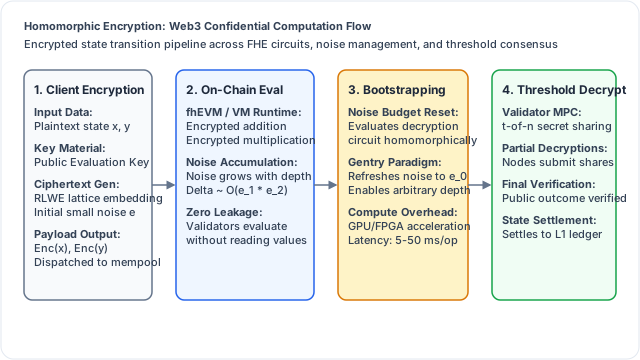
Public decentralized ledgers resolve Byzantine fault tolerance and eliminate centralized points of failure by enforcing radical transparency. On networks such as the Ethereum Foundation, Solana Protocol, and the Bitcoin Network, every account balance, token transfer, smart contract interaction, and automated market maker parameter is recorded directly to an immutable public ledger.
While public verifiability ensures auditability, it introduces structural vulnerabilities for institutional adoption and consumer financial privacy. Sophisticated trading desks exploit transparent mempools to execute predatory frontrunning and sandwich attacks via Maximal Extractable Value (MEV). Corporations cannot deploy proprietary balance sheets or private payrolls onto public execution environments without exposing sensitive operational data to competitors.
Zero-knowledge proofs such as zk-SNARKs and zk-STARKs address verification privacy by proving that an off-chain computation was executed faithfully without revealing its private inputs, as established in studies published by Coin Center and the Electronic Frontier Foundation. However, zero-knowledge proofs face a fundamental architectural limitation: a zero-knowledge prover must possess the private witness locally to generate the proof. Consequently, standard zero-knowledge systems cannot perform computations over shared, encrypted state submitted asynchronously by multiple mutually distrusting counterparties.
Fully Homomorphic Encryption (FHE) resolves this challenge. By enabling arbitrary algebraic computations to be executed directly over ciphertexts without prior decryption, homomorphic encryption allows decentralized networks to maintain shared confidential state. Validators execute smart contract logic, settle decentralized exchange trades, and update balances blindly, unlocking composable, confidential decentralized finance.
The theoretical framework for computation over encrypted data was proposed by Ronald Rivest, Leonard Adleman, and Michael Dertouzos in 1978 under the concept of privacy homomorphisms, shortly following the publication of the RSA Cryptosystem. For three decades, cryptographers discovered schemes supporting single operations, but an arbitrary, fully homomorphic scheme remained elusive.
Partially Homomorphic (1978 - 1999)
- RSA: Multiplicative only
- Paillier: Additive only
         |
         v
Somewhat Homomorphic (2000s)
- Bounded algebraic depth (low-degree polynomials)
- Uncontrolled noise accumulation
         |
         v
Fully Homomorphic Encryption (2009 - Present)
- Craig Gentry ideal lattice breakthrough
- Bootstrapping resets noise budget
- 4th Gen TFHE: Sub-second gate operations
Early systems supported only a single algebraic operation across encrypted payloads:
Multiplicative Homomorphism: In standard unpadded RSA, multiplying two ciphertexts yields the encryption of their products:
$$\text{Enc}(m_1) \cdot \text{Enc}(m_2) = (m_1^e \bmod N) \cdot (m_2^e \bmod N) = (m_1 \cdot m_2)^e \bmod N = \text{Enc}(m_1 \cdot m_2)$$
Additive Homomorphism: Developed by Pascal Paillier in 1999, the Paillier cryptosystem supports addition over ciphertexts:
$$\text{Enc}(m_1) \cdot \text{Enc}(m_2) = (g^{m_1} r_1^n \bmod n^2) \cdot (g^{m_2} r_2^n \bmod n^2) = g^{m_1 + m_2} (r_1 r_2)^n \bmod n^2 = \text{Enc}(m_1 + m_2)$$
Somewhat Homomorphic Encryption (SHE) schemes expanded these mechanisms to support both addition and multiplication simultaneously, but only for a strictly bounded polynomial degree. Every multiplication operation injects cryptographic noise into the ciphertext. Once this noise exceeds a critical decodability threshold, the underlying message is destroyed, preventing arbitrary multi-step computations.
In 2009, Craig Gentry published his doctoral thesis at Stanford University, constructing the first Fully Homomorphic Encryption scheme using ideal lattices.
Gentry introduced a foundational mathematical technique termed bootstrapping. If a somewhat homomorphic encryption scheme can evaluate its own decryption circuit homomorphically, plus at least one additional elementary algebraic gate, it can be transformed into a fully homomorphic scheme capable of evaluating circuits of unbounded depth, documented in papers cataloged across the ACM Digital Library and the IEEE Computer Society.
Modern production FHE architectures discard ideal lattices in favor of lattice problems defined over modular vectors and polynomials, specifically the Learning With Errors (LWE) problem formulated by Oded Regev in 2005 and its algebraic extension, Ring Learning With Errors (RLWE), formulated by Vadim Lyubashevsky, Chris Peikert, and Oded Regev in 2010.
LWE bases its security on the hardness of high-dimensional lattice problems, such as the Shortest Independent Vectors Problem (SIVP) and the Shortest Vector Problem (SVP). These problems are conjectured to be intractable for both classical computing clusters and quantum systems evaluated by Peter Shor at AT&T Bell Labs and standard quantum hardness frameworks analyzed by the NIST Post-Quantum Standardization Project(https://ieeexplore.ieee.org/document/365700), providing quantum resistance by design.
The BGV Scheme by Zvika Brakerski, Craig Gentry, and Vinod Vaikuntanathan and the BFV Scheme by Junfeng Fan and Frederik Vercauteren structure ciphertexts over polynomial quotient rings:
$$R_q = \mathbb{Z}_q[X] / (X^N + 1)$$
where $N$ is a power of 2 such as 4096 or 16384, and $q$ is a large modulus. Under formal analyses led by Vinod Vaikuntanathan at MIT CSAIL and Zvika Brakerski at Weizmann Institute, alongside ring polynomial foundations documented by Frederik Vercauteren at KU Leuven, a plaintext integer message $m \in R_t$ is embedded alongside a secret key $s \in R_q$ and a small Gaussian noise polynomial $e \in R_q$:
$$c = (c_0, c_1) = (-a \cdot s + m + t \cdot e, a)$$
Addition: Summing two ciphertexts directly sums their elements, with noise accumulating linearly: $e_{\text{add}} = e_1 + e_2$.
Multiplication: Multiplying two ciphertexts expands the representation from a 2-tuple $(c_0, c_1)$ to a 3-tuple $(c_0', c_1', c_2')$. A relinearization step utilizing precomputed public evaluation keys maps the degree-2 product back to a 2-tuple, while the noise accumulates multiplicatively: $e_{\text{mult}} \approx e_1 \cdot e_2$.
To manage noise accumulation across multi-level circuits, BGV employs modulus switching. By scaling down the ciphertext and its modulus from $q$ to a smaller modulus $q'$, the noise shrinks proportionally by a factor of $q'/q$, enabling long evaluation pipelines without triggering expensive bootstrapping.
The CKKS scheme, developed by Jung Hee Cheon, Andrey Kim, Miran Kim, and Yongsoo Song, treats noise as part of numerical quantization error. Rather than enforcing exact integer congruence, CKKS enables approximate real and complex number arithmetic.
CKKS is heavily utilized in privacy-preserving machine learning and encrypted neural network inference, but its approximate arithmetic makes it unsuitable for financial ledgers where precise balance accounting is required.
The TFHE cryptosystem, pioneered by Ilaria Chillotti, Nicolas Gama, Mariya Georgieva, and Malika Izabachene, operates over torus representations $\mathbb{T} = \mathbb{R} / \mathbb{Z}$, implementing fast arithmetic validated in the original TFHE Library Specification and archived within the IACR Cryptology ePrint Archive.
Unlike BGV or CKKS, where bootstrapping requires significant computational resources, TFHE evaluates a bootstrap step alongside every binary NAND or MUX gate in 10 to 30 milliseconds. Furthermore, TFHE supports programmable bootstrapping (PBS), enabling non-linear look-up tables to be evaluated homomorphically simultaneously with noise refreshing. This makes TFHE the primary choice for decentralized virtual machines executing dynamic branching and conditionals.
To run smart contracts over encrypted data, protocol engineers developed the Fully Homomorphic Ethereum Virtual Machine (fhEVM), designed by cryptography firm Zama Cryptography and implemented across protocols like Fhenix Layer 2 and Inco Network.
In a classical EVM contract, all memory slots and storage layouts are readable by anyone monitoring network state. In an fhEVM contract, variables can be defined with encrypted primitive types:
// SPDX-License-Identifier: MIT
pragma solidity ^0.8.24;

import "@fhevm/core/contracts/FHE.sol";

/// @notice Confidential ERC-20 token implementation using fhEVM encrypted primitives
contract ConfidentialToken {
/ Encrypted balance mapping: addresses link to encrypted 64-bit integers
    mapping(address => euint64) private _encBalances;
    address public owner;

    event Transfer(address indexed from, address indexed to);

    constructor() {
        owner = msg.sender;
    }

// @notice Mints encrypted tokens to an account
    function mint(address to, inEuint64 calldata encryptedAmount) external {
        require(msg.sender == owner, "Only owner can mint");
/ Convert external user ciphertext to verified internal encrypted integer
        euint64 amount = FHE.asEuint64(encryptedAmount);
        _encBalances[to] = FHE.add(_encBalances[to], amount);
    }

// @notice Executes a blind transfer without revealing the transferred quantity
    function transfer(address to, inEuint64 calldata encryptedAmount) external {
        euint64 amount = FHE.asEuint64(encryptedAmount);

/ Evaluate requirement homomorphically: returns an encrypted boolean (ebool)
        ebool canTransfer = FHE.lte(amount, _encBalances[msg.sender]);

/ Conditionally deduct balance without revealing transaction branch to miners
        euint64 transferAmount = FHE.select(canTransfer, amount, FHE.asEuint64(0));

        _encBalances[msg.sender] = FHE.sub(_encBalances[msg.sender], transferAmount);
        _encBalances[to] = FHE.add(_encBalances[to], transferAmount);

        emit Transfer(msg.sender, to);
    }

// @notice Returns an encrypted balance handle that only the account owner can decrypt
    function getEncryptedBalance() external view returns (euint64) {
        return _encBalances[msg.sender];
    }
}
Standard smart contracts control execution flow via conditional jumps (JUMPI opcodes). However, if an EVM node branches based on an encrypted condition, the control flow itself leaks the private condition to observers.
To prevent execution side-channel leaks, fhEVM contracts replace conditional branching with homomorphic multiplexers (FHE.select):
$$R = \text{select}(b, X, Y) = b \cdot X + (1 - b) \cdot Y$$
Both computational branches are evaluated homomorphically across the encrypted boolean $b \in {0, 1}$. The final assignment commits the correct state update without the validator or any external monitor learning whether $b$ was true or false.
A fundamental question for homomorphic blockchains is key custody: who holds the secret key used to decrypt the homomorphic state?
If a single sequencer or validator held the global private key, the system would collapse into a centralized, custodial database. Conversely, if users encrypted data under their personal individual public keys, validators could not perform cross-user operations, such as settling trades between two disjoint accounts.
Modern Web3 FHE architectures solve this through Threshold Multi-Party Computation (Threshold MPC).
Protocols implement Distributed Key Generation (DKG) protocols, such as those evaluated by Rosario Gennaro, Stanislaw Jarecki, Hugo Krawczyk, and Tal Rabin, alongside verifiable secret sharing schemes formalized by Torben Pryds Pedersen.
The secret key never exists in reconstructed form on any individual machine. As long as the Byzantine fault tolerance threshold is preserved, private network state remains cryptographically secure against collusion.
Despite rapid cryptographic optimization, homomorphic encryption remains computationally demanding. The primary overheads stem from ciphertext expansion and bootstrapping latency.
Achieving high transactional throughput for decentralized FHE networks requires moving beyond general-purpose x86 server architectures:
The intersection of FHE and decentralized networks has established an ecosystem of specialized privacy networks and infrastructure providers:
Zama Cryptography serves as the primary cryptographic research and tooling organization advancing blockchain-based FHE. Their open-source TFHE-rs Library provides a production-grade Rust implementation of TFHE, complete with programmable bootstrapping and GPU acceleration hooks.
Zama fhEVM protocol provides smart contract libraries that map native Solidity types into encrypted counterparts, establishing the standard programming model for confidential EVM execution.
Built as a confidential Layer 2 rollup, Fhenix Layer 2 integrates the fhEVM into an optimistic rollup framework. By employing an off-chain FHE coprocessor architecture, Fhenix enables developers to write confidential smart contracts in Solidity while offloading heavy polynomial arithmetic away from the base Layer 1 settlement layer.
Inco Network provides a modular, composable confidential computing layer secured via Ethereum staking. Rather than forcing existing decentralized applications to migrate chains, Inco operates as a shared confidential state coprocessor: an existing protocol on Arbitrum, Base Protocol, or Polygon can invoke Inco via cross-chain messaging to execute a private calculation, returning the verifiable result to the origin network, interacting directly with decentralized oracle rails such as Chainlink Data Feeds and modular rollups supported by Celestia Data Availability and CosmWasm Smart Contracts.
Positioned at the convergence of decentralized AI and restaking, Mind Network utilizes fully homomorphic encryption to secure Proof-of-Stake consensus voting and AI subnet validations. By integrating FHE with restaked assets from EigenLayer Restaking, Mind Network prevents validator collusion and bias in decentralized AI model evaluation, complementing institutional privacy frameworks championed by Coinbase Developer Platform and W3C Decentralized Identifiers.
Focusing on scalable confidential computation, Octra Network introduces Hypergraph Fully Homomorphic Encryption (HFHE). This architecture isolates execution environments within hypergraph consensus clusters, minimizing cross-validator communication latency while preserving confidential state guarantees.
Homomorphic encryption enables application designs that were previously mathematically impossible on transparent ledgers:
In traditional decentralized exchanges such as Uniswap Protocol, pending transactions broadcast raw slippage tolerances and token routing to the public mempool, inviting searchers to extract billions via generalized frontrunning.
Under an FHE-powered AMM, swap sizes, limit orders, and reserve balances are encrypted under the network public key. The pricing curve:
$$k = x_{\text{enc}} \cdot y_{\text{enc}}$$
is evaluated homomorphically. Arbitrageurs cannot inspect trade directions or frontrun orders, eliminating predatory MEV at the protocol layer, directly overcoming the frontrunning vectors exposed by Flashbots MEV-Boost and dark pool architectural proposals highlighted by Paradigm Research and a16z crypto research.
Public voting suffers from voter apathy, herd behavior, and voter coercion. If large token holders see an early lead for a proposal, voter behavior shifts predictably.
Using FHE, governance proposals accumulate encrypted voting weights:
$$\text{Tally}{\text{enc}} = \sum{i=1}^M \text{Weight}i \cdot \text{Vote}{i, \text{enc}}$$
Validators update the encrypted sum with every cast ballot without anyone learning the current standing. The network decrypts the final tally only after the proposal voting period has closed.
Under existing DeFi lending models on protocols such as Aave Protocol and Compound Finance, loans must be heavily overcollateralized due to borrower anonymity and public liquidation parameters.
With FHE, institutional borrowers can feed encrypted credit histories, off-chain bank balances, and audited financial statements into on-chain risk rating algorithms. The smart contract evaluates risk ratings homomorphically, issuing capital efficiently without revealing the borrower underlying corporate data to competitors, building upon stable credit primitives developed across MakerDAO Credit Facilities, Curve Finance, and Balancer Pools.
The widespread deployment of homomorphic encryption across decentralized architectures is driven by three technical milestones:
Through the integration of Ring Learning With Errors lattice cryptography, programmable bootstrapping, and decentralized threshold execution, fully homomorphic encryption is transforming public blockchains into universally confidential, secure distributed computers.
Explore more guides and career playbooks