Loading article...

An in-depth engineering thesis on the Cosmos SDK framework, examining ABCI 2.0, BaseApp architecture, keeper object capabilities, Protobuf schemas, and custom Go state machine development.
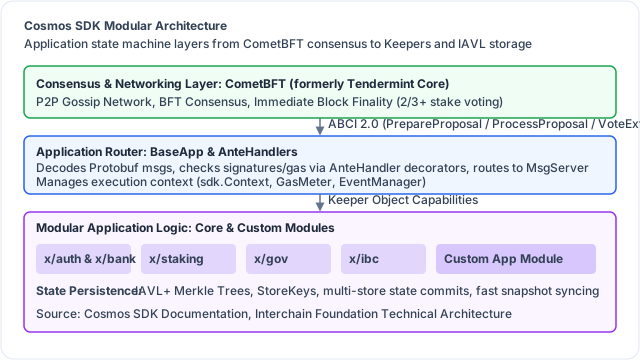
In the landscape of decentralized application engineering, smart contract platforms require developers to build within the execution boundaries of an existing virtual machine, such as the Ethereum Virtual Machine (EVM) or Solana Sealevel. While this model simplifies early deployment, it forces applications to accept fixed gas metering schedules, restricted execution runtimes, and shared network congestion.
For engineering teams seeking total architectural autonomy, the Cosmos SDK provides an open-source, modular framework for building custom, sovereign application-specific blockchains in the Go Programming Language. Powered by the CometBFT consensus engine and the Inter-Blockchain Communication (IBC) protocol, the Cosmos SDK has become the foundational framework powering major networks such as Osmosis, Celestia, dYdX Chain, Injective, and Sei Network.
This thesis provides an exhaustive technical analysis of the Cosmos SDK architecture, dissecting the execution lifecycle from consensus engine communication via ABCI 2.0 to BaseApp routing, keeper object-capability modeling, Protobuf serialization, and custom module implementation.
The Cosmos SDK is designed around a strict separation of concerns between consensus and application execution:
In traditional monolithic blockchain clients like Geth (Go-Ethereum), consensus rules, networking protocols, and virtual machine execution are tightly coupled within a unified codebase.
The Cosmos architecture decouples these layers completely:
[]byte).The transition from legacy ABCI to ABCI 2.0 (formalized in CometBFT v0.38+) fundamentally changed how application developers interact with the consensus engine.
In legacy ABCI, the consensus engine had total control over transaction ordering. The application was a passive consumer: CometBFT assembled a block, and the application executed transactions sequentially via BeginBlock, DeliverTx, and EndBlock.
ABCI 2.0 gives the application direct influence over block proposal and validator voting through four primary lifecycle methods:
Vote Extensions enable validators to perform computations or aggregate off-chain data during the consensus round itself.
For example, on Skip Protocol or sovereign orderbook exchanges like dYdX, validators use vote extensions to query real-time market prices from external exchanges, sign the price data with their validator keys, and broadcast it alongside their consensus votes. The subsequent block proposer aggregates these vote extensions, computing an in-consensus median price oracle directly inside PrepareProposal without requiring costly third-party oracle transactions.
The core operational kernel of any Cosmos SDK blockchain is BaseApp, located in the github.com/cosmos/cosmos-sdk/baseapp package. BaseApp implements the ABCI interface and coordinates the end-to-end execution of incoming transactions.
sdk.Context)Every operation in the Cosmos SDK requires an sdk.Context. The context is an immutable struct passed down through the call stack that encapsulates:
Before a transaction reaches business logic, it must pass through a chain of decorators known as the AnteHandler. The AnteHandler acts as middleware, verifying system invariants and protecting the node from resource exhaustion attacks:
// Simplified representation of Cosmos SDK AnteHandler Decorator Chain
anteHandler := sdk.ChainAnteDecorators(
    ante.NewSetUpContextDecorator(), // Initializes GasMeter and context
    ante.NewExtensionOptionsDecorator(options.ExtensionOptionChecker),
    ante.NewValidateBasicDecorator(), // Calls basic stateless validations
    ante.NewTxTimeoutHeightDecorator(), // Verifies transaction height limits
    ante.NewValidateMemoDecorator(options.AccountKeeper),
    ante.NewConsumeGasForTxSizeDecorator(options.AccountKeeper),
    ante.NewDeductFeeDecorator(options.AccountKeeper, options.BankKeeper, options.FeegrantKeeper),
    ante.NewSetPubKeyDecorator(options.AccountKeeper), // Validates secp256k1 / ed25519 pubkeys
    ante.NewValidateSigCountDecorator(options.AccountKeeper),
    ante.NewSigGasConsumeDecorator(options.AccountKeeper, sigGasConsumer),
    ante.NewSigVerificationDecorator(options.AccountKeeper, options.SignModeHandler),
    ante.NewIncrementSequenceDecorator(options.AccountKeeper), // Anti-replay nonce increment
)
If any decorator in the AnteHandler chain fails (for example, if the signature is forged, the account nonce is invalid, or the transaction gas limit is exceeded), execution halts immediately, and the transaction is discarded without mutating state.
In standard smart contract languages like Solidity, contracts interact by calling public functions on other deployed addresses. If a contract has a reentrancy flaw or an authorization vulnerability, external callers can exploit the contract directly.
The Cosmos SDK enforces security through an Object-Capability (object-cap) security model. A module cannot access or mutate another module state simply by knowing its name or address. Access to state is granted strictly through Go reference handles called Keepers.
When building a custom module (for example, a decentralized exchange module x/dex), the developer defines a minimal interface specifying only the methods required:
// internal/types/expected_keepers.go
package types

import (
    sdk "github.com/cosmos/cosmos-sdk/types"
)

// BankKeeper defines the minimal contract required by x/dex from x/bank
type BankKeeper interface {
    SendCoins(ctx sdk.Context, fromAddr sdk.AccAddress, toAddr sdk.AccAddress, amt sdk.Coins) error
    GetBalance(ctx sdk.Context, addr sdk.AccAddress, denom string) sdk.Coin
}
In app.go, during node initialization, the developer passes the BankKeeper instance into the DexKeeper. Because the DexKeeper is only given the SendCoins and GetBalance methods, it is physically impossible for a bug inside x/dex to call privileged functions like MintCoins or BurnCoins. Security boundaries are enforced at compile time by the Go compiler.
A custom Cosmos SDK module encapsulates a discrete domain of application state and logic. Standard conventions structure a module into standard sub-packages:
x/vault/
├── client/cli/          # CLI command definitions (Cobra commands)
├── keeper/              # Core business logic and database mutations
│   ├── keeper.go        # Keeper struct and constructor
│   ├── msg_server.go    # State-transition execution handlers
│   └── query_server.go  # Read-only query handlers
├── types/               # Protobuf generated code, keys, and errors
│   ├── codec.go         # Interface registrations
│   ├── expected_keepers.go
│   ├── keys.go          # Store prefixes and key generation helpers
│   └── msgs.go          # Transaction validation methods
├── module.go            # AppModule interface implementation
└── proto/               # Protocol Buffer schema definitions
    └── vault/v1/
        ├── tx.proto     # Transaction service definitions
        ├── query.proto  # Query service definitions
        └── state.proto  # Persistent state data structures
Cosmos SDK utilizes Google Protocol Buffers (Protobuf v3) via the cosmos/gogoproto compiler for message serialization, gRPC service routing, and CLI generation.
In proto/vault/v1/tx.proto, developers define transactions as gRPC services:
syntax = "proto3";
package vault.v1;

option go_package = "github.com/example/chain/x/vault/types";

import "cosmos/base/v1beta1/coin.proto";
import "gogoproto/gogo.proto";

service Msg {
  rpc Deposit(MsgDeposit) returns (MsgDepositResponse);
  rpc Withdraw(MsgWithdraw) returns (MsgWithdrawResponse);
}

message MsgDeposit {
  string sender = 1;
  cosmos.base.v1beta1.Coin amount = 2 [(gogoproto.nullable) = false];
}

message MsgDepositResponse {
  uint64 shares_minted = 1;
}
Running the code generator produces type-safe Go structs and gRPC client/server bindings automatically.
The business logic of a transaction executes inside msg_server.go. Here, the keeper verifies business conditions, mutates storage, and emits structured events:
package keeper

import (
    "context"
    sdk "github.com/cosmos/cosmos-sdk/types"
    sdkerrors "github.com/cosmos/cosmos-sdk/types/errors"
    "github.com/example/chain/x/vault/types"
)

type msgServer struct {
    Keeper
}

func NewMsgServerImpl(keeper Keeper) types.MsgServer {
    return &msgServer{Keeper: keeper}
}

func (k msgServer) Deposit(goCtx context.Context, msg *types.MsgDeposit) (*types.MsgDepositResponse, error) {
    ctx := sdk.UnwrapSDKContext(goCtx)

    senderAddr, err := sdk.AccAddressFromBech32(msg.Sender)
    if err != nil {
        return nil, sdkerrors.ErrInvalidAddress.Wrapf("invalid sender address: %s", err)
    }

/ Transfer funds from user account to module vault escrow
    err = k.bankKeeper.SendCoinsFromAccountToModule(ctx, senderAddr, types.ModuleName, sdk.NewCoins(msg.Amount))
    if err != nil {
        return nil, err
    }

/ Compute shares and mutate internal state
    shares := k.CalculateShares(ctx, msg.Amount)
    k.SetUserShares(ctx, senderAddr, shares)

/ Emit structured indexer events
    ctx.EventManager().EmitEvent(
        sdk.NewEvent(
            types.EventTypeDeposit,
            sdk.NewAttribute(types.AttributeKeySender, msg.Sender),
            sdk.NewAttribute(sdk.AttributeKeyAmount, msg.Amount.String()),
            sdk.NewAttribute(types.AttributeKeyShares, sdk.NewIntFromUint64(shares).String()),
        ),
    )

    return &types.MsgDepositResponse{SharesMinted: shares}, nil
}
State persistence in the Cosmos SDK is managed through the CommitMultiStore. Rather than storing state in a single monolithic database table, the Cosmos SDK partitions state into distinct, isolated key-value stores for each registered module using dedicated StoreKey handles.
Each module store is backed by an IAVL+ (Immutable AVL+) Merkle tree:
Engineering a production-grade Cosmos app-chain requires disciplined software engineering workflows:
The premier developer tool for scaffolding and maintaining Cosmos SDK chains is the Ignite CLI. Ignite automates boilerplate code generation:
Unlike smart contract development in Foundry where tests execute inside an EVM sandbox, Cosmos SDK testing spans three comprehensive tiers:
SimApp (Simulation Application), booting the full Cosmos SDK application with all registered modules to verify multi-module interactions.To evaluate when to choose the Cosmos SDK, consider this architectural comparison against leading alternative frameworks:
Engineering leadership should evaluate this decision matrix before committing to an app-chain architecture:
Build on Cosmos SDK if your application requires:
Build on a General-Purpose Layer 2 (Arbitrum, Base) if your application:
By mastering the Cosmos SDK, software engineers possess the technical capability to move beyond smart contract tenancy, authoring autonomous, production-grade distributed state machines that shape the sovereign frontier of decentralized computing.
Explore more guides and career playbooks