
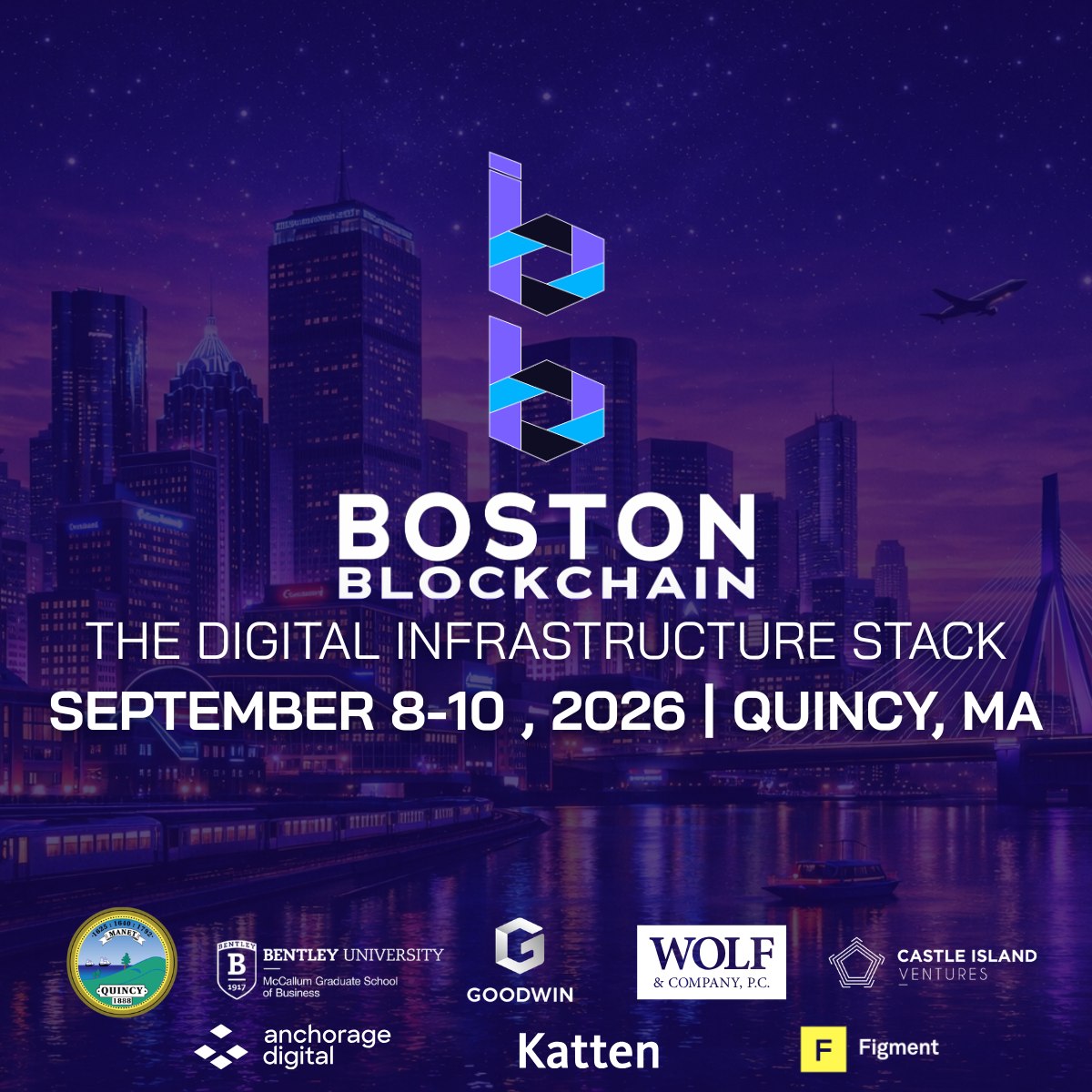
Boston Blockchain Week 2026 runs September 8-10, 2026 at the Marriott Boston Quincy under the theme 'The Digital Infrastructure Stack,' three days of tracks spanning payments, tokenization, identity and regulation, with speakers drawn from the SEC's Crypto Task Force, Coinbase and a16z.
Deployment Season in Quincy
Host QUBIC Labs frames this year's edition as the transition from experimentation to deployment — blockchain integrating with real-world systems, meeting regulatory requirements and operating at scale. After several industry cycles of pilot purgatory, that framing feels earned rather than aspirational, and the track structure backs it up.
Note the geography: this is Quincy, Massachusetts, at the Marriott Boston Quincy on 1000 Marriott Drive, not downtown Boston. Three days, one location, no campus scatter. For attendees juggling flights and childcare, a single-building format is a feature, and early September on the South Shore beats January by any measure.
Six Tracks, Two Spine Themes
The program divides into six tracks: Payment & Settlement Systems covering digital currencies, cross-border flows, treasury operations and real-time settlement; Tokenization & Asset Infrastructure spanning securities tokenization, real-world assets, custody and trading plumbing; Data & Trust Infrastructure for digital identity, credentials and record-keeping; Regulation & Compliance; Enterprise & Government Adoption with supply chain, energy markets and trade finance cases; and Building & Deploying for developer tools, security and interoperability.
Cutting across everything sit two declared themes: AI plus blockchain, and security and trust. Pairing those with the regulatory track signals who this event courts — institutions that must justify decisions to boards and examiners, not degens chasing the next narrative. Programmable financial services and instant payments get treated as current deployments, which matches reality.
A Regulator, an Exchange and a16z Walk In
Confirmed names carry weight for the theme. Taylor Lindman of the SEC Crypto Task Force gives attendees a rare line of sight into how Washington's technical staff thinks; Yolanda of Coinbase brings the exchange operator's compliance-and-product vantage point; Christian Crowley of a16z covers the venture read on where infrastructure dollars flow next.
That trio maps neatly onto the week's thesis: rulebooks, rails and capital. Boston's own DNA — fintech incumbency, university depth, a governor's office friendly to digital assets pilots — makes it a sensible host city even if the venue technically resides in Quincy.
Tickets and Practicalities
Ticketing ran through tiers: Early Bird Standard, Student tickets requiring approval of a .edu or university email, and a limited-time Flash Sale — several of which had already closed sales at the time of writing, so late deciders should expect standard pricing. Host Ian Cain, a QUBIC Labs co-founder, anchors the organizing side alongside the lab's year-round programming.
The attendee mix skews toward technologists, business leaders, policymakers and investors — the four constituencies the page addresses directly. If your 2026 roadmap includes stablecoin payouts, tokenized collateral or verifiable credentials, September 8-10 in Quincy is a concentrated place to pressure-test assumptions against people who ship.
One more consideration for planners: the single-venue format concentrates hallway value unusually well. Between tracks, the Marriott's common areas become the actual conference — regulators comparing notes with compliance leads, founders benchmarking against enterprise buyers — and three days in one building compounds those encounters instead of scattering them across a city. Boston's broader moment adds context: university research pipelines, a dense fintech payroll and policymakers increasingly engaged with digital assets have quietly assembled the ingredients this theme requires. Teams deciding whether to send one person or five should note that the payments and tokenization tracks map most directly onto what banks and fintechs are shipping this year, while the regulation track alone justifies the trip for legal teams still drafting their first stablecoin policies.