Loading article...

A comprehensive technical analysis of the blockchain oracle problem, examining deterministic execution boundaries, off-chain reporting protocols, cryptographic data attestation, and Byzantine fault tolerant consensus.
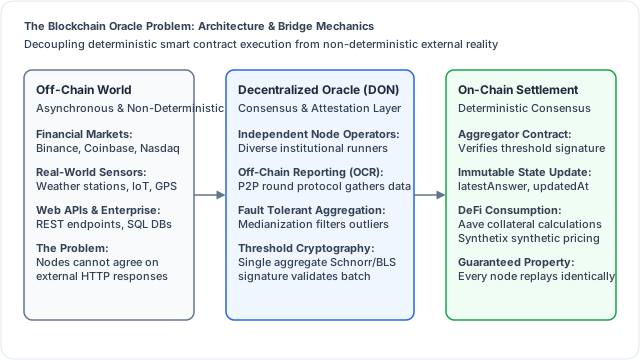
A smart contract deployed to a public distributed ledger represents an immutable, self-executing software program. When certain predefined conditions are met, the contract automatically updates account balances, issues synthetic debt, or liquidates collateral positions without human intervention. However, despite their execution speed and tamper resistance, smart contracts suffer from a fundamental architectural limitation known as The Oracle Problem.
Blockchains such as the Ethereum Foundation network, Solana Protocol, and the Bitcoin Network are deliberately engineered as isolated, deterministic state machines. Every consensus node validating a block must execute the exact same sequence of instructions and arrive at the exact same state root. If smart contracts were permitted to initiate native HTTP network calls to external APIs, such as requesting the current price of Ethereum from a web exchange or querying a weather API, different nodes would receive slightly different responses due to network latency, server downtime, or dynamic pricing shifts. This non-determinism would cause consensus to splinter instantly, breaking the fundamental integrity of the distributed ledger.
Blockchain oracles bridge this isolated computational sandbox and the external physical world. Rather than permitting the blockchain to reach outward, oracles operate as external cryptographic relays that fetch real-world data, validate its mathematical authenticity, achieve consensus across independent node operators, and write the verified results into on-chain state storage. This technical analysis explores the theoretical foundations of the oracle problem, the cryptographic protocols that resolve it, the mechanics of decentralized oracle networks, and the economic security models that protect billions in decentralized finance.
To understand why oracles are indispensable, one must analyze the mathematical definition of a state transition system. A blockchain is defined as a state machine where state $S_{t+1}$ is derived deterministically from previous state $S_t$ and transaction payload $T$:
$$S_{t+1} = ext{Apply}(S_t, T)$$
For this state machine to achieve Byzantine fault tolerance, the function $ ext{Apply}$ must be strictly deterministic across every validating node in the network. If node $A$ evaluates $ ext{Apply}(S_t, T)$ and arrives at state root $R_A$, while node $B$ arrives at state root $R_B$, where $R_A eq R_B$, the network forks immediately.
If a smart contract instruction executed a native web call:
// IMPOSSIBLE IN PURE DETERMINISTIC STATE MACHINES
function liquidateUser(address borrower) external {
/ Non-deterministic: Network latency or API updates return different values
    uint256 currentEthPrice = Http.get("https://api.binance.com/api/v3/ticker/price?symbol=ETHUSDT");
    if (currentEthPrice < liquidationThreshold) {
        executeLiquidation(borrower);
    }
}
If node $A$ executes this instruction at millisecond $t_0$, the API might return $$3,000$. If node $B$ executes the transaction at millisecond $t_{100}$, the price might have ticked to $$2,999$. Node $A$ would calculate that the loan remains solvent, while node $B$ would execute the liquidation, permanently shattering network consensus.
Furthermore, if the external server experiences an outage five years later, a newly synchronizing node replaying historical blocks from the genesis block would encounter an HTTP timeout, rendering historical verification impossible.
Consequently, all data imported from external reality must enter the blockchain as a signed transaction payload included within a block, transforming the off-chain entropy into an immutable, replayable historical input.
Early attempts to bridge real-world data onto blockchains relied upon centralized oracles. Under a centralized architecture, a single trusted server, exchange, or entity signs and broadcasts data feeds directly to an on-chain contract.
Centralized oracles introduce fatal vulnerabilities into decentralized protocols:
To eliminate these vulnerabilities, modern Web3 protocols require Decentralized Oracle Networks (DONs).
A Decentralized Oracle Network operates as an independent, off-chain consensus layer positioned between external data providers and on-chain smart contracts. Pioneered by Sergey Nazarov and Steve Ellis at Chainlink, along with research fellow Professor Ari Juels at Cornell Tech, DONs achieve fault tolerance through independent node operator diversity and multi-layered aggregation algorithms.
A robust DON, as documented in the Chainlink 2.0 Whitepaper, enforces decentralization at two independent levels:
In early oracle designs, every node operator submitted their individual price observation directly to the blockchain via independent on-chain transactions. An on-chain smart contract then calculated the median of the submitted values. While functional, this legacy model consumed massive amounts of gas, scaling linearly ($O(N)$) with the number of participating nodes.
To solve this scaling bottleneck, Chainlink introduced Off-Chain Reporting (OCR). Under OCR, participating nodes communicate over a specialized peer-to-peer gossip network built on the libp2p Networking Stack developed by Protocol Labs:
The on-chain aggregator contract executes a single signature verification, reducing gas consumption by over 90% while preserving Byzantine fault tolerance guarantees.
While financial oracles primarily report aggregated market prices, next-generation oracles must verify sensitive off-chain credentials, private bank balances, and web sessions without exposing confidential data. This has driven the deployment of cryptographic web attestation protocols:
Formalized by Fan Zhang, Ethan Cecchetti, Kyle Croman, Ari Juels, and Elaine Shi in 2016, Town Crier leveraged Trusted Execution Environments (TEEs), specifically Intel SGX Enclaves. The oracle server fetches data inside a secure hardware enclave, verifying the HTTPS TLS certificate directly within hardware and signing an attestation for smart contracts. While efficient, hardware enclaves remain vulnerable to side-channel cache attacks like Spectre and Foreshadow.
Developed at Cornell Tech by Fan Zhang, Sai Krishna Deepak Maram, Harjasleen Malvai, Steven Goldfeder, and Ari Juels and acquired by Chainlink Labs, DECO eliminates trusted hardware entirely.
DECO utilizes a three-party handshake protocol over Transport Layer Security (TLS):
This allows smart contracts to import verified web data trustlessly without requiring target websites to modify their API infrastructure.
A decentralized oracle is not secure merely because it uses multiple nodes; it is secure because the economic cost of corrupting the network strictly exceeds the financial gain of exploiting it.
Formulated by Vitalik Buterin Research and crypto-economic analyses shared across Paradigm Writing and a16z crypto research, the fundamental security condition for an oracle is expressed as:
$$ ext{Cost of Corruption (CoC)} > ext{Profit from Corruption (PfC)}$$
If an oracle secures $$5 ext{ billion}$ of collateral across money markets such as MakerDAO and Uniswap, the Profit from Corruption (PfC) equals the maximum profit an attacker can extract by reporting a forged price. If the total economic stake bond of the oracle network is only $$50 ext{ million}$, an adversary could rationally bribe a supermajority of node operators with $$100 ext{ million}$ to post a malicious report, netting a multi-billion-dollar profit.
To align incentives, modern networks implement staking mechanisms:
Integrating an oracle feed requires rigorous defensive programming. Naive oracle integrations have resulted in some of the largest exploits in decentralized finance history, analyzed extensively by OpenZeppelin Security, Trail of Bits, and post-mortem reports on Immunefi Bug Bounties and CertiK Security.
// SPDX-License-Identifier: MIT
pragma solidity ^0.8.24;

interface AggregatorV3Interface {
    function decimals() external view returns (uint8);
    function latestRoundData() external view returns (
        uint80 roundId,
        int256 answer,
        uint256 startedAt,
        uint256 updatedAt,
        uint80 answeredInRound
    );
}

/// @title Secure Oracle Consumer Implementation
contract SecurePriceConsumer {
    AggregatorV3Interface internal immutable priceFeed;
    uint256 internal constant MAX_STALENESS = 3600; // 1 hour threshold

    error StalePriceFeed();
    error NegativePrice();
    error RoundIncomplete();

    constructor(address _feedAddress) {
        priceFeed = AggregatorV3Interface(_feedAddress);
    }

// @notice Safely reads price data with multi-layer validity checks
    function getLatestPrice() public view returns (uint256) {
        (
            uint80 roundId,
            int256 price,
            ,
            uint256 updatedAt,
            uint80 answeredInRound
        ) = priceFeed.latestRoundData();

/ Check 1: Ensure positive pricing (safeguards against flash negative reporting)
        if (price <= 0) revert NegativePrice();

/ Check 2: Protect against stale data feeds during network halts
        if (block.timestamp - updatedAt > MAX_STALENESS) revert StalePriceFeed();

/ Check 3: Ensure round completion
        if (answeredInRound < roundId) revert RoundIncomplete();

        return uint256(price);
    }
}
When deploying contracts on Layer 2 rollups like Arbitrum, Optimism, or Base Protocol, transactions settle through an off-chain sequencer. If the centralized sequencer experiences downtime, transactions freeze.
When the sequencer restarts, a massive backlog of pending transactions executes simultaneously. If market prices crashed during the outage, transactions might be liquidated instantly without users having an opportunity to top up collateral.
To prevent this, Chainlink L2 Sequencer Feeds introduce a mandatory grace period. If the sequencer restarts after an outage, smart contracts reject price updates for a configurable grace window (e.g., 30 minutes), allowing users to stabilize debt positions before liquidations reactivate.
The Web3 landscape features several distinct oracle architectures optimized for different latency and cost profiles:
Serving as the undisputed industry standard, Chainlink secures tens of billions in total value across hundreds of decentralized applications. With its Off-Chain Reporting protocol, Verifiable Random Function (VRF), Proof of Reserve (PoR), and Cross-Chain Interoperability Protocol (CCIP), Chainlink provides enterprise-grade infrastructure adopted by institutional finance leaders including SWIFT, Euroclear, Franklin Templeton, and tokenized treasury issuers like Ondo Finance and Paxos Trust.
Engineered by specialized market-making firms and trading venues, Pyth Network implements a first-party, pull-based oracle architecture. High-frequency market makers publish continuous proprietary pricing ticks directly to Pythnet, which broadcasts cross-chain via the Wormhole Foundation bridge. Pyth dominates high-speed derivatives and perpetual contract protocols where sub-second pricing updates are required, powering decentralized exchange architectures like Hyperliquid Perps.
RedStone pioneers modular oracle data packaging. Rather than constantly paying gas fees to update on-chain storage, RedStone data providers publish signed payloads to decentralized storage networks like Arweave. Users attach the signed data directly to their transaction calldata, which is cryptographically unpacked and verified in-line by the target smart contract.
API3 focuses on first-party oracles via their open-source Airnode technology. Airnode enables API providers to run their own light oracle nodes, signing data directly at the source and eliminating secondary middleman networks.
The evolution of decentralized oracles is rapidly converging with cutting-edge cryptographic research:
Decentralized oracles resolve the fundamental contradiction of public blockchains: granting smart contracts the ability to interact with real-world human data while strictly maintaining the mathematical certainty of decentralized consensus.
Explore more guides and career playbooks