Loading article...

An empirical thesis on the cryptographic mechanics, architectural taxonomy, prover pipelines, and developer paradigms of Zero-Knowledge Ethereum Virtual Machines.
Scaling decentralized smart contract execution without sacrificing base-layer cryptographic security has remained the central engineering challenge of the Ethereum ecosystem. For years, the Layer 2 rollup landscape was bifurcated by an architectural trade-off: Optimistic Rollups offered developer convenience and bytecode compatibility, but imposed seven-day fraud-proof dispute windows that locked user capital. Conversely, Zero-Knowledge Rollups offered immediate mathematical finality and succinct cryptographic proofs, but required developers to rewrite protocol logic into specialized zero-knowledge intermediate representations like Cairo.
The arrival of the Zero-Knowledge Ethereum Virtual Machine (zkEVM) eliminated this trade-off. A zkEVM is a Layer 2 scaling engine that executes arbitrary Ethereum Virtual Machine bytecode off-chain, translating each opcode transition into an arithmetic circuit and generating a succinct zero-knowledge validity proof. Rather than re-executing transactions sequentially, the Ethereum Layer 1 network simply verifies a single mathematical proof, establishing validity for thousands of batched operations in milliseconds.
According to rollup telemetry tracked on L2Beat and DefiLlama, zero-knowledge rollups secure tens of billions of dollars in economic value across networks like Scroll, Taiko, Linea by Consensys, Polygon Labs zkEVM, and ZKsync. Understanding the inner mechanics of a zkEVM requires examining the mathematics of arithmetization, polynomial commitment schemes, prover hardware acceleration, and the taxonomy of EVM equivalence established by Vitalik Buterin's zkEVM Taxonomy.
The Ethereum Virtual Machine was designed in 2014 to run deterministically on commodity x86 and ARM processors, not to be proven inside zero-knowledge arithmetic circuits. In zero-knowledge cryptography, all computations must be expressed as systems of polynomial equations over large finite mathematical fields, such as the BabyJubjub or BN254 elliptic curves.
The native architecture of the EVM presents three massive hurdles for cryptographic circuit generation:
The EVM operates with native 256-bit word registers to facilitate cryptographic hashing and address arithmetic. However, standard zero-knowledge proof systems operate over finite fields whose prime moduli are around 254 bits (like the scalar field of BN254) or 64 bits (like Goldilocks in Polygon Plonky2).
Simulating a 256-bit integer addition with carry bits or executing a bitwise XOR opcode over a 254-bit field requires decomposing each 256-bit word into multiple smaller 16-bit or 32-bit limbs. A single 256-bit multiplication can explode into dozens of arithmetic constraints, expanding the prover's computational burden by orders of magnitude.
Ethereum verifies world state, storage slots, and transaction receipts using Merkle Patricia Tries structured with Keccak-256 (SHA-3) hashing. Keccak is heavily optimized for hardware execution, relying on bitwise rotations, ANDs, and XORs.
In arithmetic circuits, bitwise operations are notoriously expensive. Computing a single Keccak-256 hash inside a circuit requires approximately 150,000 arithmetic constraints. In contrast, algebraic hash functions designed specifically for zero-knowledge systems, such as the Poseidon Hash Function, require fewer than 300 constraints for equivalent security.
In the EVM, volatile memory expands dynamically, with gas costs scaling quadratically according to execution formulas specified by the Ethereum Foundation. Opcodes like MLOAD, MSTORE, and MSTORE8 operate on byte-level offsets, while storage opcodes like SSTORE and SLOAD read from a 2^256 address space.
Proving that a read operation in step 5,000 accurately reflects the state written in step 12 requires maintaining dynamic permutation arguments and memory lookup arguments (such as Plookup or multiset equality checks), placing severe memory demands on prover servers.
To transform thousands of raw transactions into a single verification transaction on Ethereum Layer 1, a zkEVM executes a rigorous, multi-stage mathematical pipeline:
The Layer 2 sequencer ingests signed transactions from users, executes them sequentially using an execution engine like Scroll or Linea by Consensys, and emits an execution trace.
The trace is a massive matrix where each row represents a discrete computational clock cycle and each column tracks a specific state variable: program counter, stack pointer, opcode identifier, gas remaining, and intermediate limb values. A single complex block can generate traces with tens of millions of rows.
The execution trace must be translated into mathematical relationships. In AIR (Algebraic Intermediate Representation) used in STARK systems, or Plonkish Arithmetization used in Plonk and Halo2 systems, circuit designers define polynomial equations that enforce execution rules:
Transition Constraints: Ensuring that if row $i$ executes ADD, row $i+1$ correctly updates the stack pointer and sets the top element to $A + B$.
Boundary Constraints: Enforcing that the execution starts in an initialized state and concludes with the correct final state root.
Lookup Tables: Using Plookup to verify that bitwise operations or precompiles match precomputed truth tables rather than arithmetizing them directly.
Once polynomials are constructed, the prover must commit to them without disclosing the entire execution trace:
KZG Commitments: Employs pairings over elliptic curves (such as BN254). KZG produces extremely succinct proofs (under 1 kilobyte) that are very cheap to verify on Ethereum L1. However, KZG requires a trusted cryptographic setup and is vulnerable to potential future quantum decryption.
FRI Protocol (Fast Reed-Solomon Interactive Oracle Proofs of Proximity): Employs collision-resistant hash functions. FRI requires no trusted setup and is post-quantum secure, but produces larger proofs (dozens of kilobytes).
Posting a 50-kilobyte proof directly to Ethereum Layer 1 is expensive. Modern zkEVM architectures utilize recursive proof composition.
The prover generates multiple STARK proofs across small transaction chunks in parallel. Then, a recursive circuit proves the correct verification of those proofs, aggregating thousands of transactions into a single top-level proof. Finally, a tool like Snarkjs or a Groth16/Plonk wrapper wraps the final proof into an ultra-succinct SNARK measuring under 300 bytes.
The rollup sequencer submits this compressed proof alongside compressed state diffs to an on-chain verifier contract on Ethereum. The verifier contract executes pairing checks, consuming approximately 200,000 gas units, and finalizes the state update permanently on Etherscan.
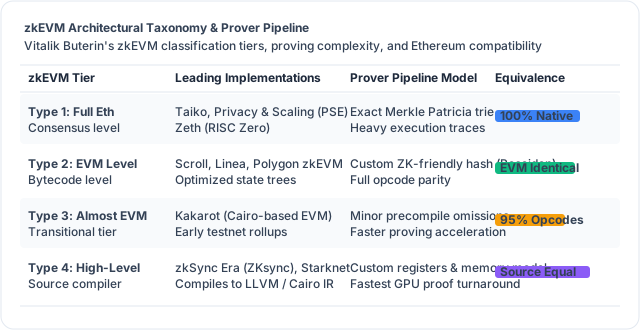
Not all zkEVMs are architected equally. In his landmark analysis, Ethereum co-founder Vitalik Buterin established a taxonomy categorizing zkEVM architectures based on their adherence to the original Ethereum protocol:
Type 1 zkEVMs introduce zero modifications to the Ethereum execution environment. They prove the exact Ethereum block hashing, state trees (Merkle Patricia Trie), and consensus rules.
Leading Examples: Taiko, Privacy & Scaling Explorations (PSE) by the Ethereum Foundation, and RISC Zero Zeth.
Trade-Off: Ultimate compatibility. A Type 1 zkEVM can verify Ethereum Layer 1 consensus directly, functioning as an enshrined zk-EVM for base-layer Ethereum. However, because it forces the prover to prove un-optimized Keccak hashes and MPT storage slots, proof generation is computationally massive, taking hours of cloud server time without specialized FPGA/ASIC hardware.
Type 2 zkEVMs preserve full EVM opcode and bytecode equivalence, allowing developers to deploy contracts compiled with standard Solidity Documentation compilers without modification. However, they modify the external state tree structure, replacing Merkle Patricia Tries with ZK-friendly sparse Merkle trees using Poseidon hashing.
Leading Examples: Scroll, Linea by Consensys, and Polygon Labs zkEVM.
Trade-Off: One hundred percent application-level compatibility with existing smart contracts, developer tools, and debugging suites, while accelerating proof generation speeds by five to ten times compared to Type 1 systems.
Type 3 systems are transitional architectures. They achieve near-total EVM equivalence, but intentionally omit or modify complex edge-case opcodes or precompiles (such as SELFDESTRUCT or specific cryptographic precompiles) that are exceptionally costly to prove in circuits.
Leading Examples: Early developmental testnets of Polygon zkEVM and Kakarot (an EVM written in Cairo).
Trade-Off: Significantly faster prover turnaround, but contracts relying on non-standard precompiles require minor refactoring before deployment.
Type 4 systems take an entirely different architectural route. Rather than proving EVM bytecode, they take smart contracts written in high-level languages like Solidity or Vyper and compile them directly to a custom, ZK-optimized intermediate bytecode using an LLVM compiler framework.
Trade-Off: Substantially faster proof turnaround and native support for Account Abstraction under ERC-4337 and EIP-7702. However, bytecodes differ completely from Ethereum L1, meaning tools that depend on raw EVM opcode inspection (like low-level debuggers or contracts relying on inline Yul assembly memory layouts) may require modification.
To understand how high-throughput zkEVMs like Scroll and Linea function in production, engineers must analyze the mathematics of Plonkish arithmetization, implemented via frameworks like Halo2 by Zcash and Arkworks.
In classical R1CS (Rank-1 Constraint Systems) utilized by systems like Circom, every constraint is restricted to the bilinear form:
$$\langle A, w angle \cdot \langle B, w angle = \langle C, w angle$$
While R1CS is computationally efficient for simple hash functions, it requires millions of auxiliary variables to represent complex EVM opcode logic. Plonkish arithmetization introduces a flexible matrix grid consisting of three distinct column types:
Advice Columns: Hold witness values and intermediate state calculations (such as memory pointers and temporary stack elements).
Fixed Columns: Contain precomputed constants and truth tables defined by the protocol (such as opcode instruction encodings and 8-bit lookup tables).
Instance Columns: Contain public inputs shared between the prover and the on-chain verifier contract (such as the pre-state root, post-state root, and transaction batch hash).
Circuit engineers define custom gates across these columns using polynomial constraints:
$$q_{add} \cdot (a + b - c) + q_{mul} \cdot (a \cdot b - c) = 0$$
Where $q_{add}$ and $q_{mul}$ are boolean selector polynomials that turn specific gate operations on or off for individual clock cycles. By combining custom gates with Plookup arguments, zkEVM engineers prove complex operations (like 256-bit arithmetic or byte-range checks) in a fraction of the clock cycles required by traditional constraint systems.
During the final proof generation phase, the prover must compute two major algebraic algorithms that consume over eighty percent of total prover compute time:
Multi-Scalar Multiplication (MSM): Computing $P = \sum_{i=1}^n k_i G_i$, where $k_i$ are field scalars and $G_i$ are elliptic curve points. Provers employ the Pippenger algorithm, bucketing scalars into windows and executing parallel bucket additions across GPU memory threads.
Number Theoretic Transform (NTT): The finite field analog of the Fast Fourier Transform (FFT), used to convert polynomial representations between evaluation form (points on a grid) and coefficient form. NTT algorithms require high memory bandwidth, making high-end GPUs and custom ASICs essential for real-time proving.
Real-time telemetry and price oracle integration with networks like Chainlink Documentation and Pyth Network allow rollups to verify multi-asset liquidity states safely. Developer ecosystems tracked in the Electric Capital Developer Report reflect expanding engineering investment in zero-knowledge infrastructure across both research labs and production protocols.
Historically, the dominant operating expense for zkEVM rollups was not proof generation; it was data availability publication costs on Ethereum Layer 1.
To ensure anyone can reconstruct state if a sequencer goes offline, rollups must publish transaction input calldata or state diffs to Ethereum mainnet. Prior to the Dencun upgrade, publishing calldata competed directly with regular user transactions, costing up to sixteen gas units per byte.
The implementation of EIP-4844 introduced temporary data storage units known as Blobs. Blobs carry 128 kilobytes of data that persist on Ethereum consensus nodes for approximately eighteen days before being pruned. Rollups reference blobs using KZG Commitments, slashing rollup transaction fees by over ninety percent across Arbitrum Docs, Optimism, and Base.
Data analysis compiled on Dune Analytics reveals that post-4844 blob adoption has driven average decentralized exchange swap costs on zkEVMs below two cents, making on-chain interactions accessible to global retail users.
The final frontier of zkEVM production engineering is hardware acceleration. In software, computing Fast Fourier Transforms and Multi-Scalar Multiplications across matrices with millions of elements requires immense CPU parallelization.
Prover infrastructure teams, including engineers at SP1 by Succinct and RISC Zero, construct specialized prover farms utilizing high-end data center GPUs (such as NVIDIA H100s and A100s) programmed with CUDA and Metal.
Hardware firms are developing dedicated Zero-Knowledge Application-Specific Integrated Circuits (ZK-ASICs). Custom silicon hard-wires finite field modular multipliers and polynomial pipelines directly into silicon gates, achieving proof generation speeds up to one hundred times faster than general-purpose GPUs while consuming eighty percent less electrical power.
Once ASIC proving reaches commercial maturity, real-time zero-knowledge proving will enable decentralized applications on Uniswap Labs, Aave Governance, Compound Finance, and MakerDAO / Sky to achieve instant settlement without dispute latency.
For application engineers, the defining triumph of the zkEVM is complete tooling parity. Developers build smart contracts without learning exotic mathematical languages or altering their established workflows:
Tooling Compatibility: Developers test and deploy contracts using standard frameworks like Foundry and Hardhat, utilizing standard OpenZeppelin contract libraries.
Client Libraries: Web applications interact with zkEVM RPC endpoints using standard TypeScript libraries like Viem and Wagmi.
Security Infrastructure: Codebases undergo static analysis using Slither, property testing with Echidna, and audits from recognized security firms like Trail of Bits and CertiK.
Security researchers hunt vulnerabilities across competitive auditing platforms like Code4rena and Sherlock, or submit responsible disclosures on Immunefi, ensuring that both L1 contracts and L2 prover circuits are thoroughly hardened against exploit vectors.
The intersection of cryptographic engineering, systems programming, and decentralized virtual machines has created extraordinary career opportunities. According to compensation reports from Pantera Capital and Web3.career:
zkEVM Circuit Engineers: Cryptographic engineers who author arithmetic circuits in Halo2, Arkworks, or Circom command base salaries between $180,000 and $280,000 USD, often augmented by substantial token allocations vesting over four years.
Prover Infrastructure and Systems Engineers: Developers proficient in Rust, CUDA, and high-performance distributed networking earn base salaries from $190,000 to $300,000 USD.
Smart Contract Application Developers: Engineers building dApps that deploy on zkEVMs command salaries ranging from $130,000 to $220,000 USD.
By bridging cutting-edge zero-knowledge cryptography with the established network effects of the Ethereum Virtual Machine, zkEVMs provide the mathematical scaling foundation necessary to onboard millions of users to the decentralized global economy.
Explore more guides and career playbooks