Loading article...

A comprehensive technical thesis on Polkadot 2.0 architecture, exploring the Relay Chain, Substrate Wasm runtimes, Agile Coretime blockspace allocation, XCM cross-consensus messaging, and pooled economic security.
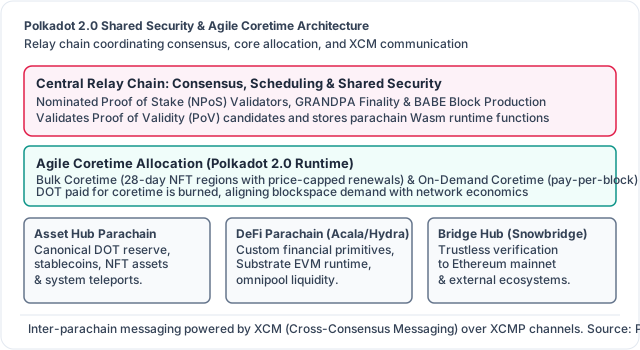
The challenge of cross-chain interoperability has historically represented one of the most severe security vulnerabilities in the blockchain ecosystem. Early attempts to connect heterogeneous state machines relied on third-party bridge contracts and off-chain multisig custodian committees. Over two billion dollars in user collateral was lost to bridge hacks, as documented by cybersecurity analysts at Trail of Bits and the FBI Internet Crime Complaint Center (IC3).
Designed by Ethereum co-founder Dr. Gavin Wood, Polkadot introduced a fundamentally different paradigm: heterogeneous multi-chain computing with pooled shared security. Rather than connecting sovereign chains through vulnerable external bridges, Polkadot operates as a Layer 0 metaprotocol that coordinates an entire federation of specialized Layer 1 blockchains known as parachains.
With the deployment of Polkadot 2.0, the network underwent a structural evolution, replacing rigid parachain slot auctions with Agile Coretime and introducing the Join-Accumulate Machine (JAM). This thesis provides a comprehensive technical exploration of Polkadot architecture, analyzing Relay Chain consensus, Substrate forkless WebAssembly runtimes, the Agile Coretime computational market, Cross-Consensus Messaging (XCM), and trustless external bridging.
In a multichain landscape composed of independent Layer 1 networks (such as Bitcoin, Ethereum, and early Cosmos app-chains), each network operates under its own isolated security umbrella:
When an application launches as an independent sovereign blockchain, it faces a cold-start security crisis: it must recruit validators, establish node infrastructure, and bootstrap hundreds of millions of dollars in staked capital to protect its ledger from 51% reorganization attacks. Furthermore, when assets cross between independent networks via lock-and-mint bridges, any compromise of the bridge validator committee results in catastrophic capital loss.
Polkadot resolves this structural weakness through pooled security: all connected parachains borrow the full economic weight of the Relay Chain validator set from the moment they produce their first block.
The central nervous system of Polkadot is the Relay Chain. Unlike general-purpose smart contract blockchains like Ethereum Foundation or Solana Foundation, the Relay Chain is deliberately minimal: it does not support smart contracts or user-facing decentralized applications.
The primary responsibilities of the Relay Chain are strictly delimited:
To achieve both rapid block production and provable deterministic finality, Polkadot decouples block production from block finalization using two distinct consensus engines:
BABE (Blind Assignment for Blockchain Extension): A slot-based algorithm that assigns block production slots to validators based on a Verifiable Random Function (VRF). Because the validator schedule is cryptographic and concealed until the slot begins, malicious actors cannot target upcoming block producers with denial-of-service attacks.
GRANDPA (GHOST-based Recursive Ancestor Deriving Prefix Agreement): An asynchronous Byzantine Fault Tolerant finality gadget. Unlike CometBFT which finalizes blocks individually, GRANDPA finalizes whole chains of blocks simultaneously. As soon as more than two-thirds of Relay Chain validators vote for a specific block header, that block and all of its ancestors are finalized deterministically.
This dual consensus enables Polkadot to maintain high availability even under adverse networking conditions without compromising deterministic finality.
A parachain is an independent, application-specific blockchain that connects directly to the Relay Chain. Parachains maintain their own state databases, token economics, fee schedules, and governance bodies.
Parachains are constructed using Substrate Documentation, a modular Rust framework engineered by Parity Technologies.
A defining technical innovation of Substrate is compiling the entire blockchain state transition function (the blockchain runtime) into a WebAssembly (Wasm) binary:
The interaction between parachains and Relay Chain validators follows a strict cryptographic verification lifecycle:
Because Relay Chain validators only need to execute the compact Proof of Validity rather than processing every historical transaction, Polkadot achieves horizontal scalability: dozens of independent parachains execute state transitions in parallel while maintaining a unified security guarantee.
In the initial implementation of Polkadot, parachains acquired blockspace through competitive parachain slot auctions. Projects were required to lock up hundreds of thousands of DOT in two-year leases via crowdloans. While this demonstrated long-term economic alignment, it imposed severe capital inefficiencies and prevented early-stage applications from accessing network security.
With the activation of Polkadot runtime v1.2.0, the network deprecated slot auctions entirely, transitioning to Agile Coretime.
Bulk Coretime provides predictable, continuous blockspace:
For applications that do not require continuous 6-second block production (such as enterprise supply chain tracking, periodic oracle settlements, or early-stage protocols), On-Demand Coretime allows developers to purchase block execution on a pay-as-you-go basis:
A critical economic innovation of Agile Coretime is that all DOT tokens paid for both Bulk and On-Demand Coretime are permanently burned by the protocol. This directly links network adoption and computational demand to the economic supply of the DOT token, establishing a sustainable value capture mechanism tracked on Token Terminal.
Cross-chain communication in Polkadot is governed by XCM (Cross-Consensus Message Format), specified by the Web3 Foundation.
XCM is not a transport protocol; it is a universal, consensus-agnostic messaging language. It defines a structured grammar for expressing computational intent between distinct state machines:
An XCM message consists of a sequential list of virtual machine instructions executed inside the XCVM (Cross-Consensus Virtual Machine).
For example, a reserve asset transfer from Asset Hub to a decentralized exchange parachain executes four fundamental instructions:
// Conceptual XCM Instruction Sequence
WithdrawAsset(assets: [DOT: 100])
InitiateReserveWithdraw(assets: [DOT: 100], reserve: AssetHub, call: [
    BuyExecution(fees: [DOT: 0.1], weight_limit: Unlimited),
    DepositAsset(assets: [DOT: 99.9], beneficiary: UserAccount)
])
WithdrawAsset: Debits the specified tokens from the sender account on the local chain.InitiateReserveWithdraw: Contacts the canonical reserve location (Asset Hub) to transfer value.BuyExecution: Pays the destination parachain in the transferred asset to purchase virtual machine execution weight.DepositAsset: Credits the net balance to the beneficiary account on the destination chain.While XCM defines the vocabulary, underlying transport channels deliver the bytes:
To optimize validator efficiency, Polkadot systematically migrated user-facing utilities off the Relay Chain into specialized System Parachains:
By moving balance transfers, staking registrations, and governance administration to system parachains, the Relay Chain remains lean and resilient, maximizing computational bandwidth for core scheduling and validity checking.
Connecting Polkadot to external Layer 1 blockchains that do not share its consensus (such as Ethereum) requires cryptographic bridge verification.
Rather than relying on third-party multisig operators, Polkadot engineered Snowbridge, an enshrined, trustless bridge connecting Polkadot Bridge Hub directly to Ethereum mainnet:
Because verification is executed strictly through on-chain cryptographic proofs, Snowbridge eliminates custodial intermediary risk, establishing a secure liquidity conduit between Ethereum DeFi and the Polkadot parachain ecosystem.
Polkadot hosts an array of specialized application networks:
To understand when Polkadot represents the optimal engineering choice, consider this comparative framework against Cosmos and Ethereum Layer 2 rollups:
Explore more guides and career playbooks