
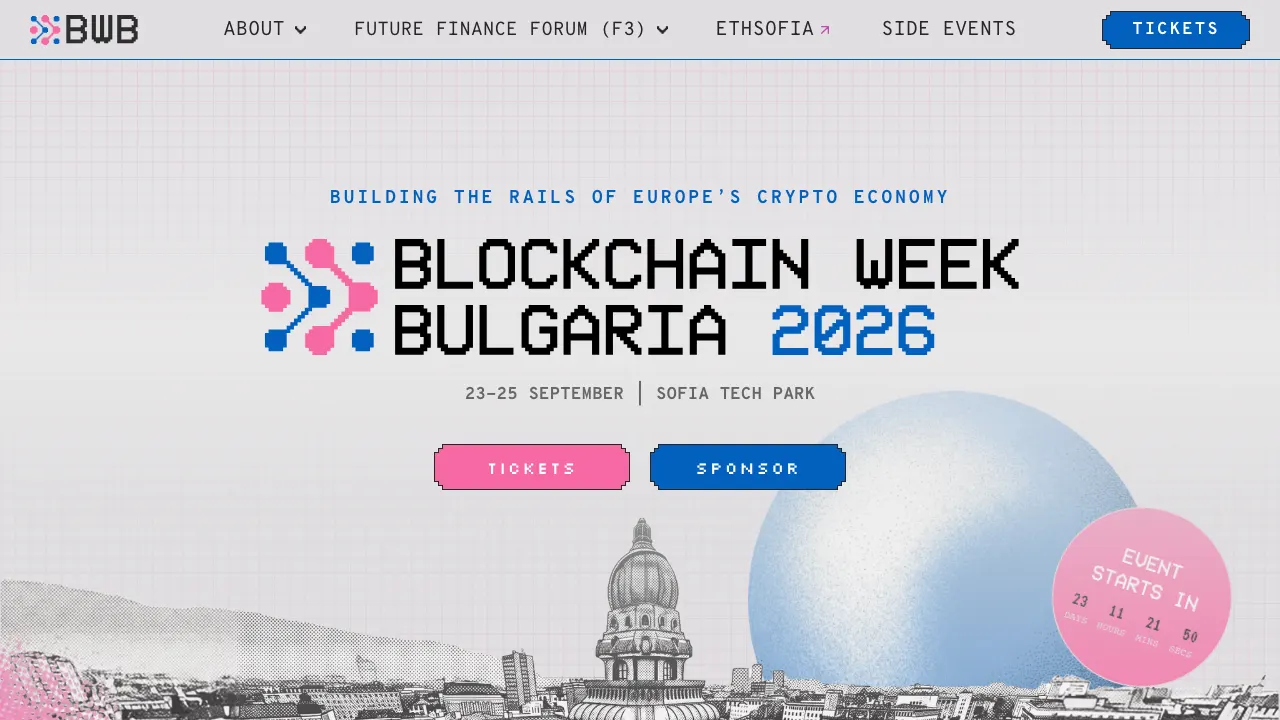
ETHSofia 2026 headlines Blockchain Week Bulgaria from September 23-25 at Sofia Tech Park, pairing the region's technical Ethereum conference with an institutional finance forum and a curated slate of side events.
One Week, One Campus
Blockchain Week Bulgaria runs September 23-25, 2026, at Sofia Tech Park, and ETHSofia anchors it as the flagship technical conference. The week is structured as a shared platform: builders, founders, financial institutions, policymakers, and infrastructure providers get one campus and one coordinated calendar instead of competing events scattered across the city.
The split is clean. September 24 belongs to ETHSofia itself, gathering engineers, founders, and protocol architects working on scalable, secure, production-ready systems. September 25 shifts registers entirely with F3, the Future Finance Forum, convening financial leaders, regulators, and enterprise innovators around tokenized assets, compliant digital finance, and AI-driven financial systems.
Around both headline days, independently organized side events plug into the official program after review by the team, which is how community workshops and individual team meetups earn a slot on the week's calendar.
Six Tracks From Protocol to Policy
Programming organizes into six themes spanning blockchain's practical footprint. Technical Innovation covers scalability, security, automation, and production-grade systems. Finance and Institutions spans tokenization, onchain automation, payments, custody, and enterprise adoption.
AI and Autonomous Finance addresses agentic AI, intelligent automation, risk systems, and AI-enhanced digital asset infrastructure. Consumer and Culture in Web3 covers real adoption, digital ownership, creator economies, and community-driven ecosystems.
Infrastructure in Production tracks the path from working prototype to deployed-at-scale, and Regulation and Policy rounds things out with compliance, legal frameworks, and the road to institutional adoption. The spread means a compliance officer and a smart-contract engineer both have concrete reasons to attend, occasionally landing in the same session, which is rarer than it should be.
Built for Two Audiences at Once
Most technical conferences struggle to hold institutional attention, and most finance forums bore engineers into the hallway. Blockchain Week Bulgaria sequences both deliberately: hard technical content on day one, institutional and regulatory content on day two, with the shared campus doing the matchmaking in between.
For Balkan-region builders especially, the week concentrates relationships that usually require separate trips to Berlin, London, or Zug. The organizing team runs visible curation across partnerships and speaker selection, signaling a reviewed program rather than pay-to-play staging.
Recap videos from the 2024 and 2025 editions are linked from the site, useful if you want a visual sense of scale and crowd composition before committing travel budget.
The week's positioning as a shared platform also cuts both ways in a good way: companies and teams that want to host their own session submit through the site for review rather than negotiating separately, which keeps the calendar coherent even while it grows.
That review step matters for attendees too. A curated side-event list is the difference between a week with a real agenda and a week of guessing which rooftop party has the people you came to meet.
Getting In and Getting Around
Tickets flow through the Blockchain Week Bulgaria site, where a countdown clock was running at publication. Sofia remains one of Europe's more affordable capitals for flights and lodging, and late September sits comfortably in shoulder season.
Sofia Tech Park occupies the innovation-district end of the Bulgarian capital, with the city center a short ride away, so pairing conference days with evening side events across town stays realistic rather than aspirational.
Choosing between headline days: pick ETHSofia for engineering depth, F3 for tokenization and regulatory direction, or the full week if your role straddles both worlds, as most product and founder roles now do whether job descriptions admit it or not.