Loading article...

An architectural guide to blockchain oracle integration, examining push vs pull data models, flash loan attack mitigation, Uniswap TWAP mechanics, and defensive Solidity implementations.
Smart contracts deployed across decentralized financial ecosystems govern tens of billions of dollars in collateralized loans, synthetic assets, perpetual futures, and algorithmic automated market makers. Because public state machines such as the Ethereum Foundation execution layer, Solana Protocol, and the Arbitrum Layer 2 are deterministic environments that cannot make external HTTP calls, protocols rely on decentralized oracle networks to inject off-chain market truth into on-chain storage.
However, integrating external data feeds into smart contracts is fraught with severe systemic risks. An oracle is not merely an informational utility; it represents the ultimate authority that determines whether collateral is sufficient, whether loans must be liquidated, and whether perpetual positions are solvent. Historical exploits across decentralized finance demonstrate that flaws in oracle integration, specifically reading unmanipulated spot prices, ignoring feed staleness, or mishandling round completion, represent one of the primary attack vectors for multi-million-dollar protocol drains.
Building resilient decentralized applications requires software engineers to understand the mechanics of decentralized data pipelines. This guide provides a comprehensive technical exploration of modern oracle architectures, contrasting push and pull delivery models, analyzing mathematical defenses against flash-loan price manipulation, and presenting hardened Solidity design patterns for production-grade protocol deployment.
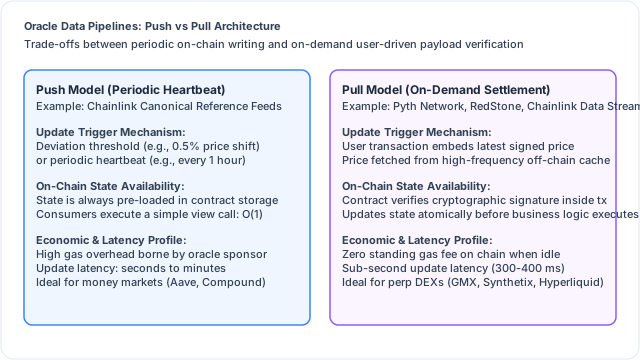
The Web3 industry has bifurcated into two primary architectural patterns for delivering off-chain data to on-chain state: the Push Model and the Pull Model. Understanding their trade-offs is essential when designing decentralized architectures.
Pioneered by Chainlink Data Feeds, the push model writes data directly into on-chain smart contract storage at regular intervals.
The oracle network constantly monitors external asset prices across venues like Binance, Coinbase, and Kraken. The network triggers an on-chain transaction under two specific conditions:
view function call (O(1) gas complexity). Protocols like Aave Protocol and Compound Finance can inspect collateral valuations at any point during liquidations without requiring users to assemble cryptographic verification proofs.To service high-frequency trading platforms such as dYdX Exchange, GMX Decentralized Exchange, Synthetix Protocol, and Hyperliquid, protocol architects designed the pull model, popularized by Pyth Network and RedStone Finance.
Under the pull architecture:
The single most catastrophic architectural error in smart contract design is relying on instantaneous spot prices fetched from automated market maker (AMM) liquidity pools, such as Uniswap v2 Reserves, SushiSwap Pools, Curve Finance Pools, or Balancer Vaults.
A flash loan, pioneered by Marble Protocol and standardized by Aave and Euler Finance, permits any user to borrow hundreds of millions of dollars in uncollateralized capital within a single transaction, provided the full amount plus a tiny fee is repaid before the transaction terminates.
If a lending protocol relies on instantaneous AMM reserve balances to value collateral:
// FATALLY VULNERABLE SPOT PRICE CALCULATION
function getAssetPrice(address tokenIn, address tokenOut) public view returns (uint256) {
    (uint112 reserve0, uint112 reserve1, ) = IUniswapV2Pair(pair).getReserves();
/ Vulnerable: reserves can be warped drastically inside a single transaction!
    return (uint256(reserve1) * 1e18) / uint256(reserve0);
}
An attacker can execute the following exploit within a single atomic block:
Because all state changes occur within a single block execution, traditional block confirmations offer zero defense against flash-loan attacks.
To eliminate instantaneous spot manipulation, Uniswap v3, based on earlier work in Uniswap v2 by Hayden Adams, Noah Zinsmeister, and Dan Robinson, introduced on-chain Time-Weighted Average Price (TWAP) oracles.
A TWAP calculates the average price of an asset over a configurable historical window (such as 30 minutes, or 1,800 seconds). In Uniswap v3, prices are tracked as log-scale price ticks, enabling geometric mean calculations that avoid arithmetic distortion.
The cumulative tick accumulator is tracked continuously in contract storage:
$$a(t) = \sum_{i=1}^t \log_{1.0001}(P_i) \cdot \Delta t_i$$
To calculate the time-weighted geometric average price between time $t_1$ and $t_2$, a smart contract reads the accumulator values at both points:
$$\log_{1.0001}(P_{t_1, t_2}) = rac{a(t_2) - a(t_1)}{t_2 - t_1}$$
$$P_{t_1, t_2} = 1.0001^{ rac{a(t_2) - a(t_1)}{t_2 - t_1}}$$
While TWAP oracles effectively mitigate flash loans, they introduce lag during genuine market crashes. If Ethereum plunges by 20% in five minutes, a 30-minute TWAP will report a significantly inflated valuation, delaying necessary liquidations and risking protocol bad debt. Consequently, modern protocols combine TWAPs with decentralized oracle feeds in hybrid architectures.
Deploying a production oracle integration requires defensive validation at every layer. Below are battle-tested integration patterns for both Chainlink and Pyth Network.
A secure Chainlink consumer contract must enforce bounds checking, staleness thresholds, round completeness, and Layer 2 sequencer availability.
// SPDX-License-Identifier: MIT
pragma solidity ^0.8.24;

interface AggregatorV3Interface {
    function decimals() external view returns (uint8);
    function latestRoundData() external view returns (
        uint80 roundId,
        int256 answer,
        uint256 startedAt,
        uint256 updatedAt,
        uint80 answeredInRound
    );
}

interface ISequencerUptimeFeed {
    function latestRoundData() external view returns (
        uint80 roundId,
        int256 answer,
        uint256 startedAt,
        uint256 updatedAt,
        uint80 answeredInRound
    );
}

/// @notice Hardened Chainlink consumer with L2 sequencer checks and staleness guards
contract HardenedChainlinkConsumer {
    AggregatorV3Interface public immutable priceFeed;
    ISequencerUptimeFeed public immutable sequencerFeed;

    uint256 public constant HEARTBEAT_LIMIT = 3600; // 1 hour staleness threshold
    uint256 public constant GRACE_PERIOD = 3600;   // 1 hour after sequencer restart

    error PriceFeedStale();
    error NonPositivePrice();
    error IncompleteRound();
    error SequencerDown();
    error SequencerGracePeriodNotOver();

    constructor(address _priceFeed, address _sequencerFeed) {
        priceFeed = AggregatorV3Interface(_priceFeed);
        sequencerFeed = ISequencerUptimeFeed(_sequencerFeed);
    }

// @notice Validates L2 sequencer status on Arbitrum, Optimism, or Base
    function checkSequencer() internal view {
        if (address(sequencerFeed) == address(0)) return; // Skip if on L1 Ethereum

        (, int256 status, , uint256 startedAt, ) = sequencerFeed.latestRoundData();

/ Status: 0 = Up, 1 = Down
        if (status == 1) revert SequencerDown();

/ Ensure grace period has elapsed since sequencer restarted
        if (block.timestamp - startedAt < GRACE_PERIOD) {
            revert SequencerGracePeriodNotOver();
        }
    }

// @notice Returns scaled 18-decimal price with comprehensive safety assertions
    function getNormalizedPrice() external view returns (uint256) {
        checkSequencer();

        (
            uint80 roundId,
            int256 rawPrice,
            ,
            uint256 updatedAt,
            uint80 answeredInRound
        ) = priceFeed.latestRoundData();

        if (rawPrice <= 0) revert NonPositivePrice();
        if (block.timestamp - updatedAt > HEARTBEAT_LIMIT) revert PriceFeedStale();
        if (answeredInRound < roundId) revert IncompleteRound();

        uint8 feedDecimals = priceFeed.decimals();
        uint256 price = uint256(rawPrice);

/ Normalize to standard 18 decimals
        if (feedDecimals < 18) {
            price = price * (10 ** (18 - feedDecimals));
        } else if (feedDecimals > 18) {
            price = price / (10 ** (feedDecimals - 18));
        }

        return price;
    }
}
Consuming Pyth Network requires submitting a fee payment along with the cryptographic update payload, verifying the Wormhole VAA on-chain before reading values.
// SPDX-License-Identifier: MIT
pragma solidity ^0.8.24;

interface IPyth {
    struct PythStructsPrice {
        int64 price;
        uint64 conf;
        int32 expo;
        uint256 publishTime;
    }

    function getUpdateFee(bytes[] calldata updateData) external view returns (uint256 feeAmount);
    function updatePriceFeeds(bytes[] calldata updateData) external payable;
    function getPriceNoOlderThan(bytes32 id, uint256 age) external view returns (PythStructsPrice memory price);
}

/// @notice Production-grade Pyth pull consumer executing atomic on-demand verification
contract PythPriceConsumer {
    IPyth public immutable pyth;
    bytes32 public immutable priceId;
    uint256 public constant MAX_PRICE_AGE = 60; // 60 seconds maximum staleness

    error InsufficientFeeSent();
    error InvalidPriceExponent();

    constructor(address _pythContract, bytes32 _priceId) {
        pyth = IPyth(_pythContract);
        priceId = _priceId;
    }

// @notice Unpacks and verifies price payload within the same atomic user transaction
    function executeOrderWithPrice(bytes[] calldata priceUpdateData) external payable {
/ Calculate fee required by Pyth contract to verify proof
        uint256 fee = pyth.getUpdateFee(priceUpdateData);
        if (msg.value < fee) revert InsufficientFeeSent();

/ Atomically update the on-chain Pyth cache
        pyth.updatePriceFeeds{value: fee}(priceUpdateData);

/ Fetch verified price guarantee
        IPyth.PythStructsPrice memory currentPrice = pyth.getPriceNoOlderThan(
            priceId,
            MAX_PRICE_AGE
        );

/ Process trade logic with currentPrice.price and currentPrice.conf
/ (Refund excess ETH to user omitted for brevity)
    }
}
Even the most robust decentralized oracle network can experience edge-case anomalies, exchange API failures, or network congestion. Consequently, high-security protocols deploy Dual-Oracle Architectures.
Protocols such as Liquity Protocol popularized dual-oracle architectures in their decentralized borrowing protocol. Liquity utilizes Chainlink as its primary feed and Tellor Oracle as an automated secondary fallback.
If the primary oracle halts updates, reports a value outside historical volatility bands, or diverges from the secondary oracle by more than a predefined threshold, the smart contract automatically engages circuit-breaker protections. Liquidations and debt issuance are paused until price feeds reconverge, protecting borrowers from predatory liquidation cascades.
The critical importance of oracle defensive engineering is underscored by notable historical exploits across decentralized finance:
In October 2022, Mango Markets on Solana was exploited for $$114 ext{ million}$. The attacker utilized two accounts funded with USDC to take opposing massive positions in the illiquid MNGO perpetual market. By aggressively dumping millions of USDC into the underlying spot market on the Serum DEX, the attacker spiked the spot price of MNGO from $$0.038$ to $$0.91$ in minutes.
Because the Mango risk engine calculated account equity based directly on this warped spot oracle, the attacker account showed unrealized collateral value exceeding $$400 ext{ million}$. The attacker borrowed genuine assets (SOL, BTC, USDT) against this paper collateral, draining the protocol reserves before the price crashed back to equilibrium.
Modern protocols mitigate this vulnerability by implementing economic risk modeling frameworks from Gauntlet Network and Chaos Labs, capping maximum borrowable capacity relative to underlying spot market depth.
During the May 2022 collapse of Terra LUNA, Chainlink Data Feeds on BNB Chain hit an internal circuit breaker floor. The feed implementation contained a legacy hardcoded minimum price threshold (minAnswer = $0.10). When LUNA plummeted to fractions of a cent, the oracle feed continued reporting $$0.10$.
Arbitrageurs noticed the discrepancy, bought millions of LUNA on external venues for pennies, deposited them into Venus Protocol at the artificially high $$0.10$ oracle valuation, and borrowed out millions in authentic stablecoins, resulting in protocol insolvency.
This exploit illustrates why smart contracts must verify that oracle answers do not equal minAnswer or maxAnswer bounds set by aggregator contracts.
Securing oracle consumption requires integrating automated testing into the continuous deployment pipeline:
Before launching an oracle integration to production, engineering teams and security auditors from firms like OpenZeppelin, Trail of Bits, Consensys Diligence, and CertiK evaluate protocols against this verification matrix:
By adopting multi-layered data verification, deploying pull and push mechanisms appropriately, enforcing strict staleness assertions, and guarding against AMM spot manipulation, smart contract engineers build decentralized financial protocols capable of withstanding hostile adversarial market conditions.
Explore more guides and career playbooks